


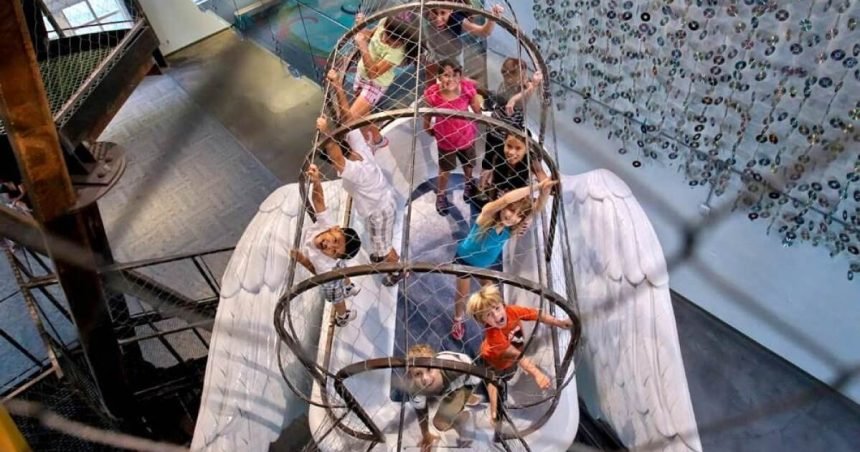
MARK BRODIE: A new preschool will be opening in downtown Phoenix next fall, and it’ll be located in a place that may be familiar to a lot of kids and their grownups.
The Children’s Museum of Phoenix — which itself is located in an old school building — is undergoing a more than 35,000-square-foot expansion and renovation that includes about 10,000 square feet for a new preschool. There will also be a new early literacy learning center as well.
Kate Wells is the president and CEO of the Children’s Museum of Phoenix. She joins me, and Kate, why have a children’s museum start a preschool?
KATE WELLS: First of all, Arizona is an absolute childcare desert. We don’t have enough quality preschools at all, and they are concentrated in different parts of the community. Downtown Phoenix in particular is really a childcare desert.
While we as a museum meet the needs of all of the young children in our community, we also feel a special kinship with our local neighbors and the families that live close by us, and also the families that come downtown for work. We recognize this as a really big need in our downtown community, and it’s a way for us to create a super high-quality preschool and act as a learning lab for other preschools around the state.
And also, we have this really phenomenal partnership with the YMCA, and they’re actually the largest childcare provider in our state. We’ve worked together on many projects, and we’re really excited about taking preschool in Arizona to the next level. Having it here at the museum will allow us to do that.
MARK BRODIE: How big of a dent in the need do you think you can provide?
KATE WELLS: Our school will have between 70 and 80 children in it. We will go all the way down to infant, because we feel like it’s really important, especially for infant caregivers, to see great examples of high quality of classrooms.
While the impact is not huge at our particular school, because the YMCA is the largest childcare provider in the state, the things that we do at our school here as a learning lab preschool will infiltrate throughout the entire YMCA program.
MARK BRODIE: I assume that I don’t have to tell you some of the challenges of starting and operating a preschool. It can be very expensive. Finding the teachers, the caregivers can be a real challenge. How do you go about trying to do that?
KATE WELLS: During COVID, actually, we received a grant from LISC (Local Initiatives Support Corporation) and the federal government. We actually did a study about what childcare could look like at the museum with our business hats on.
We evaluated four different models, including running it ourselves, having a for-profit partner come in, partnering with our local school district and then also partnering with a nonprofit who is already working in the space.
Our business modeling showed that working with a nonprofit partner that was already doing the good work, that was the best way for us to frame this as a business model. The hard parts — like the trainings and all of the software that you need to buy and the licensing — that can all be done by someone who’s great at doing it already.
The Children’s Museum, we don’t need to reinvent the wheel. We are going to stay in our wheelhouse, be really good at what we’re good at, and let our partner the YMCA be really good at what they’re great at.
MARK BRODIE: Are there other kids’ museums around the country that are doing this? It just seems like kind of — I don’t want to say outside of your lane, because that has a negative connotation to it, but it just seems like kind of an unusual thing that a children’s museum would also be an educational institution in this particular way.
KATE WELLS: Sure. … There are actually about a dozen different examples of children’s museums who do have preschools or even full schools at their facility. It really kind of does make sense if you think about it, because especially in their early years, what we adhere to is that the most important learning for young children happens when they have hands-on opportunities, things are very experiential, they like to learn through play.
That’s what we do here every day at the Children’s Museum. Creating preschools, especially that are focused on learning through play and really hands-on learning, really just complements each other perfectly.
MARK BRODIE: And you’re also going to be opening, am I right, an early literacy learning center? What does that entail?
KATE WELLS: We are. We’re so excited about the literacy center. One of the biggest challenges in our state — and it doesn’t matter whether you talk to teachers in the classroom, parents, or business leaders — our literacy rates in Arizona are, frankly, embarrassing.
The children’s museum, as a partner in this, needs to and wants to, I should say, step up and make literacy more of a focus than we already do. So we’re dedicating almost 3,000 square feet to this early literacy center, which, if you can imagine, like the most amazing children’s library, but kind of on steroids.
Our secret sauce is that, like the preschool, we’re going to bring in industry experts that are already doing great work in the space. Our plan is to partner with a handful or more literacy organizations that are already working in the field that all have very evidence-based and outcomes-based programs, and they’ll partner with us on our literacy space.
During the day when the Children’s Museum is open, we’ll have programs all day long, some of them brought to our visitors through our partnerships. But then also in the after-hours, our literacy partners will be able to use the museum’s literacy center to do programming for their clients, to bring in families and to extend the learning and the literacy focus past the museum hours into evenings and weekends when families are available for these kinds of extra help in the literacy space.
MARK BRODIE: What do you think all of this says about the state of education in Arizona, that the Children’s Museum of Phoenix is stepping into this role that traditionally has been not played necessarily by an institution like yours?
KATE WELLS: Well, I think that this is a necessity because Arizona continues to underfund education and make choices about how we support classroom learning that don’t necessarily support the way children learn.
We feel like it’s part of our role in the community. Our mission is to engage the minds, muscles and imaginations of children and the grownups who care about them. It feels like a natural extension of what we’re doing.
But we, our board of directors, who are all volunteers, and our staff and all of our partner organizations feel like it’s time that many of us step up and do more to help move the needle, especially in early childhood education.
MARK BRODIE: It sounds like at least some part of the student population at the preschool will be people who live near the museum, or, as you referenced, come down and work downtown. Is that who you’re targeting? And if so, I wonder how you try to make sure that folks can afford it, because, as you know, childcare and preschool can be very expensive.
KATE WELLS: It’s very expensive, and that’s one of the other reasons we’re so excited to partner with the YMCA, is because they’ve really worked out this tiered-tuition system, and they’re really good at it. We really intend to focus on low- and moderate-income families at our preschool to really help those families engage at a higher level in their children’s early education.
While it won’t be exclusively low- and moderate-income — and there’s certainly room for all of the tiers — we understand that being in downtown especially, that there’s a really big need and we want to make sure that everyone has access.
MARK BRODIE: That is Kate Wells, president and CEO of the Children’s Museum of Phoenix. Kate, thank you so much.
KATE WELLS: Thank you, Mark.
KJZZ’s The Show transcripts are created for audience accessibility. Transcripts are created on deadline with the assistance of AI tools and then edited, and may not be in their final form. The authoritative record of KJZZ’s programming is the audio segment.