



Micron stock has plummeted by 40% as cracks start to appear in the artificial intelligence boom.
By Anthony Di Pizio –
Key Points
-
Artificial intelligence (AI) workloads across data centers, smartphones, computers, and even cars require increasing amounts of memory capacity.
-
Micron Technology is one of the world’s top memory suppliers, and it’s experiencing more demand than it can supply.
-
Micron stock looks dirt cheap following its 40% crash, but its valuation alone isn’t the whole story.
Micron Technology (MU -1.00%) is one of the world’s top suppliers of high bandwidth memory (HBM) for data centers, which is a critical part of the artificial intelligence (AI) hardware stack. The company has experienced more demand than it can possibly supply over the last few years, but investors are increasingly worried about a slowdown in the AI boom.
AI labs like OpenAI and Anthropic continue to raise prices for the use of their models to offset soaring infrastructure costs, forcing many end users to cap their usage. Moreover, Jensen Huang resigned from his role as chief executive officer of Nvidia last week after a series of extramarital affairs came to light, one of which was with an alleged Chinese spy, casting a cloud of uncertainty over the entire AI industry.
Micron stock is down by 40% from its June peak, and closed at $719.02 on Nov. 16. Is this a golden opportunity for investors to buy it under $1,000, or is there more downside ahead? Read on for the surprising answer.
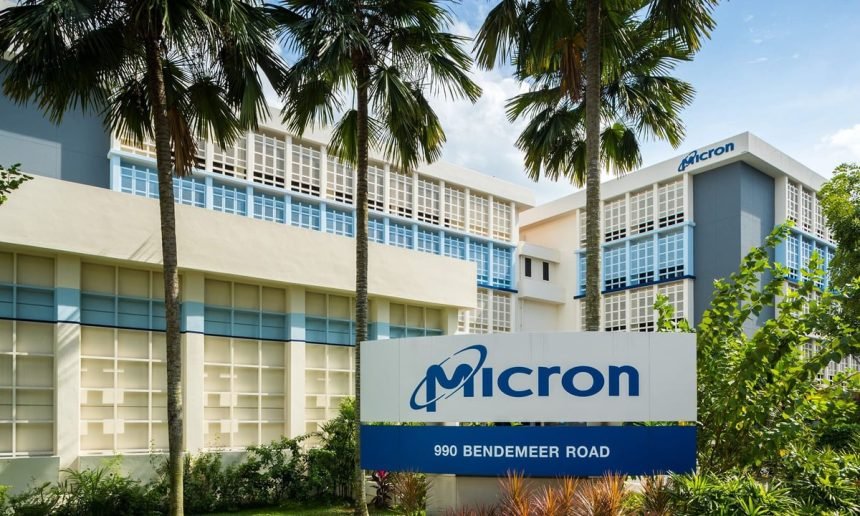
Image source: Micron.
Exceptional operating results, but risks are mounting
HBM keeps data flowing seamlessly to graphics processing units (GPUs), which are the main chips used in AI workloads. Bottlenecks would ensue without sufficient memory, because GPUs would be forced to pause their workloads while they wait to receive more data. This would create a sluggish experience for users of AI chatbots, agents, and other applications.
Personal computers, smartphones, and even cars also require an increasing amount of memory capacity to run certain AI workloads locally on-device, and Micron is also one of the top suppliers in each of those categories.
Micron generated $133.2 billion in total revenue during its 2026 fiscal year (ended Sept. 3), an eye-popping 256% increase from the previous year. AI-related memory demand was responsible for the strong result, positively impacting all four of the company’s business segments.
| Segment | Fiscal 2026 Revenue | Growth (Year Over Year) |
|---|---|---|
| Cloud memory | $43.1 billion | 219% |
| Core data center | $37.6 billion | 420% |
| Mobile and client | $36.6 billion | 209% |
| Automotive and embedded | $15.9 billion | 234% |
Data source: Micron Technology.
The cloud memory segment is where Micron accounts for memory sales to hyperscale customers (like Amazon and Microsoft), as well as HBM sales for all data center customers. The core data center segment, on the other hand, includes sales of storage and non-HBM memory solutions to data center customers.
The cloud memory business is most at risk if there is a slowdown in AI infrastructure spending. None of the hyperscalers have revealed plans to reduce their investments in data centers yet, which is a positive sign. But price hikes from AI labs like OpenAI and Anthropic could start feeding through to demand.
Over the last few months, Walmart, Amazon, and Uber Technologies are just some of the companies that have placed restrictions on internal AI usage to prevent budget blowouts, amid rising costs. Questions are also mounting about AI adoption among consumers, with Uber recently saying almost nobody is using agents on its platform.
The recent midterm elections might also be a headwind for AI infrastructure spending. The new Democratic Gov.-elect Gina Hinojosa of Texas plans to pause future data center approvals until new legislation is in place to protect local communities from issues like rising electricity costs and water scarcity. Texas is one of America’s top destinations for data center construction, so this could be problematic for semiconductor companies like Micron.
Micron stock looks dirt cheap, but there’s a catch
There is currently more demand for HBM than Micron and its peers can supply, which is giving them the ability to dictate prices. As a result, Micron’s earnings rocketed higher by 879% year over year to $74.33 during fiscal 2026, placing its stock at a price-to-earnings (P/E) ratio of just 9.7. That is one-third of the P/E of the Nasdaq-100 index, which is 29.5, so the stock appears incredibly undervalued.
MU Micron Technology
$705.27-$7.15 (-1.00%)
NASDAQ · As of 4:00 PM ET 11/18/26
Moreover, Wall Street thinks Micron could grow its earnings to $176.50 per share in fiscal 2027, placing its stock at a forward P/E ratio of just 4.1. It seems almost ludicrous that a company growing as fast as Micron would be trading at such a steep discount to the broader market. However, the semiconductor industry has always been highly cyclical, so investors know AI-related demand won’t continue at this pace forever.
Micron and its peers are racing to build more manufacturing capacity, which will ease supply constraints and put downward pressure on memory prices. Combine that with the potential demand headwinds I highlighted earlier, and it becomes clear that Micron probably won’t be able to sustain its current level of earnings for the long term. That means its stock might be more expensive than it currently appears at face value.
As a result, I personally don’t plan to buy Micron stock at the current price. The level of uncertainty is simply too high for my liking.
Where to invest $1,000 right now
When our analyst team has a stock tip, it can pay to listen. After all, Stock Advisor’s total average return is 794%* — a market-crushing outperformance compared to 203% for the S&P 500.
They just revealed what they believe are the 10 best stocks for investors to buy right now, available when you join Stock Advisor.
*Stock Advisor returns as of November 19, 2026.