



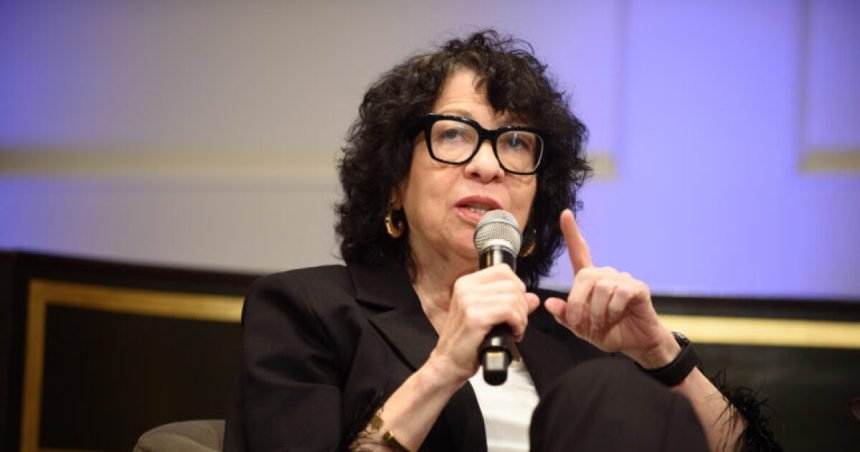
The American Philosophical Society awarded Supreme Court Justice Sonia Sotomayor the Benjamin Franklin Medal on Friday in Philadelphia, after which she spoke to members about her legal views on the court’s recent terms.
Sotomayor, who previously served as a prosecutor and district court judge, lamented that appellate decisions are too focused on “academic discussions about legal beliefs” rather than trying to improve society.
“They are law review articles,” she said. “Very few of them are talking about what’s at the center of every case, which is the people involved.”
Sotomayor has found herself at odds with the court’s 6-3 conservative majority as it has overturned long-standing precedents and challenged established legal norms she considers essential for a functioning democracy. The court overturned Roe v. Wade, which guaranteed a woman’s access to abortion, weakened the Voting Rights Act and expanded the president’s overall power.
The court ruled in 2024 that former presidents have absolute immunity from criminal prosecution for actions within their exclusive constitutional authority and at least presumptive immunity for other official acts. The case stemmed from indictments related to the Jan. 6, 2021, mob attacks on the U.S. Capitol.
Sotomayor dissented, along with Justices Elena Kagan and Ketanji Brown Jackson, and argued the majority ruling reshapes the presidency and undermines the constitutional principle that no person is above the law.
“What we’ve had is a series of norms being disrupted,” she said of that and other cases. “And without those norms, we’re removing protections that I think are critical to how we have functioned so successfully for 250 years.”
Sotomayor pointed to Trump v. Slaughter as another example of the court undermining such norms. The decision overturned a 1935 precedent that limited the president’s authority to remove members of the Federal Trade Commission.
The ruling was based on the unitary executive theory, which posits that the president has sole and absolute power over the executive branch of government. Sotomayor called it a “legal theory on steroids that has just gone off the rails.”
The justice added that there were a number of cases she thought were decided properly, such as the court’s ruling that pushed back on the president’s tariffs and efforts to end birthright citizenship.
“There are things to be celebrated, and there’s no question that some rulings were the right rulings,” she said. “Were they all for the right reasons? I don’t know.”
Photo courtesy of American Philosophical Society
However, she also criticized the recent trend of emergency dockets in which the Supreme Court makes decisions in cases that have not been heard by lower courts.
“That is bad for us as a court, because we are making decisions without being assured that all of the relevant legal questions have been actually fully explored,” she said. “It is important before the court is making a final decision that we are fully informed, and we’re not being fully informed and we’re making rushed judgments.”
The American Philosophical Society, which Franklin founded in 1743, promotes knowledge in the humanities and natural sciences. The session with Sotomayor was part of the organization’s three-day autumn general meeting, during which leading researchers presented findings on history, economics and neuroscience.
The Benjamin Franklin Medal was established in 1906 and has been awarded to prominent leaders in their fields, such as physicist Marie Curie, geneticist Barbara McClintock, and scientists Francis Crick and James Watson. Sotomayor received the medal recognizing distinguished public service, which has been previously awarded to Nelson Mandela, the South African Black activist who spent 27 years in prison for opposing the region’s apartheid system of racial segregation, former U.K. Prime Minister Margaret Thatcher and Bryan Stevenson, the founder and executive director of the Equal Justice Initiative.
Sotomayor spoke in conversation with David S. Tatel, a retired civil rights lawyer and appellate judge.