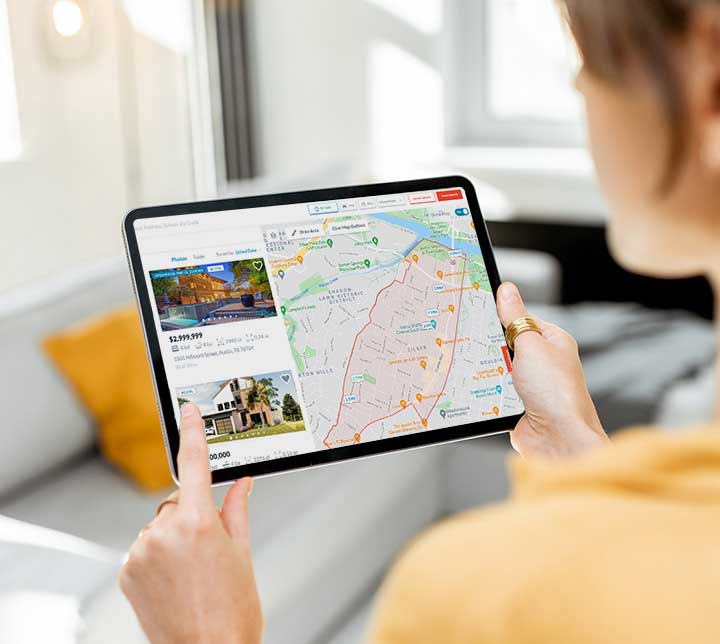
The real estate business has always been about location, but advanced digital technology has taken the location factor to a new level—multiple levels, to be exact. Take GIS spatial data products as an example. GIS stands for geographic information system, but in its simplest form, GIS is a mapping tool.
GIS connects data to a map, layering on location data, such as demographics, property values, schools and hospitals, topography, shopping districts, restaurants, weather, hazards, and more. These maps serve a broad spectrum of industries, and ATTOM data is at the forefront of parsing GIS spatial data for real estate and its related sectors.
Here’s an overview of ATTOM’s geospatial boundary data products, how they are created, and how they serve real estate agents, lenders, insurers, governments, and research institutions.
What Is GIS Technology?
Organizations in virtually every sector and industry are using GIS technology to create maps and display data to make decisions and solve complex problems. GIS uses and displays locational data at various levels from a street address or zip code to points of latitude or longitude.
The data expressed ranges from people-based information, such as population, income levels, and education levels, to an area’s physical features, such as the landscape, land use, commercial districts, housing neighborhoods, school zones, transportation, and power lines. GIS even reports on environmental hazards, flood risk zones, and weather.
GIS technology is often used to link data in an area and analyze whether different locational factors are related, such as whether factories are polluting surrounding wetlands and if water supplies could be affected.
The data and information are gathered from many sources, such as aerial photos, digital data from satellites, and existing data from government and other sources. The data is then overlaid onto a map creating a visual narrative.
GIS Technology and Real Estate
The ability to overlay data onto a map is tailor-made for the real estate sector. The maps clearly show details, such as land use, neighborhoods, schools, and economic data all in one place, and the data are presented as boundaries.
Easy-to-access boundary data, such as school districts, public parks, roads, and transportation, are invaluable to real estate brokers, investors, and urban planners, among other commercial and educational groups. Knowing where flood zones and other environmental hazards are located is critical information for the insurance sector, and population and all types of data are sought by researchers and local governments.
Recognizing the breadth of uses for GIS products, ATTOM has focused on producing an extensive range of geospatial boundary products, from school district boundaries to flood zones, for any user seeking property and environmental data.
ATTOM’s GeoSpatial Boundary Product Range
ATTOM offers geospatial data sets for property, neighborhood, and school boundaries and a complete list of census boundary layers for the entire United States.
Users can search based on counties, cities, and townships. The boundaries and associated data are regularly collected from the Census Bureau to ensure that these products are up-to-date with name or geographic changes.
ATTOM also offers postal boundaries, which are zip codes and postal cities. Users sometimes prefer this layer of city-like data to the census data because it makes more sense to property professionals.
The data includes sales trends and demographic information for the boundary layers, including hundreds of socio-economic variables, such as cost of living information, crime levels, natural disaster and flood risk zones, and more.
Three of ATTOM’s most popular boundary products are parcel boundaries, neighborhood boundaries, and school boundaries.
Parcel Boundaries
A “parcel” defines the boundary of an individual property and the extent of land ownership for that property. Each county typically has a (GIS) department that maps parcel boundaries and compiles each one into a larger map of all the properties in the county. As properties are split, combined, or modified, the GIS department updates the data at least once a year.
ATTOM’s coverage extends to over 155 million parcel boundaries, covering over 99 percent of the United States population, including the territories.
Additionally, a unique ID links the parcel boundary data to other ATTOM products. That means that users can link the parcel layer to other property data such as assessor, recorder, foreclosure, automated valuation models (AVMs), building permits, and other property products to give a complete picture of a property’s characteristics and location.
Neighborhood Boundaries
ATTOM’s neighborhood boundary product includes around 750,000 boundaries in over 600 metro areas and 10,000 cities and towns across the United States and Canada.
Neighborhood boundaries are popular and more accessible to some users. For real estate brokers, clients appreciate neighborhood boundary data because they are familiar with the names of the neighborhoods, which are more recognizable than zip codes.
Many neighborhoods fall within a specific zip code, but the neighborhood data can show the average home values, demographics, and lifestyle information at the neighborhood boundary or neighborhood community level.
ATTOM’s neighborhood boundary data are organized in a four-level hierarchy based on the size and makeup of the neighborhood:
- Level 1 (Macro Neighborhood): Macro-neighborhoods are the largest neighborhood type and typically cover a large portion of a city. For example, Lower Manhattan or Midtown Manhattan in New York City.
- Level 2 (Neighborhood): Smaller than macro neighborhoods, this level covers the type of polygons that we normally associate with core city-level neighborhoods. These boundaries are typically used by customers for associating properties to a specific neighborhood.
- Level 3 (Sub-Neighborhood): Sub-neighborhoods represent smaller, locally known areas within an existing neighborhood, primarily in an urban setting.
- Level 4 (Residential Subdivision): Residential subdivisions are found in urban and suburban areas. They are individual subdivisions within larger communities, but ATTOM’s product also includes (particularly in urban areas) housing structures such as condominiums and apartment complexes that are recognized by local citizens as where they live.
Because each record includes a unique neighborhood ID. That ID can be used to match a neighborhood to other data products to pull contextual information (community demographic or home sales trend data, for instance). ATTOM also provides the metro, county, and city in which the neighborhood is located, the boundary centroid geocodes, and other identifying and classifying information.
For these reasons, neighborhoods and subdivisions are an excellent option for real estate and other local search applications.
School Boundaries (Districts and Attendance Areas)
School District Boundaries define the school district or school catchment areas for elementary, middle, and high schools. These zones are defined by the local school board and school district administrators based on factors including school capacity, transportation considerations, and socio-economic diversity.
District boundary data includes all the schools, while school attendance area boundaries define the areas within which students are assigned to regular neighborhood schools based on where they live.
School ratings, programs, and athletic and extracurricular activities for schools are key factors affecting homeowner’s buying decisions. Investors can use hyperlocal school data to assess potential property values.
The school boundary data are published at the granular individual grade level – there is a different boundary layer of data for pre-K through 12th grade – but the data can also be summarized for elementary, middle, and high school levels. For schools near the US/Mexico border, different layers of data are offered for the different attendance areas for bilingual vs. monolingual students.
Who Needs Boundary Data?
Perhaps the question should be, who doesn’t need boundary data? We’ve already discussed how boundary data can benefit home buyers, real estate agents, and property investors, but its applications extend to a much larger audience.
Home service companies can gather information on neighborhoods and decide whether to market their services in an area based on demographics or economic data. For example, is there a large population of high earners with new homes locally who might be interested in smart home products? Insurance companies can determine if a neighborhood is located in a high-risk flood zone and adjust their policies accordingly. Investors can gather boundary data on real estate trends and use them to assess potential returns in local neighborhoods.
How can you use ATTOM’s boundary data?