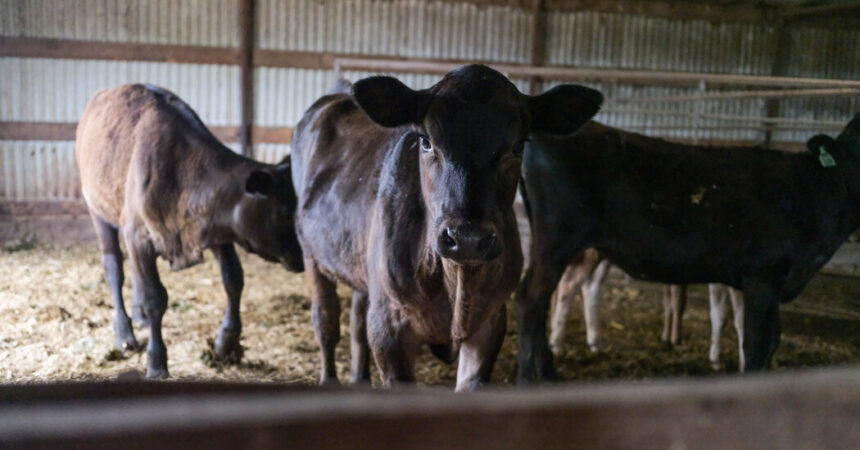
Ever since scientists discovered influenza infecting American cows earlier this year, they have been puzzling over how it spreads from one animal to another. An experiment carried out in Kansas and Germany has shed some light on the mystery.
Scientists failed to find evidence that the virus can spread as a respiratory infection. Juergen Richt, a virologist at Kansas State University who helped lead the research, said that the results suggested that the virus is mainly infectious via contaminated milking machines.
In an interview, Dr. Richt said that the results offered hope that the outbreak could be halted before the virus evolved into a form that could spread readily between humans.
“I think this is good news that we can most likely control it easier than people thought,” Dr. Richt said. “Hopefully we can now kick this thing in the behind and knock it out.”
The findings have yet to be posted online or published in a peer-reviewed science journal.
Seema Lakdawala, a virologist at Emory University who is researching the virus on dairy farms and was not involved in the new study, cautioned that breaking the transmission chain would require serious changes to how farmers milk their cows.
“It’s really great that these results are coming out,” she said. “But this is a real logistical problem.”
In January, veterinarians began to notice individual cows suffering mysterious declines in milk production. They sent samples to the Department of Agriculture for testing. In March, the department announced that milk from cows in Kansas, New Mexico and Texas contained a deadly strain of influenza that is widespread in birds. They also found the virus in swabs taken from the mouth of a Texas cow.
Since then, 132 herds in 12 states have tested positive for the virus. The cows suffer a drop in milk production and then typically recover, although some cows have died or have been slaughtered because they were not recovering.
Researchers have long known that some strains of influenza viruses can infect mammary cells in udders and can be shed in milk. But they had never seen an epidemic of bird flu circulating in cows as they have this year.
So far, state or federal officials have reported that only three people in the United States have been infected from the cows. Two of the infected farm workers suffered conjunctivitis, otherwise known as pink eye. The third victim also experienced a cough and other respiratory symptoms.
The rapid spread of the virus among cows puzzled scientists. One possible explanation for the virus’s transmission was that it took advantage of how cows get milked on large farms. Workers clean a cow’s teats, squeeze them by hand to produce a few squirts then attach four tubes, known as a claw. When the claw is finished drawing out the cow’s milk, the worker removes it and places it on the next cow. A claw will typically be used on hundreds of cows before it is cleaned.
In another study published on Wednesday, Dr. Lakdawala and her colleagues found that the influenza virus could stay viable on a claw for several hours.
Scientists have also worried that the cows might be able to spread the virus as a respiratory disease. A cow with the virus in its airway would expel droplets as it breathed or coughed. Other cows might inhale the droplets, or pick them up by physical contact.
If that were the case, the virus might have the potential to attack cows that are raised for meat rather than milk. It might also allow the virus to spread more easily between humans.
In May, Dr. Richt and his colleagues in Kansas joined forces with German researchers to run experiments in which they deliberately infected cows. The two teams run high-level biosecurity facilities that can house animals as big as cows.
Martin Beer and his colleagues at the Friedrich-Loeffler-Institut in Greifswald, Germany, injected the virus into the teats of three lactating cows. Within two days, the animals developed clinical signs of infection much like what has been observed on farms: They got fevers, lost their appetites and produced far less milk.
What milk they did produce was thick. “It’s like yogurt coming out of the udder,” Dr. Beer said.
To see if the flu strain in the cows was significantly different from other strains infecting birds, Dr. Beer and his colleagues also injected cows with a different strain of the H5N1 bird flu virus. The cows suffered the same clinical signs of infection.
“So this can happen anywhere where this virus is in the environment,” Dr. Richt said.
Dr. Richt also injected the cattle flu into three female cows that were not lactating, and into three males as well. Instead of injecting the virus into the udders, his team injected the viruses into the mouths and noses of the animals.
The cows developed low-level infections, and they shed the virus from their noses and mouths for eight days.
Two days after the infection, three healthy cows that had not been infected with the virus were put in the same room as the sick ones. Over the course of 19 days, the scientists checked to see if the uninfected animals also developed the flu, whether by making contact with the sick cows or breathing in droplets they exhaled.
None of the healthy cows got sick. “We did not see transmission,” Dr. Richt said. “The virus is not behaving like a typical respiratory influenza virus.”
He cautioned that the results from the two experiments involved a small number of cows. The scientists also studied an early strain of the virus. The virus has been mutating as it has moved from animal to animal, and the researchers can’t say whether a more recent strains would behave more like a respiratory disease.
Dr. Lakdawala said that the new findings from the researchers in Kansas and Germany, which were consistent with epidemiological studies, added more urgency to stopping the spread of the virus in dairy cows.
But that may be easier said than done. Disinfecting the milking claws between each cow would slow milk output at farms. The chemicals used to clean the claws could also end up in the milk supply. “We don’t want bleach in milk,” Dr. Lakdawala said.
In addition to stopping the spread from cow to cow, she also said it was vital to protect people from the virus. “We don’t want these dairy workers to get infected,” she said.
In a typical milking parlor, the cows stand on a platform so that their udders are at eye level to the workers. When milk splashes on the platform, it may turn into droplets that can fly into the eyes of workers or get inhaled. Personal protective equipment like goggles and face shields could help block that route of infection.
Stopping the spread to dairy workers won’t just protect their health. It may also prevent the virus from getting a new opportunity to evolve inside a human host and better adapt to our species.
“You never know what happens with this virus in the future,” Dr. Richt said.