



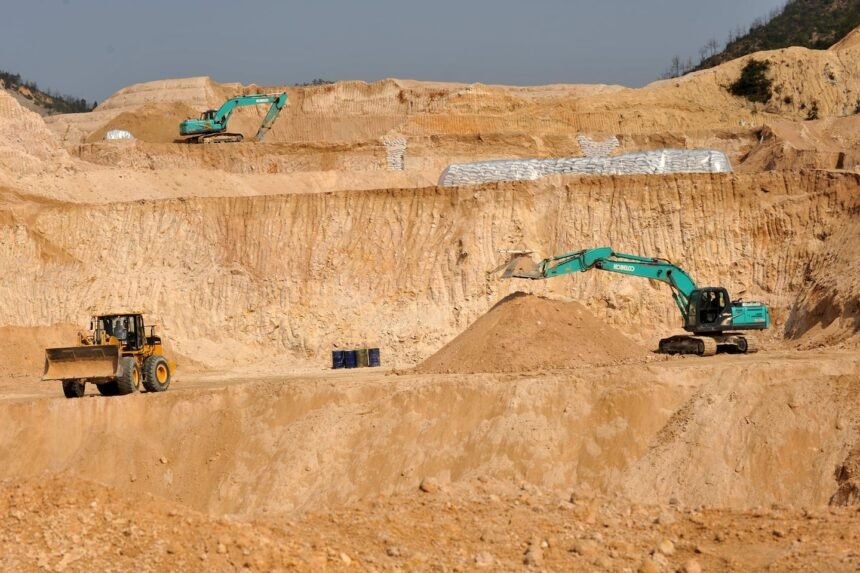
The US was once a major supplier of rare earths. But mining and refining the stuff is a deeply toxic business that fell afoul of environmental regulations. US companies abandoned the market to China, which was less concerned about the pollution problem. Now, Phoenix Tailings hopes to revive the industry by extracting the metals from “tailings,” the rubble created by mining for other minerals, such as iron. It turns out this inexpensive waste matter is full of rare earths. Villalon says his company has developed a new way to capture and refine this metal, while generating virtually no toxic waste.
Indeed, Phoenix Tailings has already begun, according to chief executive Nick Myers. “We ship on the tonnage scale globally today,” said Myers. “The primary amount of our contracts are with the automotive sector.” Myers wouldn’t identify specific customers, but said that the company’s pilot plant in Burlington can put out a maximum of 40 tons of rare earth metals per year.
In addition, Phoenix Tailings just closed a $76 million funding round to pay for a factory in Exeter, NH capable of making between 200 and 400 tons of refined rare earths per year. Investors include the venture firm Escape Velocity, carmaker BMW and the venture arms of Japanese companies Sumitomo and Yamaha.
Phoenix Tailings has also begun preliminary planning on a still larger plant with an annual capacity of 2000 tons. Meyer estimates that such a plant could produce 30 percent of the rare earths needed by US civilian industries, and much of the military’s needs as well, and could be in operation by 2027.
Success isn’t assured. Jonathan Hykawy, president of Stormcrow Capital, a Canadian company that tracks the global rare earths market, said that the industry is subject to dramatic swings in pricing that could discourage the kind of long-term investment needed to rebuild the business. “It’s a tough space to make money in,” said Hykawy. “It’s a small market so it’s subject to prices shooting up and coming down hard.”
Only 390,000 tons of rare earth oxides were produced worldwide last year, compared to 2.5 billion metric tons of iron. Just 45,000 tons were mined in the US, but nearly all of it was shipped to China to be processed into usable metal.
Neodymium and praseodymium are especially prized by carmakers because adding them to an electric motor’s iron-based magnets produces a stronger magnetic field and a more powerful and energy-efficient motor. It takes only a little — about five pounds of rare earths in a typical electric car. But 17 million EVs were produced last year, so it adds up.
Then there are wind turbines. Adding neodymium to a windmill magnet can produce up to 25 percent more power than a regular iron magnet. These magnets weigh several tons, with rare earths making up around a quarter of their total weight. That’s several hundred pounds of rare earths for every wind turbine, and 23,000 such turbines were installed worldwide last year, with thousands more on the way.
In short, we’re going to need a lot more rare earths. Villalon and Myers began working the problem in 2019, before most people had begun thinking about it.
The two men met through prayer. Villalon, a Roman Catholic, got to know Myers during a Catholic religious retreat in Cambridge. Myers is Greek Orthodox, but he showed up anyway. “It’s close enough,” Meyer said Besides, he added, “I like the people.”
The two men shared a background in science and a shared interest in minerals and clean energy. Myers earned a physics degree at St. Michaels College in Vermont and an MBA from Northeastern University, while Villalon earned an undergraduate degree in materials science from the Massachusetts Institute of Technology and a doctorate at Boston University.
“We started talking about, how do we make the metals that power the next 50 years of our civilization?” said Villalon. He and Myers targeted rare earth refining because it’s particularly dirty.
In 2019 Villalon, Myers, Michelle Chao, another MIT materials scientist, and chief commercial officer Anthony Balladon got to work, building an experimental refining system in Villalon’s back yard. Instead of using traditional ores, they focused on tailings, which are cheap and plentiful. The challenge was figuring out how to extract the rare earths stored therein.
They hit upon a solution of water and solvents that would dissolve the rare earths. The liquid is mixed with molten salts, heated to about 1,300 degrees Fahrenheit, then pumped over electrified membranes that capture the rare earth metals in pure form. There’s virtually no toxic waste. The solvents and salts are reused, and the leftover tailings can be buried.
The resulting process can be fine-tuned for each of the 17 rare earth metals. Phoenix Tailings is producing four rare earths so far, and can begin offering others if market conditions make it worthwhile. The system works with tailings, but can also extract rare earths from old ground-up EV batteries. And Villalon said it can also be modified to extract lithium from vast underground brine deposits in the southern US.
It’s good news for the Pentagon, because rare earth-based magnets are vital to many military systems. The US is especially worried about samarium, a rare earth used in making magnets that can withstand extreme heat. At present, all the world’s refined samarium comes from China.
But Meyer said the New Hampshire plant will be able to produce samarium in small quantities, while completely satisfying military demand for neodymium, praseodymium and two other critical metals, dysprosium-ferroalloy and terbium. And Villalon said the company is in discussions with the US Defense Department about its rare earth needs.
While most industry experts say it’ll take a decade or more to rebuild US rare earths industry, Villalon and Myers say their system is relatively easy to build and easy to scale.
“With traditional technologies you’re looking at 15 to 20 years to be able to build and deploy these things,” said Meyer. “We can scale up in a fraction of that time.”
It might not help during the current trade spat with China. But in some future dispute, Phoenix Tailings might give the US a few more cards to play.
Hiawatha Bray can be reached at hiawatha.bray@globe.com. Follow him @GlobeTechLab.