Under the string lights of a food truck park and market, El Zócalo, several Folklorico dancers wearing brightly colored traditional Jalisco-style dresses, as the fabric flutters in the setting sun.
The performance was part of an event called Viva México, where several Denton community members celebrated ahead of Mexican Independence Day and the start of Hispanic Heritage Month on Sept. 13 from 5-10 p.m. Mexican Independence Day is observed on Sept. 16 and celebrates Mexico’s separation from Spain in 1810.
“It is important for the current generation to see and feel proud of their culture,” said Kate Romero Ramos, a university dance major and president of the university group Folxlórico. “It also sends a message to people. We are here, we are seen and we are proud.”
Romero Ramos said Ballet Folklorico has been an essential way for her to connect with her Mexican heritage and maintain cultural tradition, as folklorico dances are a vibrant display of culture used in times of celebration.
The event dedicated time for people of all Hispanic and Latino backgrounds to connect with their culture and heritage. Latin American countries Costa Rica, El Salvador, Guatemala, Honduras and Nicaragua, all celebrate their independence from Spain on Sept. 15, a day that is now the start of Hispanic Heritage Month.
Attendees of Viva México were encouraged to celebrate their rich cultural heritage by shopping from many Latino-owned businesses, watching dance performances, listening to Latin music and enjoying meals from a selection of food trucks.
Ballet Folklorico is a traditional style of highly choreographed dance derived from different cultural regions of Mexico. Folklorico performers danced to traditional songs throughout the event as their family members cheered and clapped along.
Folklorico groups ranging from fourth graders to seniors in college performed throughout the night. A school group from Alexander Elementary School began performing at 5:30 p.m., followed by groups from Nette Shultz Elementary School, Ryan High School and the university’s own Folxlórico.
Five members of Folxlórico performed to “El Son de la Negra,” a popular mariachi song and dance in the style of the Mexican state of Jalisco. Romero Ramos said she thinks spaces like El Zócalo are lacking in Denton but are a necessary part of keeping Latino traditions and cultures alive.
“To have these spaces not only [allows] people to embrace and share their culture but also allows others to look in and witness these cultures,” Romero Ramos said. “By sharing and witnessing, people can come together as a more unified community.”
One of the event organizers, Victor Ambrosio, 46, owns two businesses in the El Zócalo market: Second Hand Sports and Game Swap and Ambro’s Tacos Y Más, which celebrated the soft opening of its bar during the Viva México event. Ambrosio, who grew up in Mexico City, said he missed the vibrant culture and thinks it is essential to have spaces like that in Denton.
Ambrosio helped organize the event because he wanted to celebrate Latino identity by creating a space that felt like a home away from home for members of the community.
“We feel like we’re right at home, and I feel like that’s what we were missing,” Ambrosio said. “I’m not trying to get paid or be someone, I just want to have a spot for something else that would make people feel comfortable, just like I would.”
Ambrosio said he wants to make plans with other business owners to host more events like Viva México throughout Hispanic Heritage Month, so members of the Latino community can feel like they belong.
“I feel like there’s a lot of Hispanic people sometimes who don’t know how to feel comfortable in their own culture and their own environment,” Ambrosio said. “I personally would drive an hour, hour and a half to go to a place like this just to be able to play the music that I like to listen to and that other people can enjoy as well.”
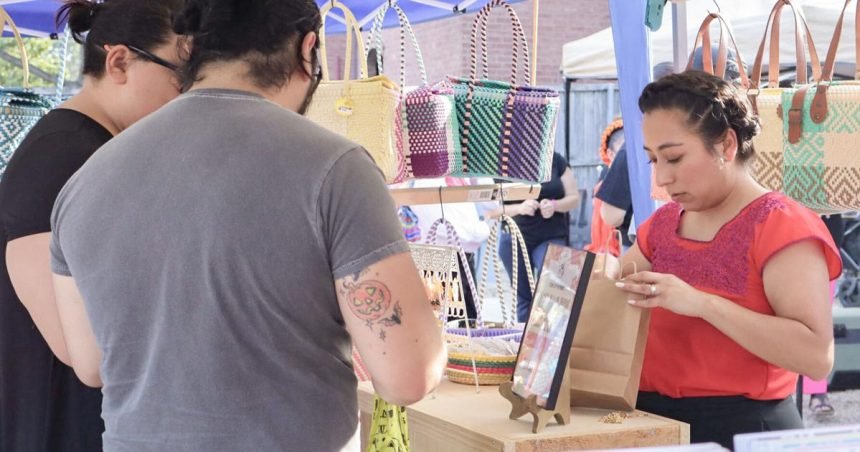
One of the other event organizers, Biri Ordoñez, 36, is the owner of M&B Tiny Shop, a small business that used to have a storefront in El Zócalo but is now an online store. Along with several other small business owners, Ordoñez set up a small version of her store for attendees to shop from.
Ordoñez sold items like jewelry, clothing, journals and bags handmade by Mexican and Guatemalan artisans. All of the items are covered in brightly colored designs, but the most striking are the mercado bags, a traditional type of bag named for its use in markets or grocery stores, which are made of woven recycled plastic that creates intricate patterns.
Ordoñez said she opened up her shop in 2018 because of the lack of Latino representation in her community. One of the most essential things to Ordoñez is to carry on cultural traditions like dance, art and language to future generations.
“It’s important to represent who we are and not forget what our parents did for us and why they came here in the first place and to continue in that generation,” Ordoñez said. “I don’t want our children to forget where we come from, because that’s always going to be part of us.”