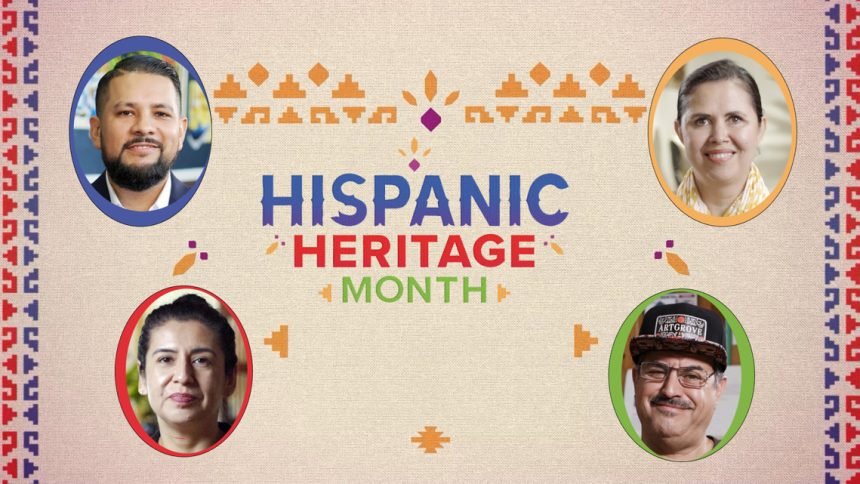
Meet four business owners blending family, culture, and resilience this Hispanic Heritage Month.
SACRAMENTO, Calif. — National Hispanic Heritage Month runs from September 15 to October 15, a time to honor the histories, cultures, and contributions of Hispanic and Latino Americans. The month begins on a symbolic date — September 15 — the anniversary of independence for Costa Rica, El Salvador, Guatemala, Honduras, and Nicaragua, all of which broke free from Spain in 1821. Several other Latin American nations also celebrate independence during September.
The 2025 theme for National Hispanic Heritage Month is “Collective Heritage: Honoring the Past, Inspiring the Future.” It’s a celebration of the shared legacy and forward momentum of Hispanic and Latinx communities, according to the National Council of Hispanic Employment Program Managers (NCHEPM).
To mark the month, ABC10 spoke with four Sacramento-area Latinos who shared what Hispanic Heritage Month means to them – from the hard work and sacrifices of their elders to the values passed down through generations, and the responsibility they feel to carry their culture and community forward.
Marcoantonio Rodriguez
Marcoantonio Rodriguez was born and raised in Fairfield, but his family’s story begins in México. Today, he’s a successful entrepreneur and the creator of Miche Marlin, a popular michelada mix that took off during the pandemic.
His parents migrated to the United States and worked in the fields to provide for their children. He remembers spending a lot of time in the orchards of Vacaville with his mom, dad, cousins, aunts, uncles, and even his grandmother. Growing up, he noticed the challenges his parents faced not knowing the language or how to navigate life in the U.S., but he also saw their sacrifices, working from morning to night so their children could have a better lifestyle.
For Marcoantonio Rodriguez, Hispanic Heritage Month is a time to reflect on sacrifice and resilience.
“Being from Mexico, first-generation Mexican-American here, I could tell that our life was a little different,” Rodriguez said. “While most kids were out playing with their friends, I spent a lot of time working with my parents.”
His parents migrated from Ocotlán, Jalisco, to California, where they started as migrant workers.
“We picked fruit in the Vacaville orchards, and I spent a lot of time with my mom and dad picking with them,” he said. “It wasn’t just myself. I was there with my cousins, my aunts, my uncles, even my grandma. They were trying to find their way and make their way here in the United States.”
That hard work left a lasting impression.
“Real young, I realized that life isn’t necessarily fair,” Rodriguez said. “My parents had to work very hard, and they’ve taught us what it is to sacrifice, to work hard, to be the first ones working and be the last ones to come out.”
Inspired by his mother, Rodriguez saw entrepreneurship as a path to freedom.
“So entrepreneurship for me was a pathway to freedom, not just for financial freedom but freedom of time, freedom of travel, freedom of living in the spaces that we want to live in,” he said.
In 2007, his family opened La Costazul in Fairfield.
“Our restaurant really has become more of a cultural center,” Rodriguez said. “It’s a place where people come together and share good times with their loved ones.”
The restaurant later inspired Miche Marlin Micheladas, a three-time award-winning michelada mix created from his family’s recipe.
“This ingredient is a recipe that my parents put together, but it was inspired by many of the authentic flavors that we get from Ocotlán, Jalisco, Mexico,” Rodriguez said. The michelada mix has grown from a local favorite to a national product, available at Sacramento’s Golden 1 Center and shipped across the country.
“We’ve shipped this product nationwide,” Rodriguez said. “Everywhere as far as New York, Washington, Texas, Oregon, there’s a demand for our product.”
His experience growing up and perspective shapes how he sees Hispanic Heritage Month.
“What Hispanic Heritage Month means to me is an opportunity to have representation,” he said. “To have representation of people like my family, like my mom, hardworking Mexicans, Latinos, people that come to this country to create a better life for themselves and for their loved ones and to leave a generational impact.”
Rodriguez hopes his story inspires others.
“If you have a dream, and you’re willing to work towards it, make some sacrifices, you can make your dream come alive just like we did,” he said.
Maria Harrington
Maria Harrington is the owner and director of Casa de Español in Sacramento. When she introduces herself, she often begins with both sides of her story: Harrington, who was born in Pachuca, Hidalgo, Mexico, came to the U.S. as a child and grew up in Sacramento, later spending her teenage years in Wilton and Elk Grove. Her upbringing was shaped by two cultures at home — a Mexican mother who spoke Spanish and an American father who spoke English.
“I didn’t really realize that there was a difference until I started school,” she said.
Her parents modeled a deep work ethic. Her father ran a small painting business in Sacramento for 40 years, while her mother taught bilingual education.
“I saw how my mom would stay up really late to finish her lesson plans and then my dad, he would work weekends to make sure that we had food on the table,” Harrington said. “That really instilled the importance of doing a great job in whatever I did.”
But at school, Harrington was told her bilingualism was a problem.
“I had a principal who told me and my mom that she should stop teaching me Spanish because it was going to be a handicap, and I would never really be truly American if I kept speaking Spanish,” she recalled. The message filled her with shame, and for years she spoke English in public, embarrassed when her mom addressed her in Spanish.
That changed when Harrington spent her freshman year of high school in Mexico. At first, she struggled.
“Every single day was a challenge. I was learning new things, not only with the language but also the culture,” she said.
By the end of the year, she loved it.
“I wanted to stay in Mexico, and my mom said, no, you promised a year and now you come back.”
Determined to reclaim her heritage, Harrington earned a bachelor’s degree in Spanish and international relations and later a master’s in Latin American studies. She worked with communities in Chiapas, Mexico, where she saw the power of service and cultural exchange.
She returned to Sacramento with a vision: a language school and cultural hub that would celebrate Latino identity. In 2011, she opened Casa de Español.
“Casa de Español is a center for language and culture,” Harrington said. “We offer classes both virtually and in person for all ages, and we also do our wonderful summer camps that are infused with both language and culture.”
The school started in a 750-square-foot space on J Street. Today, it spans 4,000 square feet with six classrooms, serving more than 300 students each quarter and reaching learners as far away as Europe and the Philippines. Casa also hosts monthly cultural events — First Friday celebrations of food, music, art and theater from across Latin America.
For Harrington, Casa de Español is more than a business; it’s a way to repair the harm done to children who once felt ashamed of Spanish.
“Being here at Casa de Español, it’s a comfortable, open, positive area for them to practice their Spanish if they already know it, or learn Spanish if they don’t,” she said.
Harrington said community collaboration has been central to the school’s success. From local artists to immigrant-rights organizations, Casa serves as a gathering place where culture and service intersect.
As Hispanic Heritage Month unfolds, Harrington hopes Sacramento will not just observe but engage.
“Latino culture is all about exchange and community,” she said. “No matter who you are, you are welcome to whatever event we have here at Casa de Español or any other Hispanic Latino event in Sacramento.”
And she adds one final cheer: “Que viva Sacramento, que viva la comunidad, que viva.”
Melissa Sánchez
Melissa Sánchez is an attorney working in the cannabis industry and an entrepreneur and small business owner of a wine bar in Sacramento.
When Melissa Sánchez opened Alma Wine Bar in Sacramento less than a year ago, she wanted it to be more than a place to sip wine. For her, Alma — which means “soul” in Spanish — is a community gathering space rooted in family, culture and tradition.
“I try to imagine it like my grandmother’s little store in Mexico,” Sánchez said. “People would come in, have a chat, have a laugh, and leave feeling happy. That’s what I hope Alma is for Sacramento today.”
Sánchez’s family history is woven deeply into her business. Her parents, both from Jalisco, Mexico, earned doctorate degrees and set a standard of hard work and education. Her grandmother, Luisa Guzmán, ran Mitiendita — “my little store” — while raising six children as her husband worked in the U.S. under the Bracero program. That example of resilience and entrepreneurship inspired Sánchez to create a space that blends culture and commerce.
Her path to owning a wine bar wasn’t straightforward. After studying economics and international relations at UC Davis, Sánchez went on to Columbia University to earn a law degree. She later worked in the cannabis industry, helping small entrepreneurs navigate complex regulations. She credits that experience with showing her the importance of small businesses and giving her the skills to launch her own.
But her love of wine traces back even further. While studying abroad in Bordeaux, France, Sánchez fell in love with the way wine was integrated into daily life. Later, working in the wine industry in Napa and earning certifications at Napa Valley Wine Academy, she began imagining a project of her own.
Alma started as an idea for a wine school, and Sánchez still plans to offer classes in both English and Spanish. But the concept expanded into a bar that celebrates sustainable agriculture, small producers and diversity in the wine industry.
“We try to carry as many wines as possible from winemakers and owners of color, women, and LGBTQ+,” she said.
A special focus is highlighting Latino winemakers, who Sánchez says often go unrecognized despite their central role in California’s wine history.
“Latino winemakers don’t get highlighted as much as they deserve,” she said. “I want Alma to be a platform to celebrate them.”
Events, mixers and classes at Alma emphasize inclusion.
“There’s always room for one more,” Sánchez said. “That reflects the way I grew up. There was always an extra plate at the table.”
For Sánchez, that spirit connects to the meaning of Hispanic Heritage Month.
“To me, it means hospitality,” she said. “Latinos have a natural sense of wanting people at the table. We’re such an important part of the present, the past and the future. Let’s celebrate together.”
She hopes Alma can continue to grow as both a wine school and a gathering space for Sacramento.
“I want people to see they can have their own business, enjoy what they do, and build community while doing it,” she said. “That’s what Alma is all about.”
Markos Egure
Markos Egure is a Sacramento-born Mexican American artist and entrepreneur.
He grew up in South Sacramento, where multicultural neighborhoods shaped his early worldview.
“I got to interact with a lot of different people growing up,” Egure said. “It was also unique because of its diversity.”
His family roots trace back to Ciudad Juárez, Mexico, and the South Texas region. His mother, who did not have a high school diploma, worked her way up in the almond industry, starting on the belt line and becoming an inventory specialist. His father labored for the Southern Pacific railroad, proud to be one of many who built long careers there.
“Their work life influenced me — always on time, always being what they had to do at their jobs,” Egure said. Both of his parents held their jobs for 40 years, a commitment he said he respected and admired.
When it came time to chart his own path, Egure said he went “outside of the box” and became an entrepreneur. He launched Wes Kos Images, a mural and graphic design company, in 1997.
Since then, Egure has spent more than 30 years painting murals across Sacramento, many of which are located at local schools and in the neighborhoods where he grew up.
Today, Egure serves as a board member with the Mexican American Hall of Fame Sports Association and works with ARTners, a nonprofit he co-founded in 2019 to provide programming and community projects.
Through ARTners, the group helped establish Mural Expressions, which has partnered with the Hall of Fame to raise scholarships and spearhead the WX Sacramento Mural Museum. For the museum, the group is working with the city and Caltrans to paint freeway columns between Interstate 5 and Highway 99.
The Hall of Fame carries a personal connection for Egure. His father was inducted in 1992 for track and field and later became a board member. Egure said his own involvement began in the late 1980s, when he was finishing high school at Luther Burbank and entering his twenties.
One of his projects is the “Sports Raza” mural at the Hall of Fame, which highlights Mexican American roots and history in sports. Among the athletes on the mural are Egure’s father and uncle, shown running for Clarksburg High School, now known as Delta High.
“Just seeing the good work that the board was doing, how it meant something to our community … it made me want to connect to it,” he said.
Egure said his work today reflects both his family’s influence and the community that raised him.
“All those good attributes about being who we are lead us to who we are today,” he said. “We’re Hispanic Heritage Month. You’re looking at somebody who I like to think looks like so many other people, but there are differences. And it’s important to have representation.”