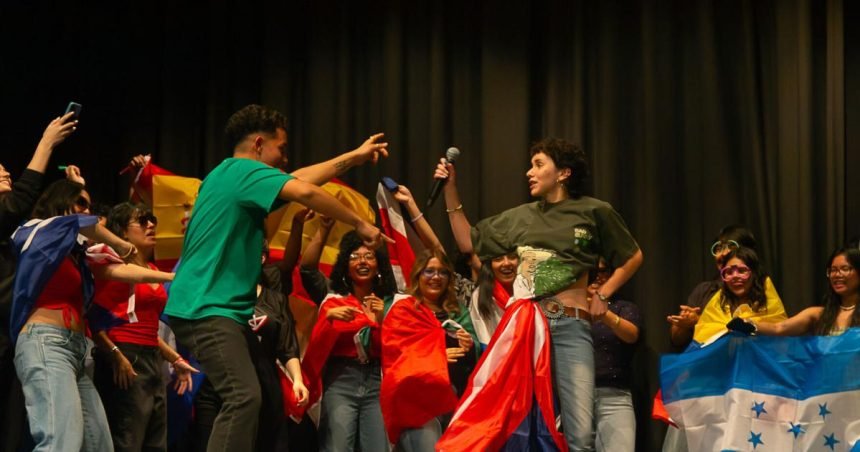
“Noche de Nuestra Cultura” filled the Ashurst Hall stage with sweeping skirts, beating drums and performers sharing dance rituals from Latin America and beyond.
The Latine Student Union (LSU) hosted its first “Night of Our Culture” event on Nov. 13, featuring performances from NAU clubs, dance groups and musicians. Attendees were invited to celebrate their own cultural practices and learn about traditions from around the world.
The Japanese Culture Club performs a dance to sōran bushi in Ashurst Hall, Nov. 13. Sōran bushi is a traditional Japanese folk song. Athena Roberts/The Lumberjack
LSU event manager Ayejah Rivera said the club wanted to host the event to celebrate the diversity of Hispanic cultures and showcase them to the NAU community.
“Our culture is what keeps all of us centered, especially being at an academic institution,” Rivera said. “Bringing our cultures into this space and being able to share them with others is really important to all of us.”
The celebration featured performances of several Latin American dance styles, including Colombia’s cumbia and Mexico’s folklórico.
One of the opening dances was bomba, a Puerto Rican style with roots in West African culture. During the performance, dancers moved with the rhythm of the drum and twirled their skirts in time with the beat.
Rivera participated in the bomba and folklórico presentations. She said LSU made an effort to showcase as many different cultures as possible during the event, as it could help challenge common assumptions about the Latine community.

The Hapa Hawaiian Club performs Ka Uluwehi O Ke Kai hula on stage in Ashurst Hall, Nov. 13. Ka Uluwehi O Ke Kai is a Hawaiian song by Kekuhi Kanahele that explores the connection between the ocean, the land and the people. Athena Roberts/The Lumberjack
“There’s this idea that Latinos are just Mexican, and that’s not the case,” Rivera said. “We have all these different dances, dialects, songs and costumes, and learning those can help push the boundaries of what many people think a Latino is.”
Between each performance, attendees were encouraged to indulge in an array of Latin American foods, including tamales, ceviche and sopapillas. Others spent the evening competing in games, like musical chairs and a chancla-throwing competition.
Several other cultural organizations performed at the event, including the Filipino-American Student Association, Hapa Hawaiian Club, Japanese Culture Club and Unity Dance Crew.
The Japanese Culture Club presented a traditional Japanese song and dance called sōran bushi, which originated from the fishing communities of Hokkaido, Japan. During their performance, the dancers used sweeping arm movements to recreate the motions of waves and fishermen pulling their nets aboard.
Rivera said one goal of the event was to create a space for students who might not always feel represented on campus.

Students perform a traditional Mexican folklórico dance in Ashurst Hall, Nov. 13. Folklorico dance is often characterized by the intricate footwork and lively music that plays as they dance. Athena Roberts/The Lumberjack
“We want to show people that we are here no matter what,” Rivera said. “We want LSU members and those from other clubs to know that they do belong, and we all want to share our culture in a way that’s inviting and encourages others to learn and celebrate with us.”
NAU was designated as a Hispanic-Serving Institution in 2021 upon reaching the 25% Hispanic enrollment requirement.
As of Fall 2025, Hispanic/Latino students make up 26% of NAU’s total student body. Native Hawaiians and other Pacific Islanders represent 1%, and Asian students make up 8%.
LSU president Beau Arenas said he hoped the performances would help attendees discover and celebrate the cultures of underrepresented groups on campus.

Mariachi Los Madereros preforms as the trumpet player starts to sing in Ashurst Hall, Nov. 13. Athena Roberts/The Lumberjack
“We wanted to showcase all these different cultures on a bigger scale than we usually do,” Arenas said. “I hope people got to experience parts of their own culture on stage, or learn about others they might not have been familiar with.”
As the event drew to a close, Ashurst Hall was filled with students cheering on the final performances and talking among themselves.
Arenas said he wanted the event to be a space where students of similar backgrounds could connect and support one another, just like LSU has been for him.
“LSU has massively changed my experience at NAU,” Arenas said. “It’s given me a sense of community and helped me realize that I always have people to rely on.”

The curtains close as the students finish the final performance in Ashurst Hall, Nov. 13. Athena Roberts/The Lumberjack
Rivera and Arenas said they hope “Noche de Nuestra Cultura” becomes an annual event where students can come together and celebrate the diversity at NAU.
For more information on LSU and its upcoming events, visit the club’s Instagram page.