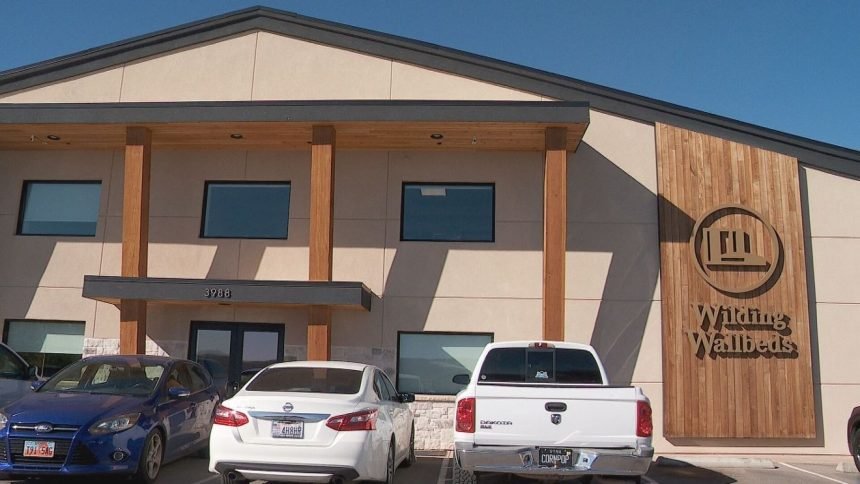
ST. GEORGE, Utah (KUTV) — Wilding Wallbeds in St. George is a small business success story. The family-owned company has been manufacturing Murphy beds for 25 years and currently has 80 employees who build solid wood cabinetry surrounds for the wall-mounted beds, which are shipped and sold across the country.
Dennis Wilding, who founded the company with his father, attributes its success and longevity to a focus on quality and the use of solid wood sourced from U.S. mills.
While the company’s future once seemed clear, Wilding said President Donald Trump’s 2025 tariffs have created new costs that raise concerns about what comes next.
MORE | Eye On Your Money:
Eye On Your Money. (Graphic: KUTV)
“Sometimes I feel like I’m flying a plane through the clouds and I don’t know if a mountain is coming. There’s uncertainty and I don’t know what’s out there,” he said.
Wilding said the tariffs imposed by Trump on many countries, including India and China, have been sudden and ever-changing — like a “roller coaster” — making it difficult to plan. He said shifting tariff rates add surprise costs and uncertainty to his bottom line.
“Businesses don’t like uncertainty. That’s a struggle,” he said.
Although Wilding’s beds and cabinetry are fully made in Utah, a steel mechanism that allows the beds to fold into the wall is imported from India or China. Wilding said he has struggled to find a U.S. manufacturer willing to make the part.
One recent shipment of those parts left China, and while the cargo was en route to the United States, the tariff rate jumped.
“Tariffs suddenly went from 35% to 145%,” Wilding said.
A broker helped him secure a hold on the cargo at the U.S. port, hoping the fluctuating tariff rate would drop enough to make the cost and port fees manageable.
In the end, that shipment cost Wilding Wallbeds $140,000 more than usual.
While the company has absorbed the added cost of tariffs to avoid raising prices for customers, Wilding said doing so long term isn’t realistic — nor is it what he wants.
His Murphy beds are a high-quality product not everyone can afford, which already limits his potential customer pool. Raising prices could shrink that group even further.
“There is a finite amount of people who will spend the money to get these products, and as soon as we raise prices, we will lose customers,” he said.
Small businesses are especially vulnerable to the impact of tariffs, according to the American Action Forum, a nonprofit that analyzes the effects of government policy.
“Small businesses are uniquely vulnerable to the administration’s protectionist trade policy due to their inherent disadvantages compared to large corporations,” the group wrote in a recent analysis.
The analysis noted that small businesses, which employ nearly half of all workers in the country, do not have the leverage to soften the blow of tariffs like larger corporations, which often have more power to negotiate with suppliers or adjust supply chains.
It also said small businesses take on more indirect costs because they lack the resources to navigate new trade rules and regulations.
Braxten Wilding, the son of Dennis Wilding and the company’s vice president of finance, said the company pays upfront for overseas part orders. While tariff rates may fluctuate while the shipment is at sea, the final price is set when the cargo arrives at the port.
At that point, the Wildings receive an invoice from the shipping broker that includes broker fees, tariffs, and port fees.
“We could say we don’t want the shipment anymore, but we’ve already paid for it,” he said.
Dennis Wilding said he is not opposed to tariffs, but not at the high and ever-changing rates he’s seeing now.
“I want there to be consistency again. I want to know where the tariffs are going to be so I can run the business based on the reality of the costs,” he said.
_____