Jim Browning, a research professor in the Department of Electrical and Computer Engineering at Boise State University, recently made waves at the 23rd International Vacuum Congress in Sydney, Australia. His invited talk, “Reliability of Gated Vacuum Field Emitters,” showcased an important collaborative effort with Rushmita Bhattacharjee, an alum of Boise State’s Electrical and Computer Engineering Ph.D. program, and Professor Tayo Akinwande from the Massachusetts Institute of Technology.
Their research aims to fundamentally improve the reliability of gated field emission arrays (GFEAs). GFEAs are crucial components in advanced microwave vacuum electron devices and vacuum transistors — tiny devices that can operate in high-temperature and high-radiation environments, such as those found in space exploration. By gaining a deeper understanding of these mechanisms, Browning’s team seeks to enhance the reliability and longevity of these critical devices.
“Dr. Browning’s work could enable the development of electronics that are more robust and suitable for use in harsh environments,” Electrical and Computer Engineering Chair and Professor Neal Bangerter said. “Vacuum field emitters are being investigated for use in a range of devices, all of which push the boundaries of what is possible in electronics.”
This innovative work holds immense promise for advancements across various technological sectors, from high-frequency communications to advanced sensing applications. The ability to precisely control electron emission at the nanoscale opens doors to developing more efficient, compact, and powerful electronic components, potentially revolutionizing areas such as next-generation computing, space exploration technologies, and medical imaging.
Browning underscored the global impact and collaborative spirit of Boise State saying, “our research in plasma and vacuum electron devices has provided research opportunities, collaborations, and invited talks with counterparts in Australia and expanded our worldwide reach with support from the Air Force Office of Scientific Research and the National Institutes of Health.”
In addition to the invited talk, Boise State researchers contributed to the International Vacuum Congress with a poster presentation titled “Development of a 10 cm x 10 cm Cold Plasma Array for Surface Sanitization.” Researchers on this project included Ken Cornell from Boise State’s chemistry department, Sumona Islam, Marcus Pearlman , and Ranajoy Bhattacharya from the electrical and computer engineering department.

Browning’s international research collaboration efforts exemplify Boise State’s commitment to forming partnerships in order to tackle real-world problems. With applications in agricultural and medical settings, cold plasma arrays can be used to treat surfaces, such as conveyor belts, and products like crop seed, eliminating harmful bacteria and fungi. This technology could be highly beneficial to the food processing industry in Idaho. It will reduce water consumption and chemical usage, resulting in both financial and environmental benefits.
Following the International Vacuum Congress, Browning visited the Royal Melbourne Institute of Technology to strengthen his collaboration with Nirantar. This ongoing partnership is generously supported by an Air Force Office of Scientific Research grant (FA2386-24-1-4055), specifically designed to bolster research capabilities in directed energy in both Australia and the United States.
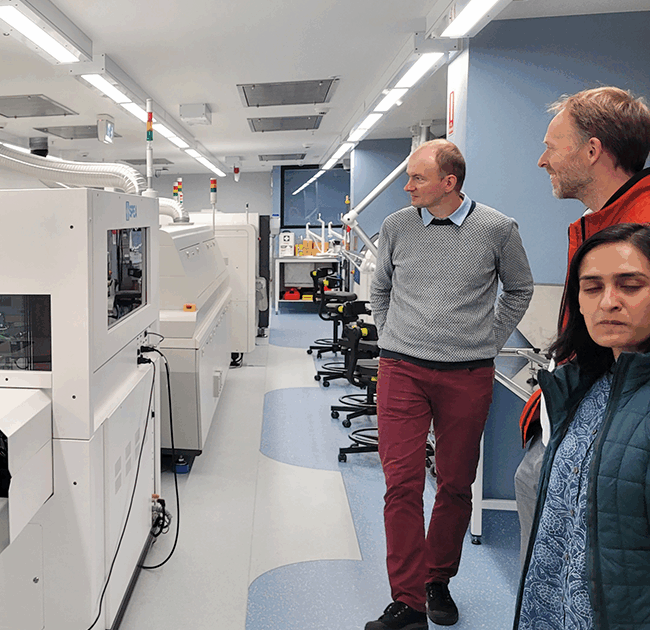
During his visit, Browning toured the institute’s state-of-the-art fabrication facilities and explored their innovative “Discovery to Device” industry collaboration facilities. He fostered new collaborations with Nirantar’s research team and delivered a seminar, “Plasma and Vacuum Electron Devices,” to the research community at the Royal Melbourne Institute of Technology’s School of Engineering. This continued international engagement solidifies Boise State’s position as a leader in cutting-edge research in vacuum field emitters and plasma technology.