Electric vertical takeoff and landing (eVTOL) aircraft developer Archer Aviation, which has announced urban air taxi networks in Los Angeles, San Francisco, and New York, on Wednesday pulled back the curtain on a fourth service location.
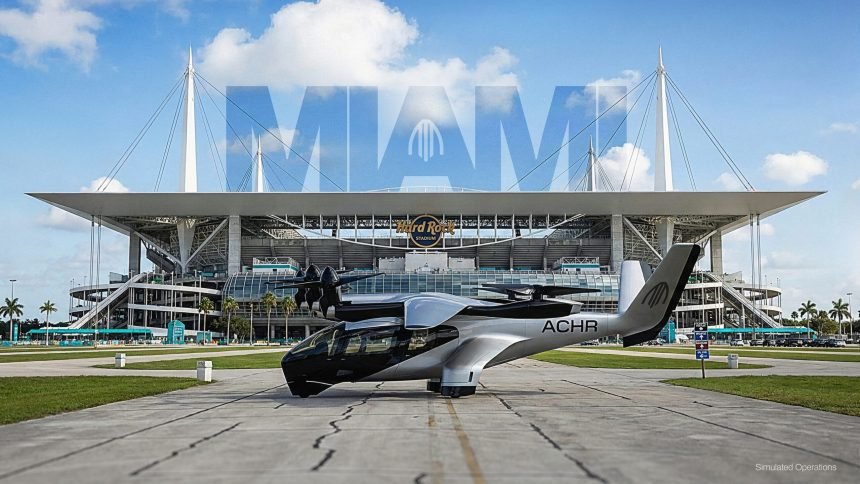
Archer said its flagship Midnight, designed for a pilot plus four passengers, will soon connect “major population and business centers” in South Florida—including Miami, West Palm Beach, Boca Raton, and Fort Lauderdale—with zero-emission, 10-to-20-minute flights. That could include service to and from Hard Rock Stadium, home to the NFL’s Miami Dolphins, University of Miami athletic teams, Formula 1’s Miami Grand Prix, and other sports and entertainment events.
Archer said it plans to build air taxi infrastructure at Miami International (KMIA), Fort Lauderdale-Hollywood International (KFLL), and Palm Beach International (KPBI) airports. Routes could also connect Miami Executive (KTMB), Miami Opa-Locka Executive (KOPF), Fort Lauderdale Executive (KFXE), Boca Raton (KBCT), and Witham Field (KSUA) airports.
According to a map of the network, it will leverage Atlantic Aviation and Signature Aviation FBO terminals at these locations. Archer reached agreements with both companies in 2024 to install electric aircraft chargers it purchased from competitor Beta Technologies.
In Miami, Archer will prepare existing heliports for Midnight in partnership with developer Related Ross, whose founder, chairman, and CEO, Stephen Ross, is the principal owner of Hard Rock Stadium and the Dolphins. Ross is co-founder of Apogee Golf Club in nearby Hobe Sound, where Archer plans to modify another heliport. The company will also build a new vertiport at the developer’s $10 billion mixed-use community in downtown West Palm Beach.
“We’re excited to embrace a forward-thinking vision that transforms how people and businesses move across the region,” Ross said in a statement.
In addition, Archer is working with Miami’s Magic City Innovation District to build a vertiport within the planned 18-acre business, technology, and luxury residential hub in the city’s Little Haiti neighborhood.
Connecting all of these sites will be Midnight, which could one day be autonomous but will initially carry a pilot plus four passengers. The model cruises at 150 mph and is optimized for back-to-back, 20-to-50-mile trips. Its six electric battery packs each power a pair of engines and propellers—half are fixed for vertical takeoff, and the other half tilt forward to support cruise flight. Archer bills the eVTOL as significantly quieter than a helicopter.
Florida Embraces Air Taxis
Archer is not the first air taxi operator to show an interest in the Florida market.
Hyundai air taxi unit Supernal, for example, in 2022 reached a formal agreement with the city of Miami for a commercial launch in 2028. However, the company recently paused its air taxi work.
More recently, Boeing’s Wisk Aero said it is exploring vertiport projects at Miami International, Miami Executive, and Miami Opa-Locka Executive airports in partnership with the Miami-Dade Aviation Department. Earlier this month, fledgling operator UrbanLink Air Mobility—whose fleet includes Beta’s Alia, Regent Craft’s Viceroy electric seaglider, and other novel designs— began researching operations using Signature’s Florida network.
Airports themselves have also shown interest in the technology. Earlier this year, the Greater Orlando Aviation Authority (GOAA) published a request for partners to build a vertiport at Orlando International Airport (KMCO) by 2028. In September, Orlando International became the second airport to take part in eVTOL air taxi simulations at the FAA’s William J. Hughes Technical Center in New Jersey.
Archer’s Expansion
Miami is just the latest addition to Archer’s U.S. network, which the company aims to be operational by 2026.
One of its first locations could be Los Angeles, where it has secured partnerships with organizers of the 2026 FIFA World Cup, Super Bowl LXI in 2027, and the 2028 Los Angeles Olympic Games. Under the latter partnership, Midnight could ferry spectators, VIPs, and even athletes between Olympic venues.
Planned nodes in the network include Los Angeles International Airport (KLAX) and airfields in Hollywood, Orange County, Santa Monica, and Long Beach. Terminals will be operated by Atlantic, Signature, Clay Lacy Aviation, and airline partners United Airlines and Southwest Airlines. Routes could also serve the Los Angeles Convention Center, University of Southern California, and SoFi Stadium, which will host Super Bowl LXI.
Earlier this month, Archer paid $126 million to acquire Hawthorne Municipal Airport (KHHR)—located within 3 miles of LAX—as the centerpiece of its LA network. Founder and CEO Adam Goldstein compared the site to New York City’s Grand Central Station, adding that it will be a central hub for maintenance, storage, and other operations.
Southwest, with which Archer partnered in July 2024, also has hubs in San Francisco—another potential launch market. That same month, Archer signed an agreement with Kilroy Realty Corporation to link the latter’s South San Francisco location to airports in Napa, San Jose, Oakland, and Livermore.
Newark Liberty International Airport (KEWR) in New Jersey to New York’s Downtown Skyport (KJRB), formerly the Downtown Manhattan Heliport, was the first route Archer announced with United in 2022. In April, it revealed additional locations: LaGuardia Airport (KLGA), John F. Kennedy International Airport (KJFK), Westchester County Airport (KHPN), Republic Airport (KFRG), West 30th Street Heliport (KJRA), East 34th Street Heliport (6N5), and Teterboro Airport (KTEB) in New Jersey.
The company’s New York hubs will be operated by United, Southwest, Atlantic, Signature, Modern Aviation, and Air Pegasus.
Rival Joby Aviation, meanwhile, plans to fly its S4 air taxi out of New York facilities it acquired from Blade Air Mobility in August. As soon as next year, they could compete for passengers in the Big Apple.
Joby last week filed a lawsuit against Archer, alleging that a former employee downloaded sensitive information that the latter used to undermine a potential partnership.