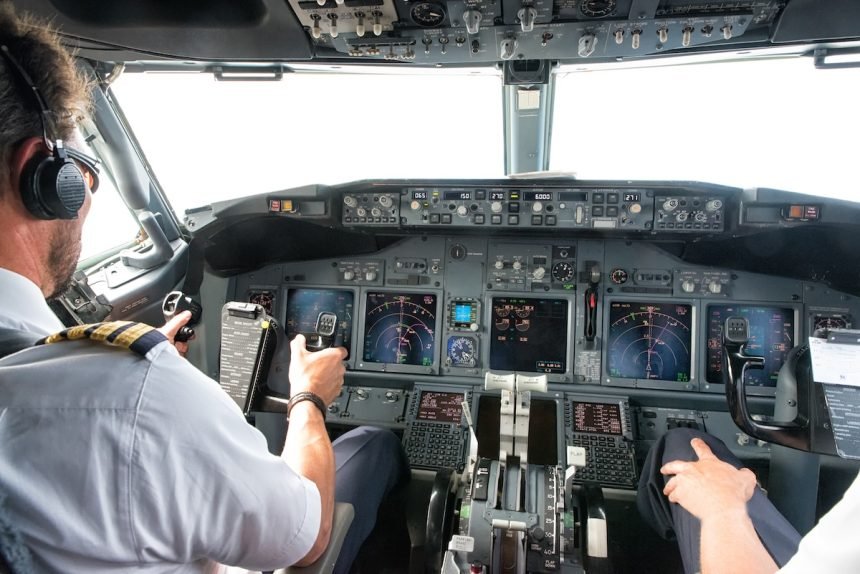
The Air Line Pilots Association (ALPA) is calling for a renewed emphasis on fundamental flying skills as automation becomes more common in air carrier operations.
In a recent interview at the Skift Aviation Forum in Fort Worth, Texas, ALPA first vice president Wendy Morse, a Boeing 787 captain, said the union is advocating for pilots to “go back to our roots” by maintaining strong manual-flying proficiency throughout their careers.
The union represents over 80,000 airline pilots at 43 carriers.
“So the biggest thing is [getting] back to basics…We have to maintain a basic level of flying, a basic level of flying skills, and we have to continue to maintain those basics,” Morse said. “This business about positive rate, gear up, [and] put on the autopilot is not a good idea. We have to keep flying the airplane so that we’re good at it.”
Morse added that she routinely hand-flies the aircraft to cruise altitude.
“People are like, ‘Oh, my gosh, all the way to 37,000 feet?’ Yep,” she said. “That’s what I do because I like to fly.”
‘Losing Their Skills’
She said the industry recognized the need for more manual flying through safety data that showed pilots’ hands-on skills were beginning to erode.
“The data was saying that pilots are losing their skills,” Morse said. “So we need to start [suggesting] to them and recommend that we think you should be flying planes—hand-flying the airplane.”
Addressing cockpit staffing, Morse referenced ALPA’s “Safety Starts With Two” campaign opposing single-pilot airline operations. She criticized past proposals from Airbus and others to reduce cockpit crews.
“They decided one pilot in the cockpit was a good idea because it would cost less money,” she said, describing scenarios in which the sole pilot might need to leave the controls. “Who’s at the controls? Oh, nobody’s at the controls.”
She said efforts to advance reduced-crew operations are “paused and not over.”
Morse emphasized that technology is valuable when it supports pilot decision making, citing terrain-avoidance systems and real-time turbulence tools on flight decks. She said artificial intelligence will likely assist with learning and data analysis but stressed that it must be monitored.
“We have to be very careful to not let AI give us bad data,” she added, noting that data-sharing programs have been the “game changer” in improving safety over the past two decades.