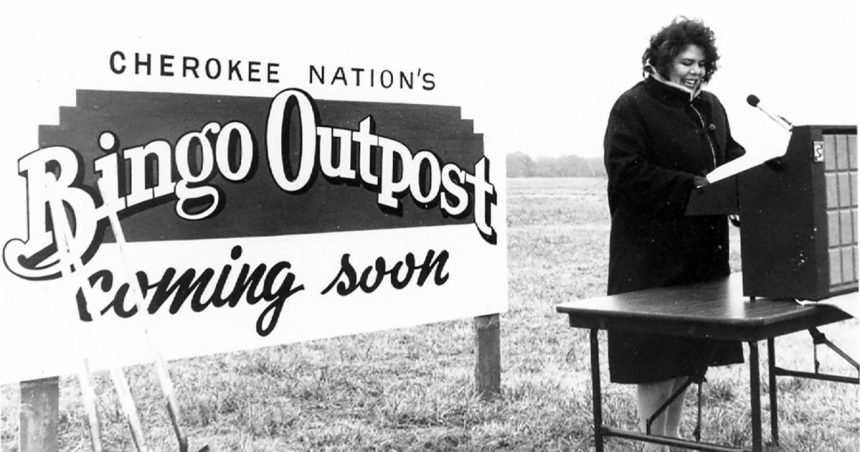
CATOOSA – When the Cherokee Nation’s first bingo hall opened in the fall of 1990, then-Principal Chief Wilma Mankiller promised “major” economic impact.
From that spark, the tribe built a gaming and hospitality enterprise that today delivers what the current chief calls a “staggering” dividend to the Cherokee people.
Cherokee Nation Principal Chief Chuck Hoskin Jr. talks to reporters Dec. 8 about the tribe’s 35-year gaming history.
“Over the course of 35 years, there’s been over a billion dollars delivered to the Cherokee Nation in terms of our dividend,” Principal Chief Chuck Hoskin Jr. said. “It goes into jobs for Cherokee people, scholarships, better health care, housing, you name it.”
Cherokee Nation leaders and representatives of the tribe’s business and entertainment arms met Dec. 8 at Hard Rock Hotel & Casino Tulsa to celebrate the 35-year gaming milestone. They reflected on the “very bold” vision to pursue gaming, in particular the first venue, called Bingo Outpost in Roland, Oklahoma.
“That was just a tin building,” Cherokee Nation Businesses CEO Chuck Garrett said. “And here we are today in a gorgeous venue which has served our customers so well for so long. It’s a story of perseverance, resilience. I mean, those 35 years haven’t always been easy.”

Hard Rock Hotel & Casino Tulsa is the Cherokee Nation’s flagship gaming venue in Oklahoma.
The small outpost in Roland, which employed 64 people, later led to expansion with additional Bingo Outposts opening in Catoosa near Tulsa in 1993 and West Siloam Springs in 1994. By 2004, the tribe had advanced its operations further by transitioning bingo facilities to Class III gaming beginning with a major expansion in Catoosa, which laid the foundation for a robust casino and hospitality business that now employs more than 4,000 people.
Cherokee Nation Entertainment manages 10 casinos across northeast Oklahoma, including its flagship Hard Rock location in Catoosa. In 2022, Cherokee Nation Entertainment Gaming Holdings, LLC, a subsidiary of CNB, acquired the operations of Gold Strike Casino Resort in Tunica, Mississippi – the tribe’s first non-Oklahoma casino.
“What that ultimately means is economic prosperity for the Cherokee people and all of our friends and neighbors because it turns out this has been tremendous for the economy,” Hoskin said of the tribe’s thriving casinos.
Prosperity for the Cherokee Nation also spurred leadership in the late 1980s.
“In the past, the Cherokee Nation has been somewhat reluctant to enter the Indian gaming arena for a variety of reasons,” Chief Mankiller said in 1989. “It wasn’t an easy decision now for many of our elected leadership, but it is a decision based on economics and the opportunity to fund important health and education programs for the Cherokee people.”
Gaming itself means jobs for Cherokee people, Hoskin noted, and revenue for programs and services.
“It’s gone to fund scholarships,” he said. “We have expanded our health-care system … Whether it’s infrastructure, whether it’s housing … all of that has been made possible because leaders 35 years ago were very daring. I think we’ll forever be grateful for their leadership, their decision-making, at a time when many of the rest of us could not understand – maybe we were not in a position to understand – how impactful it was going to be.”

Cherokee Casino & Hotel Roland in Roland, Oklahoma, was formerly the Cherokee Nation’s first gaming venue called Bingo Outpost, which opened in 1990.
Gaming and entertainment revenue has also allowed the Cherokee Nation to invest in road and bridge improvements across Oklahoma, four health centers in the reservation and clean-water initiatives.
Other Cherokee Nation gaming and entertainment operations include a horse-racing track, four resort hotels with more than 1,800 rooms, multiple restaurants, golf courses and more. While the Cherokee Nation has excelled at gaming, it has also branched out into a growing federal contracting operation. The tribe announced in March 2025 that CN’s overall economic impact surpassed $3 billion.