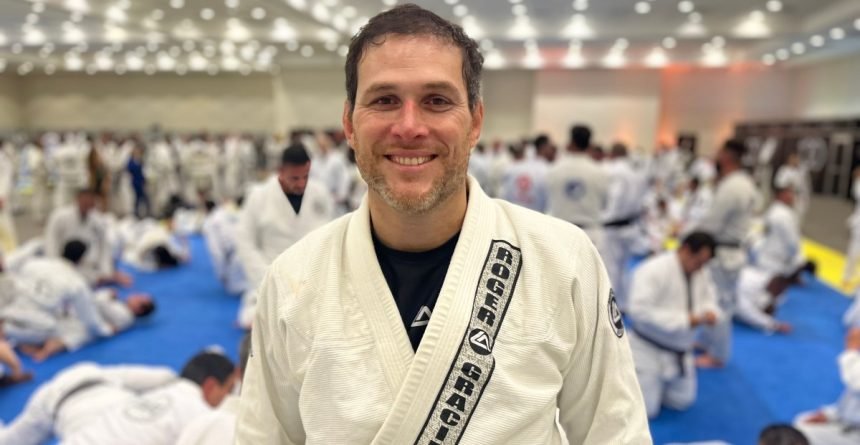
RIO DE JANEIRO — Roger Gracie is one of the best to ever do it when it comes to Brazilian jiu-jitsu and grappling — the No. 1 all-time, depending on who you ask. Just don’t ask him to engage in that debate.
The fact that Gracie stopped competing in 2010, doing only three superfights since, distances him from the young generation of grapplers and fans. His highlights are available online and he’s still treated as a living legend in seminars and appearances, but others shine in a time where clips and hot takes go viral and helps create the mystique around younger beasts like Gordon Ryan.
It’s like saying LeBron James is a GOAT when you weren’t around to watch Michael Jordan do his magic. Or maybe Tom Brady over Joe Montana, and Messi or Cristiano Ronaldo topping Pelé’s greatness.
Gracie dominated his division — and the absolute — between 2005 and 2010, winning 59 of 63 matches to claim two ADCC gold medals and a historic 10 IBJJF world championships, among other titles. He would most often compete in those two tournaments in an era where there weren’t many options for elite grapplers.
Nearly a decade removed from his last time on the mat, when he choked out a prime Marcus Buchecha in 2017, Gracie said he’s fine if some say other names when asked who’s the greatest grappler all-time.
“I built such a big name in jiu-jitsu that it’s hard to erase over time,” Gracie told MMA Fighting. “Of course, as time passes, the importance fades a bit, but I still feel there’s a lot of recognition for what I’ve achieved — and there always will be. I don’t have the illusion that as time passes the new generation won’t see champions from the past. But recognition isn’t what matters [to me], though. What matters is what we do.”
Gracie mentioned Mica Galvão, Tainan Dalpra, Mikey Musumeci, Diogo Reis and Nicholas Meregali as the ones who likes watching the most today.
Gordon Ryan often gets the recognition in GOAT debates given his dominance in grappling in recent years, running through competition between 2017 and 2024 — and winning more than 100 matches with only five defeats over the past nine years.
With an often heated argument when it’s time to crown Gracie or Ryan the GOAT — or the ones who preceded them in the early days of jiu-jitsu — Gracie doesn’t think the debate is fair.
“That’s normal, there will always be comparisons,” Gracie said of the praise around Ryan. “But you can’t compare generations. The only fair comparison would be if they competed against each other. Without that, it’s meaningless. I don’t even think it’s nice to compare. Every champion used the tools needed to overcome the challenges of their time. Everyone had their own journey, their own battles to win.”
Some argue Gracie could have gone on a longer reign had he not decided to transition to mixed martial arts in 2010, a route he chose to go to represent the family in Sengoku, Strikeforce, UFC and finally as ONE champion.
“In the early days, up until my generation or a bit earlier, no one made money with jiu-jitsu,” Gracie said. “There were no paid competitions, it was all amateur. Fighters had to go into MMA to make a living. But now, jiu-jitsu has grown so much that it’s actually easier to earn a living through it than through MMA.”
If jiu-jitsu and grappling paid big-money prizes like the ones we often see today, Gracie admits “I wouldn’t have made the transition to the rings and cages.“
“I was part of the last generation that felt the need to represent the family in the ring,” Gracie said. “That’s why I fought MMA, because I felt the need to represent the family in the ring just like the Gracies before me.”