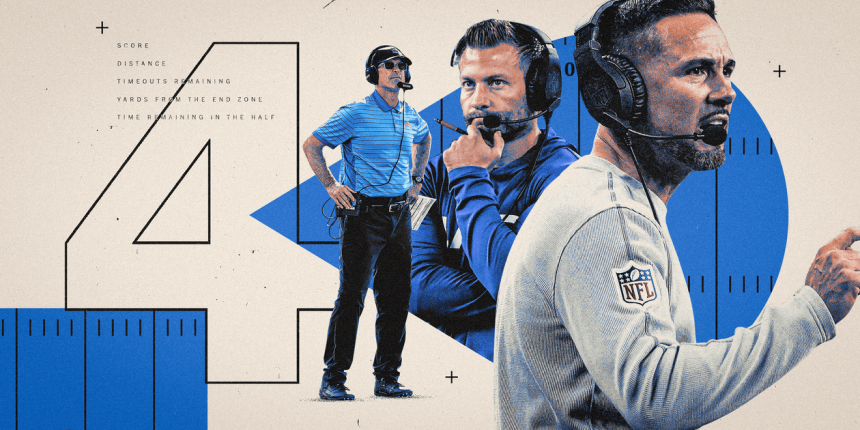
NFL coaches are getting more aggressive.
Ahead of the postseason last year, I conducted a study of how often coaches made the correct “go” decisions on fourth downs during the regular season. The study revealed that coaches made the right call 56 percent of the time. This year? That number spiked to 64 percent.
Bye, bye punts. So long, field goals. The era of conservative thinking and “taking the points” is over.
OK, fine. That might be overstating things a bit (especially for a few coaches, ahem, Jim Harbaugh). You’re still going to see punts and field goals during the postseason, but there is no doubt that some of the brightest minds in the sport are becoming more and more open to being aggressive and making smart decisions on fourth downs.
Speaking of the playoffs, I once again wanted to see which of the 14 coaches in the postseason is likely to give his team the biggest edge in some of the game’s biggest moments. To do that, I examined how each coach has performed in fourth-down situations this season.
For those who want a deeper understanding of my methodology, scroll down to the bottom of the story for a longer explanation. However, the gist is this: I’ve taken fourth-down data collected by rbsdm.com, which has a model that determines how often a team is expected to “go for it” and draws conclusions about how often the coach makes the “right” decision.
Before getting to the data, a few notes: First, no model is perfect. Teams throughout the league use different models, so some of those “toss-up” decisions the model deemed to be “wrong” might not be in their eyes. Second, these decisions are part of a small sample — an average of about 19 decisions per coach — so one or two can sway the percentages. And finally, there are situations where the model might suggest being aggressive, but no team or coach is likely to go for it, so I’ve filtered those situations out.
An example: Say a team is facing fourth-and-1 on its own 10-yard line in a tie game with 5 minutes left in the third quarter. The rbsdm model has that as a firm “go for it” situation, but few (if any) coaches would elect to keep their offense on the field there. So while that decision is seen as “wrong,” I won’t count it as such in my study.
Now, onto the data:
Takeaways
Let’s go LaFleur it
When I ran the analysis, I was shocked to find that LaFleur was leading the way among playoff coaches, because last year the Packers coach was firmly in the bottom half. In fact, LaFleur was 13 percent worse than the average playoff coach, making a correct decision just 40 percent of the time. This year, though, LaFleur has rocketed to the top and is now 18 percent better than the average playoff coach, making a correct decision 81 percent of the time. Without star pass rusher Micah Parsons for the playoffs, LaFleur will need to keep maximizing his chances of winning by keeping his offense on the field and not relying on a below-average defense.
Matt LaFleur: “I thought the only way you come into this place (and win), which is not an easy place to play, is you’ve got to be aggressive.”
What if the last fourth-down try failed?
“I’d rather go down swinging.” https://t.co/QHE35IWpKQ
— Matt Schneidman (@mattschneidman) November 28, 2025
Have you learned nothing?
Last year, Chargers coach Jim Harbaugh entered the playoffs as the coach least likely to make the right decision to go for it on fourth down, and he took that crown again this year.
Perhaps he can take comfort in knowing he isn’t the only coach stuck in outdated thinking. Fellow long-time coaches Mike Tomlin (Steelers) and Sean Payton (Broncos) each found themselves in the bottom four last year, and they find themselves there again this season. Before you go jumping to conclusions, this isn’t an age thing. At least not exclusively. Houston’s DeMeco Ryans, 41, ranks just behind Harbaugh as the coach least likely to make the right decision to go for it on fourth down.
All of these coaches are leaving points and, in some cases, wins on the field with their poor decision-making and would benefit from going by the book — or model — more often on fourth downs.
Didn’t think I’d see you here
Before conducting my analysis, I assumed Seahawks coach Mike Macdonald would find himself firmly on the positive side of this study. Boy, was I wrong. Macdonald’s decision-making hasn’t been terrible this year, and there are, of course, small sample issues here, but he found himself 5 percent worse than his peers during the regular season. Macdonald preaches finding “hidden edges,” so seeing him this far down the list is bewildering. Now, combined with the small sample size and the possibility that the Seahawks are using a different model for decision-making, perhaps Macdonald grades out better internally. Still, I think it’s safe to say this NFL Coach of the Year candidate has some room to grow.
Advantage, Patriots
In terms of fourth-down decision-making, there is one mismatch this weekend that stands out: Mike Vrabel’s Patriots versus Harbaugh’s Chargers. I already outlined Harbaugh’s poor decision-making, but it stands in stark contrast to his counterpart this weekend, who is one of the best. Vrabel ranks third among playoff coaches, as he made the right decision 15 percent more often than the average coach. If there is a big fourth-down decision to be made Sunday in Foxboro, I expect Vrabel to be on the right side of it. I can’t say the same for Harbaugh, and that might be enough to decide the game.
Methodology
The methodology for this is based on rbsdm.com’s fourth-down decision model. The model takes into account the strength of both teams, down, distance, yards from the end zone, time remaining in the half, score and timeouts remaining for both teams. The outputs of the model see what the odds are to win the game based on going for it, kicking a field goal or punting.
Like last year with exercise, I chose to only examine decisions made during the regular season that changed the win probability by at least one percent. Anything less than that felt like a coin flip, so I didn’t want to judge coaches on any decisions that didn’t seem to have a clear “right” decision.
Another parameter: I only included decisions that were made 55 yards from the end zone or closer — from a team’s own 45-yard line to the end zone. There are a lot of decisions that are deemed as a “Go” that may occur on your own 20-yard line, and I don’t think it’s reasonable to expect the majority of coaches to go for it that close to their own end zone. Perhaps that day will come, but it’s not here yet.
With those parameters in place, that left us with a small-ish sample size. So, these numbers should be taken with that in mind, though I do believe they’re directionally correct. It’s also important to note that each team is probably not using rbsdm’s model, though they are likely using one like it.