Sunday, Jan. 18, 2026 | 2 a.m.
Editor’s note: Este artículo está traducido al español.
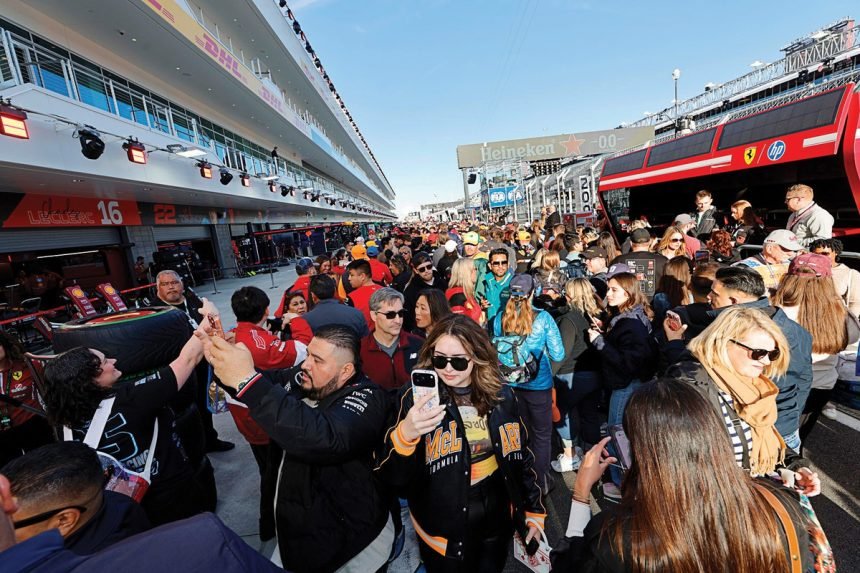
Hannah Stocking, a comedian with more than 68 million collective social media followers, wore a VIP pass to the Las Vegas Grand Prix in November.
Perched above the race’s starting line, she recorded the track for a post on TikTok. In it, she tapes her eyelids open to not miss a second of the action.
The moment she closes them, the postrace fireworks go off, and the top three finishers are spraying one another with champagne.
The post garnered about 361,000 likes, and 13,300 people saved it. “Do you ever run out of ideas?” one user replied.
“This is what they mean when they say don’t blink,” commented @Vegas, the TikTok account for the Las Vegas Convention and Visitors Authority.
But the post wasn’t organic. Stocking had a contract with the Las Vegas Convention and Visitors Authority to promote the race — one of a dozen influencers the agency enlisted for Formula One weekend. A Sun analysis found that two-thirds of those online personalities failed to clearly disclose their partnerships in at least one post, raising legal questions under Federal Trade Commission rules on influencer advertising.
“Influencers have a legal obligation to clearly and conspicuously disclose their material connection to the products or services, brands or companies they promote in their social media feeds,” said Laura Smith, legal director at nonprofit Truth in Advertising.
The Federal Trade Commission can fine advertisers and influencers up to $53,088 per post in violation ofthe law. But before those fines are issued, the commission often sends a warning letter notifying people and companies of their misconduct.
A material connection doesn’t necessarily mean cash exchanging hands. In the F1 influencers’ case, many were “just provided event access and travel,” according to Molly Castano, LVCVA vice president of public relations and communications.
The LVCVA has been working with influencers to promote the weekend since the Las Vegas Strip track’s first race, Castano wrote in an email. And the authority hosts creators regardless of whether they have a contract with the LVCVA or the event itself in the months before the race, she continued.
That work produced “outsized results” this year, Castano said: over 400 million impressions and “millions in estimated media value from minimal investment.”
Castano says the LVCVA mandates FTC disclosures, requesting that influencers use tags such as “#ad” or “#vegaspartner” on posts to ensure their audiences know about their partnership.
In practice, multiple influencers retroactively added those required disclosures weeks after the posts were made and only after the Sun contacted them. That included Stocking and TikToker Austin Sprinz.
But Castano said that posts required by their contract with the influencers had partnership disclosures, according to an LVCVA review. Any content outside of what was agreed upon is “the responsibility of the influencer to ensure compliance with applicable disclosures,” she said.
Smith said the disclosure requirement applied regardless of whether the post was part of a contract.
“As part of our regular, ongoing audit process with hosted influencers, we monitor contracted content for compliance and follow up as needed to request that missing disclosures or hashtags be added,” she said. “Compliance with these requirements is a factor we consider in future partnerships.”
However, the review the LVCVA provided the Sun showed multiple posts that were edited after the original was published. The Sun confirmed that a post from Zack Fairhurst, who has 642,000 Instagram followers, included in the report was changed to add the disclosure.
“It’s interesting that they would go back and do that, because I think a lawyer may have told them not to,” Matthew Mitchell, an economics professor at the University of Toronto who has studied online disclosures, said of the influencers’ edits. “It might generate liability as much as it avoids it.”
Mitchell emphasized that he isn’t a lawyer, and Smith also wasn’t positive how the FTC would view the edits. Their efforts may just get regulators “to move on to the next thing,” she said, but that depends on how much engagement happened before and after the change.
Mitchell noted that most social media posts tend to be “short-lived,” drawing the bulk of their engagement — likes, comments and views — within the first hours or days after publication.
The team behind Overtime Megan, an influencer who makes sports content and is included in the LVCVA’s list of contractors, told the Sun that the social media star had worked with the Las Vegas Grand Prix.
Ryan Orozco, head of digital media talent on Overtime Megan’s management firm, wrote in an email they had complied with FTC-required disclosures under that agreement. The post the Sun highlighted was “organic,” with the social media star receiving no compensation, he said.
“Out of an abundance of caution and in the interest of transparency, we’re happy to update the post with disclosure language reflecting her broader relationship with the appropriate parties or simply remove the content altogether,” Orozco wrote in an email.
Other influencers who worked with the LVCVA did not respond to the Sun’s request for comment.
The FTC has long acknowledged that online personalities are subject to the same rules for truth in advertising as traditional media.
In 2017, the FTC approved a settlement with online gaming creators who promoted a gambling website without disclosing to their fans that they owned it. And in 2023, the FTC warned trade associations over their influencers not disclosing their business relationship.
Despite those obligations, the lack of disclosure from the influencers the LVCVA worked with is the norm for the industry. Researchers based in the United Kingdom found that 95% of analyzed sponsored influencer posts made on X, then known as Twitter, were undisclosed. Smith couldn’t pin down an exact number of unmarked posts, but said the issue was “widespread.”
Influencers also have reason to skirt the rules. Mitchell, in research he published in 2020, found posts that disclosed they were advertisements had about half the engagement of undisclosed posts.
“All the parties have an obligation to follow the rules,” Smith said. “Historically, the FTC used to pursue the brands only in these kinds of cases, but more recently, in some of its more recent actions, it’s included influencers.”