The 2026 offseason has been thoroughly brutal to awful and impressive coaches alike. Both Mike Tomlin and Brian Callahan ended up unemployed this winter, despite a difference of 197 NFL wins between them. 10 teams wound up losing their coaches between the start and finish of the season, charging up a coaching carousel that was light on big names back in December.
That leaves us with a lot of work to do as new coach announcements are weaved into the backdrop of the still-ongoing NFL Playoffs.
Grading NFL coaching hires in their immediate aftermath is a fool’s errand. I once thought Matt Patricia would work out as Detroit Lions head coach (and fail as Ohio State defensive coordinator. Two absolute garbage predictions). But the offseason is hurtling toward us. Let’s talk about the new head coaches, how they’ll shape their new teams and which team did the best, at least in a snap judgment kind of way.
Previous job(s): Head coach of the New York Jets (2021-2024), defensive coordinator of the San Francisco 49ers (2017-2020, 2025)
On one hand, Saleh’s inability to make the Jets’ quarterbacks viable is a concern. On the other, his hand-groomed franchise cornerstone was Zach Wilson, which leaves him in prime position for a do-ever.
Indeed, Saleh made good on his promise to make the New York defense the best it could be. After a slow start he had the Jets ranked fourth, then third in points allowed in his second and third seasons at the helm. New York ranked sixth in expected points added (EPA) per play through the first five games of 2024 with Saleh at head coach. After firing him, that dropped to 30th. Rarely do you get as blatant an illustration of a coach’s influence but, well, here we are.
That’s wonderful news for Jeffery Simmons, T’Vondre Sweat and L’Jarius Sneed (who badly needs a re-do of his own since landing in Nashville). The question is if Saleh can put Cam Ward in position to succeed one season after being the top pick in the NFL Draft. The lauded quarterback had his moments but largely struggled in an offense where his top targets were Elic Ayomanor, Chigoziem Okonkwo and Chimere Dike. Support is badly needed, and a top five draft pick and a league-best $93 million in estimated cap space can provide it.
The Titans are betting on a Mike Vrabel-style revival with a retread head coach, second-year quarterback who’s shown flashes, impressive draft position and a boatload of salary cap space at their disposal. Saleh can come through on the defensive side of the ball. Getting the offense up to speed is going to take a lot of work from a head coach who hasn’t fulfilled that end of the bargain yet. Tennessee’s assistant hires and offseason personnel additions will define how this turns out, but it’s a sensible move from a franchise in need of a stable floor.
Grade: B+
Previous job(s): Defensive coordinator of the Green Bay Packers (2024-2025), head coach of the Boston College Eagles (2020-2023)
Well, the Dolphins didn’t wait around for their top choice to get sniped, assuming they weren’t in on Kevin Stefanski or John Harbaugh. Still, Miami leapt at the chance to hire 2026’s first non-retread head coach after landing on Hafley.
It’s a curious choice and a stark departure from the offensive-minded Mike McDaniel. Hafley spent the last two seasons building a respectable Green Bay defense, but his success has been fleeting. The Packers ranked only 16th in the NFL when it came to expected points added (EPA) allowed with Micah Parsons on the field. After losing him in Week 15, that number crashed to 26th and Green Bay finished the year on a five-game skid.
The Dolphins don’t have the raw defensive talent the Packers did. They may also wind up eating a record $99 million in dead salary cap space to separate themselves from Tua Tagovailoa, which will limit their room to improve in the immediate future. Hafley will have to prove himself a builder — something he did to modest success in four seasons at Boston College (22-26 with three bowl eligible campaigns). His blitz-averse defenses make sense given Miami’s lack of stars in the secondary, and hitting on the right quarterback in the draft could spur a Denver Broncos-esque turnaround.
But Hafley’s resume has a fraction of Sean Payton’s success. The 2026 NFL Draft doesn’t seem to have a Bo Nix waiting for the Dolphins at the 11th overall pick. This is a big risk — and one Miami jumped into with both feet.
Grade: C-
Atlanta Falcons: Kevin Stefanski
Previous job(s): Head coach of the Cleveland Browns (2020-2025), offensive coordinator of the Minnesota Vikings (2019)
Stefanski’s ability to turn chicken crap into chicken salad made him a two-time Associated Press Coach of the Year in six seasons with the Browns. He turned Baker Mayfield into a playoff winner. He managed to be the first head coach in modern Browns existence to earn multiple playoff invites, the second coming despite trading away three first round picks and handing over $230 million guaranteed for Deshaun Watson, the league’s 38th-best quarterback on the field and a man who faced more than 20 accusations of sexual misconduct and what the NFL described as “predatory behavior” off it.
Also, that second playoff berth? That came after signing a 38-year-old Joe Flacco off the street in November.
Stefanski has proven he can create sums larger than the total of their parts. The concern is we don’t know what that looks like on a roster loaded with offensive talent because, well, he spent six seasons with the Browns.
Indeed, Atlanta will flank him with a shaky quarterback situation between a recovering Michael Penix Jr. and a potentially-released-for-cap-space Kirk Cousins. But he’ll get to turn to Bijan Robinson, Drake London and maaaaybe a re-signed Kyle Pitts to do so. Riding one or two above average skill players has worked in his past (Nick Chubb and Kareem Hunt in 2020, Amari Cooper and David Njoku in 2023). The Falcons can offer him more than he ever had in Cleveland, albeit with a lesser defense.
There are concerns about Stefanski. His uncertain role in the franchise’s decision to add Watson casts a minor shadow over his leadership. But his resume suggests he can go from zero to 60 with elite acceleration before franchise-imposed restrictor plates kick in. Now Atlanta has to make sure he has the personnel he needs to succeed.
Grade: A
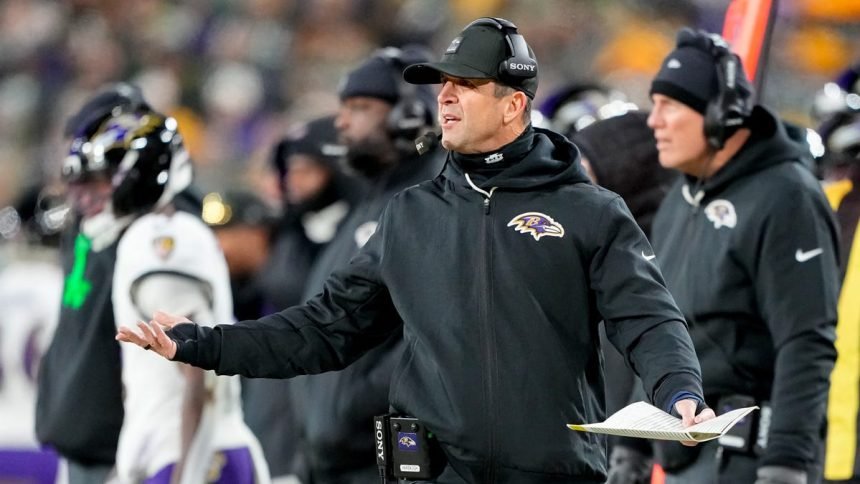
Previous job(s): Head coach of the Baltimore Ravens (2008-2025), special teams coordinator of the Philadelphia Eagles (1998-2006)
After trying and failing to pluck a rising star from the assistant coaching ranks, the Giants landed a championship head coach with extensive experience leading a franchise. An old-school throwback worked when it was Tom Coughlin running the show in New York. Now the Giants are betting Harbaugh can be pick up that mantle — and not be the Jacksonville Jaguars version of Coughlin, who was squarely behind the times and unable to fix a broken franchise.
Harbaugh’s ousting in Baltimore came on the back of continued postseason failures. He was just 4-7 in the playoffs after winning Super Bowl 47 despite rostering two-time regular season MVP Lamar Jackson the last eight years. That’s a bridge New York can cross once it gets there, as the franchise has had a single winning season since 2016. Establishing a baseline of success, even if that’s just being a nuisance in the NFC East and invitations to the Wild Card round, should give him a long enough leash to build a roster in his image and attempt to make the Giants a northern extension of the Ravens’ hard-hitting style.
There are already some pieces in place for that. Jaxson Dart is a mobile, injury-adjacent quarterback who isn’t close to Jackson’s level but should be able to incorporate pieces of his offense. Malik Nabers, Cam Skattebo, Theo Johnson and Andrew Thomas all look like young(ish) building blocks. Most importantly, the man who guided eight different Baltimore defenses who finished in the top three when it came to points allowed inherits a unit loaded with talent (Abdul Carter, Brian Burns, Jevon Holland) that needs a cohesive force to make it more than the sum of its parts.
Grade: A-