A plan to build a tower in Central City is still in the works, but the Salt Lake City Council made it clear there’s more work that needs to be done on the project before it could move to a vote.
Members of the council got their first public briefing for a proposal that would replace a three-story office building with a mixed-use tower in Central City and effectively move Downtown’s heights further east.
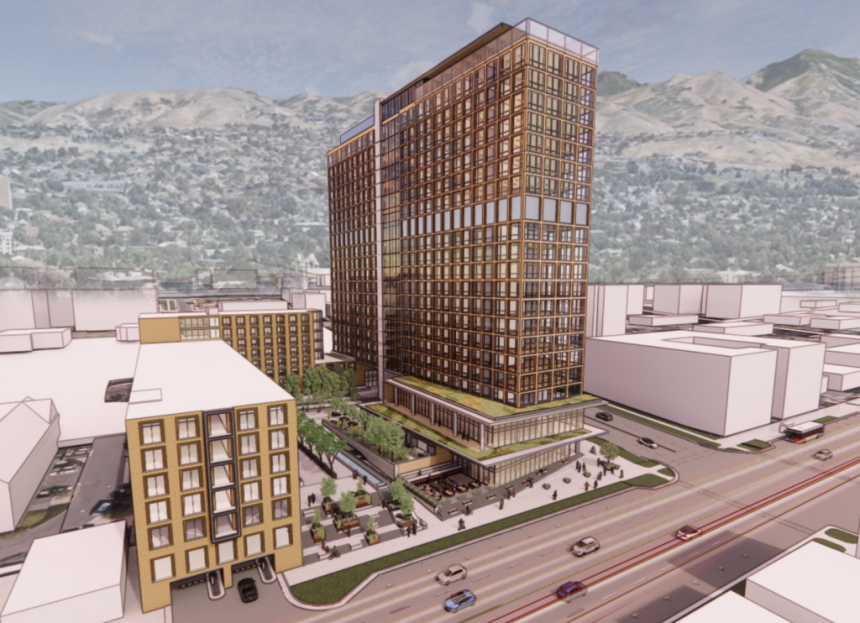
If approved, the proposal would rezone an office building at 265 E. 100 South from MU-8 to Central Business District (D-1). At MU-8, the site’s maximum height would be 90 feet, and if the D-1 rezone is approved by the city council, the maximum height would stretch up to 225 feet.
Typically buildings with D-1 zoning don’t have a height limit (there is a design review required for buildings over 200 feet), but city planning staff has recommended the 225-foot cap for this site and the Salt Lake City Planning Commission included the height limit in its approval back in October. During that planning commission meeting, commissioners voted 7-1 to forward a positive recommendation of the proposal to the council.
If the rezone is ultimately approved by the city council, the 2.19-acre site would be redeveloped into a 420-unit residential tower that would include around 24,000 square feet of commercial and amenity space on the first two floors. Parking for the tower would be underground. The parcel is currently owned by Raven One, LLC, which is a subsidiary of Cummings Capital Management (CCM). Silverado Development is the company that would develop the tower.
John Anderson, a planning manager for Salt Lake City, outlined the current proposal to council members Tuesday. He said 20% of residential units would be restricted to those who earn 80% AMI or below, and at least 8% of units would be family-sized units of three or more bedrooms.
He explained that planning staff felt this site needed a cap on its height because, “this is on the edge of the Central Business District, it really is morphing from high, intense uses to a little bit less in the MU-8 (zone).”
Council members seemed generally supportive of a taller building at that site, but also questioned why the building needed the D-1 zoning instead of another zone like MU-11, which allows heights of up to 125 feet through a design review. Another issue discussed Tuesday was regarding St. Mark’s Cathedral, a historic Episcopal church next door to the parcel.
Council Member Eva Lopez Chavez, who represents much of the Central City neighborhood, said the church began putting in solar panels in 2021, and the current tower plans would likely block those panels from seeing sunlight. David Hunter of Silverado Management said there’s no plan in place currently, but he would plan to work with the church to find a solution.
That answer didn’t seem to suffice, as Lopez Chavez said the church uses the solar panels as around 53% of their electrical supply. She added, “I don’t love your answer, in the sense of you don’t have a solution in place. I’d love to better understand how we do that.”
Hunter later said a big reason why they’ve requested the D-1 zone is to maximize the number of units that the parcel could hold, citing the state’s ongoing shortage of housing units. He said building a structure within the MU-8 parameters would likely block the church’s solar panels anyway, and he said if that’s the case, “then why wouldn’t we try to solve the bigger problem and add more affordable housing in Downtown Salt Lake?”
Image via Method Studio and Raven One, LLC
Multiple council members asked about the MU-11 zone and if those parameters could be used for the parcel, though planning documents and presentation materials didn’t include alternatives to the D-1 rezone proposal.
During a back-and-forth with Council Member Victoria Petro, Hunter said, “that all things will be contemplated and delivered in a development agreement before anything is approved.” He added that the Cummings family is ingrained in Downtown and is committed to improving the city and building more affordable housing.
“I’d love to hear more information about the possibility of what could be done under MU-11, just for due diligence purposes,” Petro said. “And while I’m so thankful for those big families who continue to build, the counterbalance to that is our neighbors who are feeling disenfranchised every day and need to be equally represented in this.”
Council Member Alejandro Puy, recently elected to be council chair for 2026, said Salt Lake City has led the way statewide in terms of density and recent zoning code changes underscore that point. However, it’s the council’s job to ask tough questions and find the best solution for the community.
“I think that we’re in the right process, if we are willing to sit down and work through this issue,” Puy said. “Ultimately, this council, this city, has been in the forefront of heights, on the forefront of density. So knowing that has been the reputation so far, I feel like that gives you a good direction of where to go. But ultimately, we are concerned about what the community is saying around your project.”
No vote was taken during the Tuesday meeting. The council will be accepting public comments on the project during their meeting on Feb. 3. If the council does approve the rezone, the council and developers would need to work out a development agreement prior to beginning building.
Image via Method Studio and Raven One, LLC