Education plays a central role in shaping economic opportunity, civic engagement, and the long-term health of a democratic society. As colleges and universities continue to evolve, understanding public attitudes toward higher education is essential. This Spotlight Analysis examines Americans’ views on the value of higher education, the role of government, and the future of academic institutions.
Most Americans Say College Is a Smart Investment
PRRI’s 2025 American Values Survey finds that seven in ten Americans agree that a college education is a smart investment (70%), compared with 27% who disagree. Although partisans differ, solid majorities agree: 86% of Democrats, 71% of independents, and 65% of Republicans.
There is widespread agreement on the importance of a college education across religious traditions as well, with higher agreement among Hispanic Catholics (87%), Jewish Americans (86%), and Latter-day Saints (82%), while religiously unaffiliated Americans (66%) and white evangelical Protestants (65%) agree less.
Views of a college education as a smart investment are also high across racial groups, with AAPI (85%) and Hispanic Americans (77%) expressing the strongest agreement, followed by white (67%), Black (66%), and multiracial Americans (63%).
While views of a college education as an investment do not differ by gender or age, they differ by educational attainment: 80% of Americans with a college degree say education is a smart investment, compared with 64% of those without a college degree.
From 2016 to 2024, PRRI asked variations of the question of whether a college education is a smart investment or a gamble. Throughout this eight-year period, Americans have become less likely to say that a college education is a smart investment, although recent years show a modest recovery. In 2016, a slight majority of Americans agreed with this view (55%), but support declined consistently to 42% by 2022. Since then, this view has gone up, reaching 48% in early 2023 and 47% in 2024.
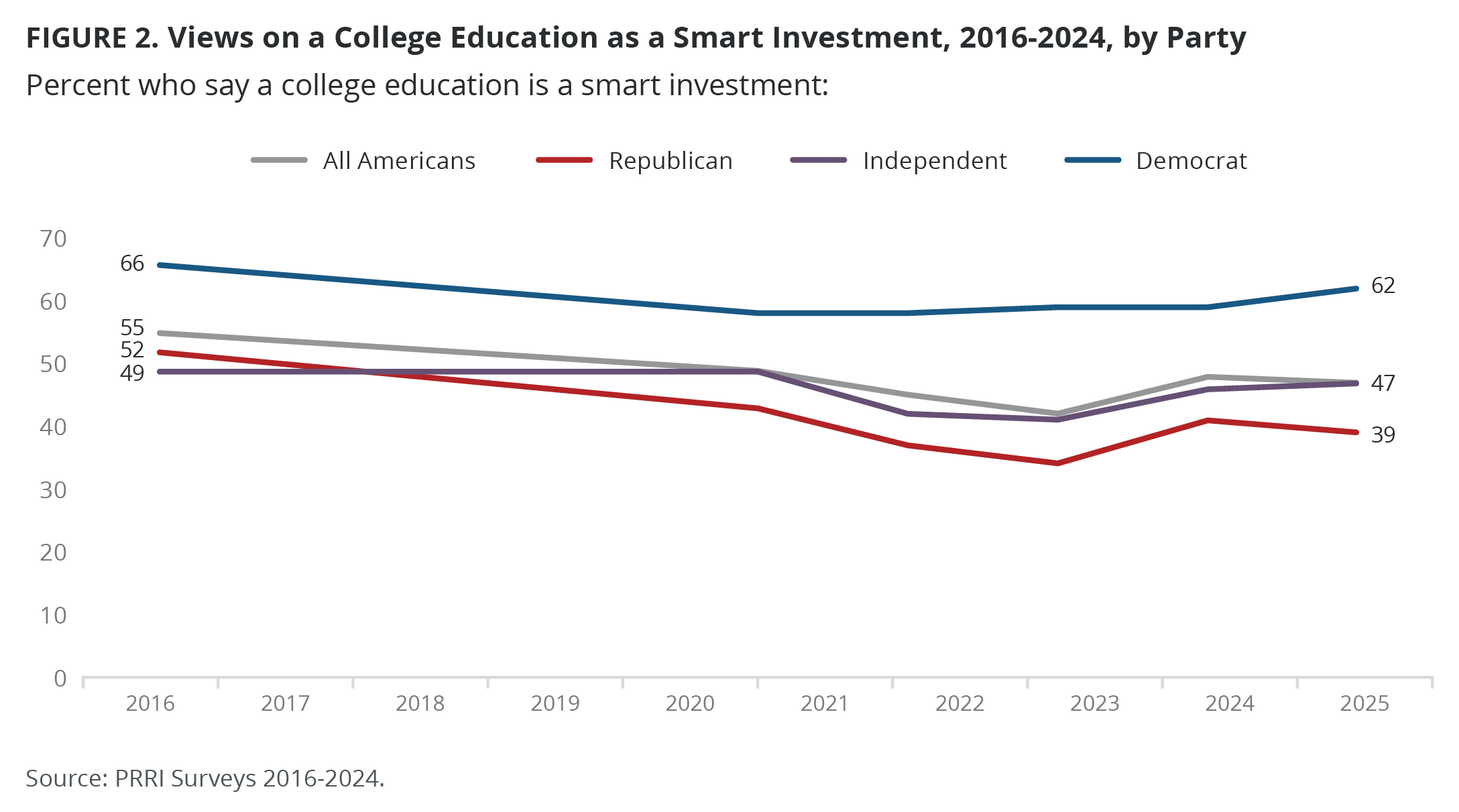
Partisan differences are notable: Democrats have consistently viewed a college education as a smart investment, with a brief decline from 66% in 2016 to a low of 55% in 2023 before returning to 62% in 2024. Among independents, this view declined from 49% in both 2016 and 2020 to 37% in 2023, before returning to 47% in 2024. Republicans have consistently been the least likely to view education as a smart investment, dropping from 52% in 2016 to 34% in 2022, and increasing to 39% in 2024.
PRRI’s 2025 American Values Survey also shows that most Americans (57%) have a great deal or some confidence in colleges and universities.
The Role of the Federal Government in Higher Education
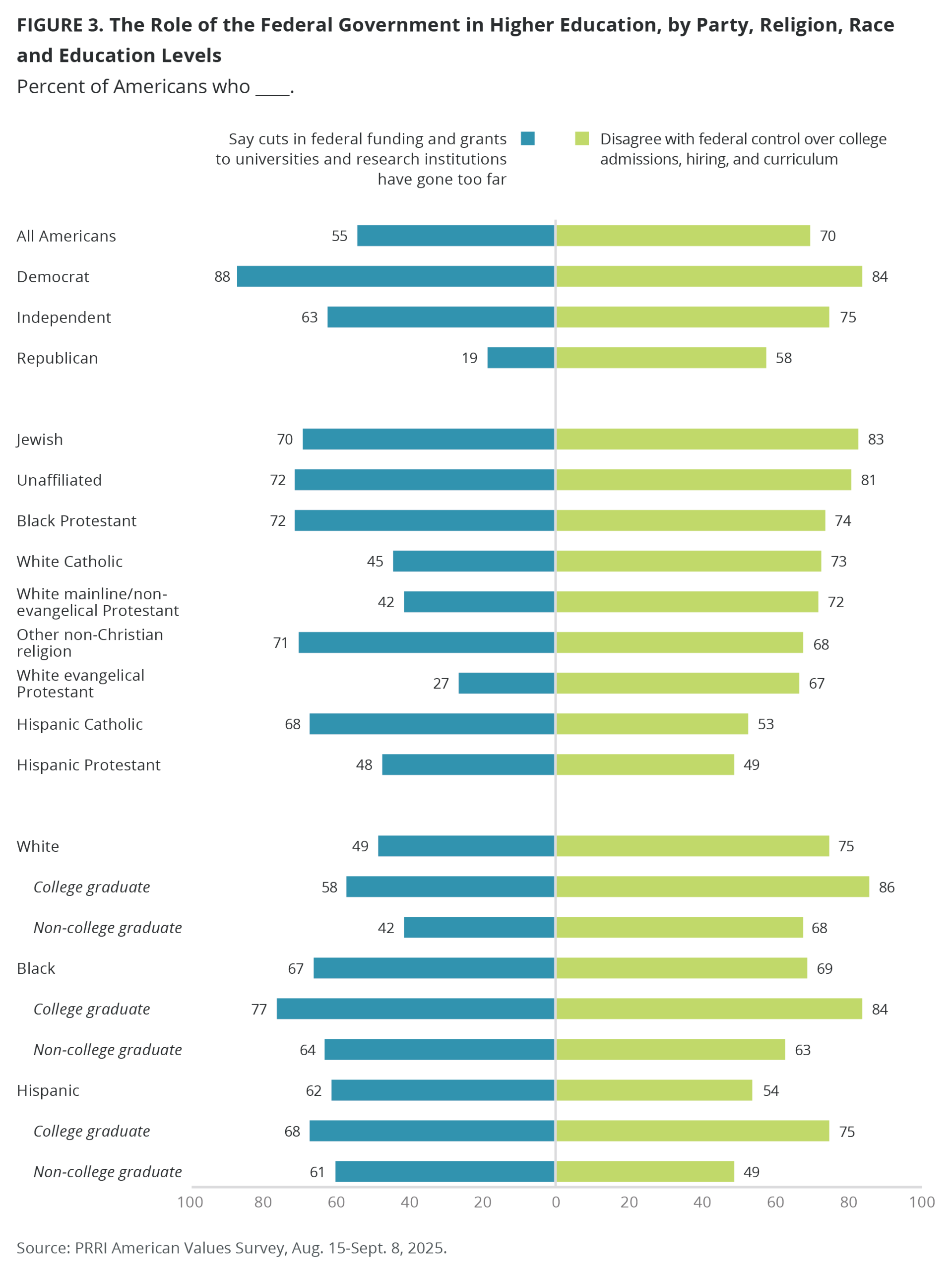
Most Americans Say Cuts in Federal Funding and Grants to Universities and Research Institutions Have Gone Too Far
A majority of Americans (55%) believe that cuts in federal funding and grants to universities and research institutions have gone too far, but there are substantial differences by party affiliation. Nearly nine in ten Democrats (88%) agree that cuts in funding have gone too far, compared with around six in ten independents (63%) and just 19% of Republicans.
These views also vary across religious groups. Most Jewish Americans (70%), other non-Christians (71%), unaffiliated Americans (72%), Black Protestants (72%), and Hispanic Catholics (68%) say cuts in federal funding and grants to universities have gone too far, while white evangelical Protestants (27%) are the least likely to share this view.
Similarly, white Americans (49%) are the least likely to believe that cuts in federal funding to universities and research institutions have gone too far, compared with majorities of AAPI (72%), Black (67%), and Hispanic Americans (62%). Americans with a college degree (62%) are also more likely than those without a college degree (50%) to believe these cuts have gone too far.
When it comes to funding cuts, women (57%) are more likely than men (52%) to say that cuts in federal funding to higher education and research have gone too far, as are younger Americans ages 18-29 (57%), compared with Americans 65 and over (50%), though they do not differ from Americans ages 50-64 (54%) or Americans ages 30-49 (57%).
Americans who have some or a great deal of confidence in colleges and universities are twice as likely as those who do not have confidence in colleges and universities to say that these cuts have gone too far (70% vs. 34%).
Most Americans Disagree with the Federal Control Over College Admissions, Hiring, and Curriculum
When it comes to the role of government in higher education, most Americans (70%) disagree that “the federal government should have the authority to control student admissions, faculty hiring, and curriculum in U.S. colleges and universities to ensure they do not teach inappropriate material,” compared with 26% who agree. However, partisan differences are significant: Republicans (58%) are significantly less likely to disagree, compared with most independents (75%) and Democrats (84%).
These views also vary by religious traditions. Jewish Americans (83%) and unaffiliated Americans (81%) show the strongest disagreement. By contrast, Hispanic Protestants (49%) and Hispanic Catholics (53%) show the least disagreement.
While disagreement with federal control over college admissions does not differ by gender or age, it does by race and education. Hispanic Americans (54%) are notably less likely than Black (69%) and white Americans (75%) to disagree with the federal control of higher education. In fact, Hispanic Americans without a college education are significantly less likely than those with a college education to share this view (49% vs. 75%). More broadly, Americans without a college degree (63%) are 20 percentage points less likely than those with a college degree (83%) to disagree that the federal government should control admissions, hiring, and curriculum.
Americans who have some or a great deal of confidence in colleges and universities are more likely than those who do not have confidence in colleges and universities to disagree that the federal government should have the authority to control student admissions, faculty hiring, and curriculum (76% vs. 64%).