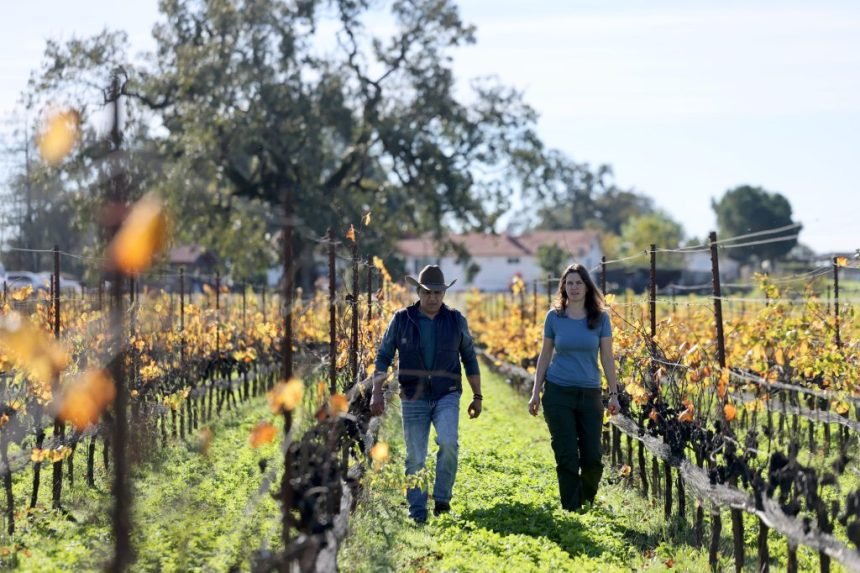
Jaime Rojas was 44 the first time he tasted wine made from grapes he grew himself.
The wine — a Pinot Noir 2016 — came from Bravo Toro, the small vineyard at his home in Santa Rosa. Nearly 30 years had passed since he first stepped into Napa Valley vineyards as a teenager, pruning and grafting for wineries that would bottle the fruit he helped grow — wines he never had the chance to enjoy.
“I was always fascinated by the processes of grafting and growing grapes,” Rojas said. “I wanted to know how the variety I cultivated tasted but I never got to experience it.”
Today, Rojas, 52, and his wife Jana Rojas, 40, run a vineyard management company serving Sonoma, Napa and Oregon. They also produce their own wines a small label featuring Russian River Valley varietals, grown and crafted on the land he once only dreamed of owning.
His path remains rare in Wine Country, where Latino workers make up much of the vineyard workforce but few winery owners.
The Mexican American Vintners Association, counts just 18 Latino-owned wineries in Napa and Sonoma counties. Combined, the two counties have more than 800 physical wineries, according to local tourism data.
“There are several Latino-owned wineries now,” Rojas said. “We work the land, we understand the product, so when you have the opportunity to make your own you take it.”
Jana said she believes that shift will continue — even slowly.
“It was bound to happen,” she said. “Vineyards in Wine Country are worked by Latinos. Little by little they will carve out a place for themselves in the industry.”
Dylan Sheldon, co-owner of Inspiration Vineyards, the winery that provides custom crushing services for the Rojases, said wineries coming from field work still face barriers.
“We can do better with diversity,” Sheldon said. “There is a lack of representation of Latino (wineries) in the California, Oregon and Washington’s wine industries.”
Rojas’ wines have already earned recognition with over 30 awards in nearly a decade. His 2022 Cabernet Sauvignon, Pavel, received Best in Class at this year’s Sonoma County Harvest Fair, beating out more than 100 entries.
Still, awards haven’t solved the hardest part: selling wine.
He said the local wine market is already well-established, and added that visibility matters more to producers than awards. This year, he said, has been especially challenging due to slowing demand.
“It’s a single market where we all need each other — Latinos or not,” he said.
From a motorcycle dream to a life in Wine Country
Rojas arrived in Napa Valley in 1989, following a path his father, Antonio, had started more than a decade earlier. Marco emigrated from Oaxaca in the 1970s to work vineyard jobs and later gained legal residency through the Immigration Reform and Control Act of 1986, which granted amnesty to agricultural workers. The program would eventually allow him to bring the rest of the family from Santo Domingo Tonalá to Napa — another son, two daughters and his wife. Rojas’ older brother, Marco Antonio, was already in St. Helena, and the three initially shared a house with other farmworkers.
Their experience reflected a broader shift. An estimated 3 million people — primarily Hispanic agricultural and service workers — gained legal status through the act during that decade, according to the Library of Congress.
Rojas didn’t plan to stay long. The goal was simple: save enough money to buy a motorcycle and return to Mexico for school. A year later, Marco Antonio was killed in a car crash along Silverado Trail.
“My dad was going to be alone,” he said. “I stayed and worked with him.”
Rojas eventually bought the motorcycle he’d planned for — but he didn’t return to Mexico. Instead, he spent the next decade working the same vineyards, developing a deeper appreciation for grape cultivation and soil management.
“My mindset was different,” he said. “I enjoyed working in the fields, but I needed to improve my skills and make progress in life.”
Much of his training came from his late father and from the late Ulises Valdez, the respected vineyardist behind Valdez Family Winery, who taught him grafting and more advanced viticulture techniques.
-
Jaime Rojas at 17 years old, working at the grapevine rootstock nursery of Emmolo Winery in St. Helena in 1990.


1 of 3
Jaime Rojas at 17 years old, working at the grapevine rootstock nursery of Emmolo Winery in St. Helena in 1990.
By 2000, Rojas had earned his farm labor contractor license and launched Napa Second Generation, his vineyard management company. The business grew steadily, taking on clients across Napa and Sonoma counties and specializing in building vineyards from raw land through first harvest.
“I began specializing,” he said. “Creating vineyards from start to finish.”
Rojas sees the wine business as a thought-driven industry where field decisions and timing matter. Learning how to manage long days and fatigue, he said, is just part of the work.
“What was the phrase your dad used to tell you when you were out in the vineyards?” Jana asked Rojas.
“If you cut off your finger,” he answered, “leave it there and keep working.”
A turning point — and a new label
Rojas said the turning point came during a grape sale.
He had a buyer lined up to purchase fruit at $5,000 a ton, but at the last minute, the offer dropped to $3,000.
“I thought it was a joke,” he said.
When he declined, the buyer questioned what he would do with the grapes — since Rojas didn’t produce wine.
Rojas said that moment pushed him toward launching his own label. He contacted Sheldon, a winemaker who crushes grapes for others, asking him for one thing: “Help me make me the best wine you can.”
The first vintage — the 2016 pinot noir — earned a gold medal at the Orange County Wine Competition and a bronze at the San Francisco International Wine Competition.
Sheldon, 52, considers the fruit from Bravo Toro some of the best Pinot Noir he has worked with in 25 years.
“I helped the Rojas family to start their label,” he said. “To understand what their vision was.”

Cultivating a family
Rojas and Jana met through a Spanish-language internet chatroom 25 years ago. Jana, then living in the small Czech village of Skalná, had been teaching herself Spanish and joined the chat to practice.
“Jaime was in a Spanish chat room,” she said. “He was the only one willing to talk to me because I had a lot of trouble responding.”
After two years of long-distance communication, she moved to Napa in 2003. They now have three daughters — Emily, Nathalie and Anna — who grew up among the vineyards.
In 2009, the family moved to Santa Rosa and bought a home that came with an 8-acre property — land that would become Bravo Toro Vineyards.
Nathalie, now 17, remembers when the vineyard site was nothing more than open ground.
“This place was just a field,” she said. “Now, you can see how much the business has grown. I’m very proud of my parents.”
She’s already begun learning the work firsthand. Still in high school, Nathalie is taking an agricultural class at Santa Rosa Junior College as her interest in farming develops.
Jana said she hopes her daughters will continue the business one day. Sheldon said if they do, it could become a lasting family legacy.
Agustín Durán, a vineyard supervisor who has worked with Rojas for more than 20 years and grew up in the same town in Oaxaca, said tasting the wine they farm feels meaningful.
“It always feels very nice,” he said. “It comes from the grapes we have cultivated with our own effort.”
Looking ahead in a shifting industry
The Rojas family now produces about 400 cases a year — a micro-winery model driven by limited acreage and handcrafted production.
But this year, he said, demand slowed sharply. Restaurants are leaning toward lower-cost imports from South America, some local growers have unsold fruit and vineyard management hiring stalled.
Industry analysts echo his concern. Nearly half a million tons of grapes may go uncrushed statewide this year, according to Jeff Bitter, president of Allied Grape Growers in Healdsburg. He predicted that 2025 could be California’s smallest crush in 30 years.
Still, Rojas remains committed.
He now leases two vineyards in Dry Creek Valley to expand varieties, including Zinfandel, Cabernet Sauvignon, Cabernet Franc, Sangiovese and Sagrantino. The bull on his label is a nod to his address and the jaripeos, Mexican rodeo-style events he enjoys.
For him, the work remains simple — and deeply personal.
It’s about being able “to enjoy a glass of wine from a bottle that comes from your work,” he said, “and your crops.”