State officials and Hartsfield-Jackson Atlanta International Airport are facing criticism for a lack of information following a Friday jet fuel spill that contaminated the Flint River, which provides drinking water to 400,000 people south of Atlanta and in central Georgia.
Cleanup continues, authorities said, but neither the Georgia Environmental Protection Division nor the airport has released information on the volume or duration of the leak that led Gov. Brian Kemp to declare a state of emergency Friday. The silence has drawn criticism from environmentalists and residents in nearby Griffin who report that tap water still smells of fuel despite local officials reporting the water is safe to drink.
“Information is not very forthcoming from the airport. That’s disappointing,” said Flint Riverkeeper Gordon Rogers. “We don’t know the duration of the spill. We don’t know the volume of the spill. We’re just left to speculate.”
GET THE MORNING HEADLINES.
The spill occurred Friday when a “sight valve that had failed” led to “jet fuel releasing into the storm water system that got into the Flint River,” EPD Director Jeff Cown said to a House legislative committee Monday. Cown, responding to Musella Republican Rep. Robert Dickey’s question about whether the airport had any compliance issues, downplayed the concern, saying the state would simply discuss “better secondary containment in the future” with airport officials.
But days after the spill, Griffin residents’ complaints about odor from the water continue. Jayme Aldridge, a Griffin resident and father of two, including a newborn, described a Sunday shower in which the water felt oily and caused itching afterward.
“You could smell it as soon as you walked in the bathroom. It’s like a kerosene type smell, some type of fuel,” Aldridge said.
To keep his 2-year-old daughter and newborn safe, he has since turned off the city water to his house.
“I shut off all the water to the house, because my daughter likes to brush her teeth all the time, so she kept trying to go to the sink. So I told her to stop that and shut the water off,” he said, adding that they started using bottled water instead, and that is costly.
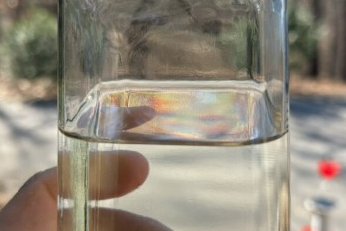
Aldridge said he had the instinct to conduct a home test by letting tap water sit in a jar overnight, and in the morning, he described a thin layer of separation on top with “a rainbow slick on it.”
Fuel odors have been reported up to 40 miles downstream, Rogers said, and if true, “that would mean that a lot of fuel was spilled to be smelling it that far downstream.”
EPD spokesperson Sarah Lips said Monday that an investigation on the cause of the spill is ongoing, but provided no timeline. Alnissa Ruiz-Craig, the airport’s interim director of communications, said in an email Monday that “we do not have an update at this time.”
Rogers called the spill part of a decades-long pattern.
“This kind of thing has been going on for a very long time,” Rogers said. “We’re sort of done with the friendly approach.”
YOU MAKE OUR WORK POSSIBLE.