The Atlanta Opera broke ground Monday afternoon on the Molly Blank Center for Opera and the Arts at the historic Bobby Jones Golf Course Clubhouse along Woodward Way in Buckhead.
The project celebrates Atlanta’s history with the renovation of the Bobby Jones Clubhouse, designed in a neoclassical style, which opened in 1941.
On the back of the historic building, Atlanta architects Allen Post and Chris Loyal’s titular firm Post Loyal has designed a dramatic, forward-looking building overlooking the Bobby Jones Golf Course and the Atlanta NW Beltline Connector Trail.
The new facility will feature Rosemary Hall, a 200-seat recital hall on one wing and the Atlanta Opera Coca-Cola Theatre, a 6,000 square foot, flexible rehearsal space that can host chamber opera performances, cabarets and multimedia productions.

Tomer Zvulun, the Atlanta Opera’s general director and artistic director (a position named after W. Knobloch, Jr.), credited a board member who did not want to be identified for suggesting the Opera look into preserving the Bobby Jones Clubhouse and moving its headquarters to the historic building.
“There’s a whole history of it belonging to the community,” Zvulun said, adding that the building is an important part of Atlanta history. It was listed by the Georgia Trust for Historic Preservation as one of its 2016 Places in Peril.
“One of the reasons we are so inspired by this space is nature connecting with art,” said Zvulun, describing it as “biofelia,” which comes from the Greek word for the human instinct to connect with nature with other living beings. “It’s a love of nature and how it’s connected to art.”
The new headquarters for the Atlanta Opera, which will open in the fall of 2027, is symbolic of the spirit Zvulun has brought to Atlanta since moving here in 2013.
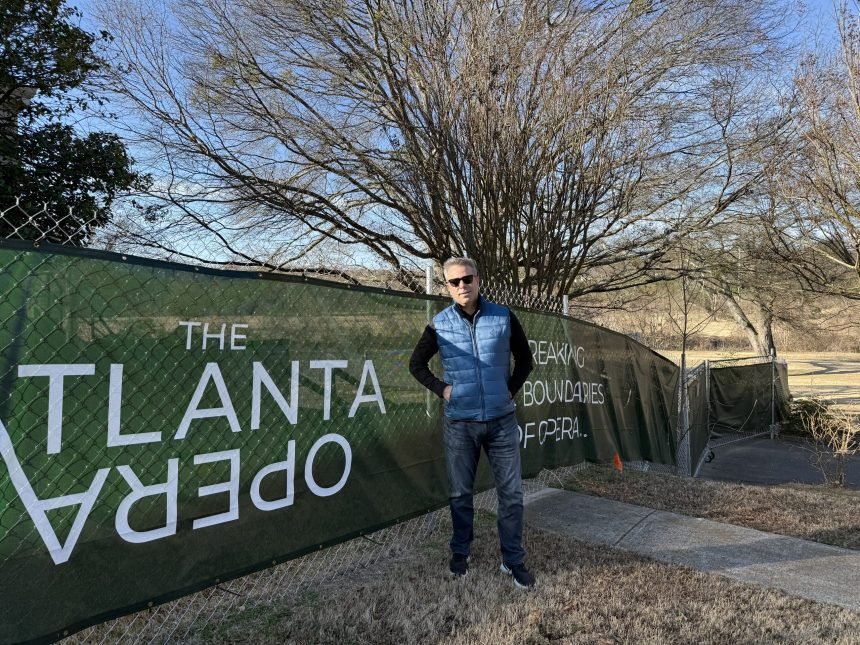
The logo of the Atlanta Opera says it all. The word “Opera” is upside down. And the tagline is “Breaking the Boundaries of Opera,” a phrase that describes Zvulun’s leadership and the new home for the Atlanta Opera.
“Opera is an interdisciplinary art form,” Zvulun said while giving a tour of the historic Clubhouse three days before the groundbreaking. He showed how the modern expansion with “huge” windows would open up to nature and welcome people to the space. “We’re taking opera to the community and away from the Ivory Tower.”

As Zvulun sees it, opera combines music, art, theater, film and multimedia, all drawing from a variety of influences. Different artforms will have conversations with each other. There will be the ability to project movies on the side of the building and even have outdoor concerts on the lawn, on what used to be the 18th hole of the golf course.
“It’s the community-based vision of breaking the boundaries,” Zvulun said. “We have to respect the past. You can have the future and the past.”
Zvulun then talked about how the Bobby Jones Golf Course was the city of Atlanta’s first public golf course. In 1951, Alfred “Tup” Holmes, an African American golfer, was denied access to the course because of his race. Holmes sued the City of Atlanta, and he took his lawsuit all the way up to the U.S. Supreme Court, which sent the case back to the federal district court with instructions to end segregation.
On Dec. 22, 1955, a federal district judge ordered the City of Atlanta to permit Black players to use municipal golf courses “immediately.”
David Mitchell, executive director of the Atlanta Preservation Center, applauded the Atlanta Opera for its sensitivity to preserving the historic Clubhouse.
“We are so fortunate to still have structures like the Bobby Jones Golf Course Clubhouse,” Mitchell said. “This seems to be the spirit of an institution focused on an appeal to the past and to use it to explain who we are and who we once were. The preservation of the Bobby Jones Golf Clubhouse demonstrates a shift in our city from viewing “old” as bad. And that the ‘new’ only flourishes when it both appreciates and understands the past.”

In thinking about the future, Zvulun said the facility will minimize cars, with the hope that people will use different modes of transportation to experience the place. There will be a parking lot for about 120 spaces. The development will also include retention ponds aimed at capturing stormwater. They will be surrounded by trees.
The Atlanta Opera has a 50-year lease for 4.7 acres with the State of Georgia, which currently owns the property and the adjacent golf course. The Opera development will also incorporate 1.3 acres of land owned by the City of Atlanta, which will be used for parking, the retention ponds and stream protection.

The capital campaign for the new headquarters of the Atlanta Opera is $72 million, of which all but $10 million has been raised. In addition to the $48 million in “bricks and mortar,” the campaign includes $16 million in improvements to the grounds, as well as setting aside $8 million for contingencies.
Major contributors to the campaign include $25 million from the Arthur M. Blank Family Foundation to name the facility after Molly Blank, the late mother of Arthur Blank, a lover of the arts.
Another major gift of $10 million came from the Lettie Pate Evans Foundation, which is part of the Robert W. Woodruff family of foundations. The Lettie Pate Evans Foundation has a focus on culture, the arts and education. There was also an anonymous $10 million donation.
Coca-Cola, PWC, Georgia Power and the Carol and Ramon Tome Family Fund also made major gifts to the campaign.
There is also a parallel $70 million five-year operating campaign for the Atlanta Opera. As Zvulun explained, it is quite expensive to have an opera company. The Arthur M. Blank Family Foundation also made a $2.5 million donation for operations.
Only 25 percent of its revenues come from ticket sales, and it costs as much as $1 million to put on one of its major productions. Most of them are performed at the Cobb Energy Performing Arts Centre, which the Atlanta Opera must rent. The opera company also does not receive any of the food and beverage revenues from its performances.
Once the new headquarters opens, it will be able to enjoy new lines of revenue like parking, rental and food and beverage.

Combining both campaigns, Zvulun said the Atlanta Opera has crossed the $100 million fundraising mark.
“We are grateful to those who have supported this vision,” said Michelle Winters, who leads communications for the Atlanta Opera. “We have $40 million to go, and we are energized and committed to build this for our city.”
Under Zvulun’s leadership, the Atlanta Opera has grown from having a budget of $5 million to a $15 million budget in 2024. It has also gone from being 35th among opera companies in the United States to being in the top 10.
Zvulun grew up in a small town in Israel, which did not have an opera company. Although his parents had hoped he would become a doctor, Zvulun was drawn to film and the arts. He has been recognized for breaking down barriers to opera, including performances of La Boheme at Pullman Yards in September 2024. During COVID, unlike other opera companies, “we chose to perform rather than close down like the others,” Zvulun said. “From that moment, the company took off.”

With the future relocation of the Atlanta Opera’s headquarters to the Bobby Jones Clubhouse, Zvulun said: “We are moving it into Atlanta, and to the Beltline. We can do however many shows we want.”
The hope is that opera will become more accessible both financially and culturally to new audiences while at the same time generating new revenue streams for the opera company.
Again, it’s all about capturing the best of the past and the present.“With the preservation of the Bobby Jones Golf Course Clubhouse, we see the embrace of our success being preserved to capture the visual arts and the humanities,” Mitchell said. “It’s not only in action but in the sound of the Opera as well, ensuring that we remain Atlanta.”