COLUMBIA — Shad Sones, the general manager of BlackHawk Aerospace in Columbia, says he couldn’t believe it when he saw the news of the technology, he and his team worked on potentially saving lives.
“It was actually something that we installed, we had our hands on,” Shones said. “And it was because of that being installed, it had the potential of saving lives and the aircraft itself.”
Shones and his team at BlackHawk have installed around a half a dozen Autoland systems and plan to have four more installed by February.
He says it’s become very popular, and he hopes to keep installing the systems.
It’s drawn the attention of one Missouri based company pilot. Jim Brodigan said as soon as heard about the technology, he knew he had to get it.
“It’s peace of mind,” Brodigan said. “If something happens to me and we’re in the air and I’m the only pilot in the airplane, somebody can press the button and we’re all going to be OK.”
Brodigan had a co-worker who had a stroke while flying a helicopter to St. Louis.
“And there’s kind of a partition between that and the med crew in the back. The nurse and the medic, they cannot get up front,” Brodigan said. “They noticed that he was going off course, he was in a bank, and he was not going the way to go home.”
They tried seeing if he maybe saw something he was trying to avoid and then started poking him, but they then realized he was unresponsive.
“But he could hear them apparently because they said, ‘Joe you’ve got to get us down right now. You need to land, something’s wrong,'” Brodigan said. “And he was able to get the helicopter down without crashing it.”
In a similar situation on board an airplane, the Autoland system could have detected the banking, and a notification would have popped up asking to activate the Autoland.
If there was no response, then the Autoland would have automatically taken over.
The system takes into account the nearest airport, the field range, train avoidance, and if there was weather in the intermediate route, it would have to know how to navigate around it.
It also broadcasts to air traffic control that it’s under distress. It updates with how far out from the runway it is, lines up with the runway, extends the landing gear, extends the flaps, lands the aircraft and shuts it down.
“Everything a pilot would do would do turns into completely automated through the computer,” Shones said.
There are, however, different times when you can override the system. For example, in training pilots will sometimes do unusual attitudes and extreme turns.
The system will recognize the abnormal condition and turn on. If a pilot is doing it intentionally, the pilot can override the system and turn it off if needed.
“Basically, they push a button on the yolk,” Sones said, “and it’ll disarm the system for them.”
However, in an extreme emergency, the Autoland will automatically take over.
“So it’s a really steep angle, it’s going to turn on automatically and recover the aircraft, straighten level, and then prompt the pilot do you want the Autoland to engage,” Shones said. “And if he doesn’t respond then it’ll go through the next step of notifying ATC and finding an airport nearby to land.”
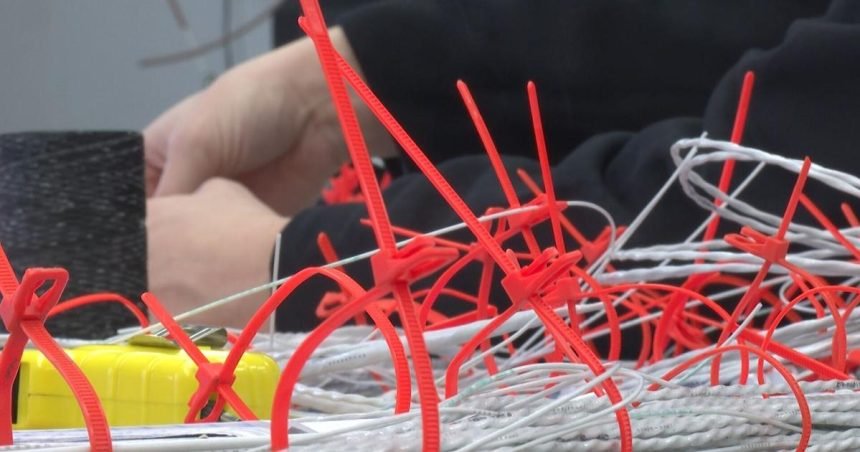
A basic upgrade for a plane that already has most of the needed wiring takes about five weeks to complete. That includes two weeks of preparing additional wiring and then when the aircraft comes in, BlackHawk needs another three weeks to have it all installed.
If they’re starting from scratch, the process will take around five weeks in the wire lab, and up to five weeks once the aircraft arrives to install everything.
“It’s not awful for what you actually have incorporated,” Sones said. “You’re getting new state of the art electronics versus equipment that was basically designed in the late ’80s that have analog dials and mechanical steam gauges.”
Sones said they were the first ones to install the Autoland system in a King Air 200, and the first ones to release it.
Shones said it’s pretty niche because there’s not many companies that install this magnitude of avionic systems.
Sones’ hopes to expand the market.
“Right now, it’s very select aircraft that it’s able to go into,” Shones said. “If there’s other models that can broaden it, so that we can basically incorporate that into other aircraft besides the king air that we work on.”
However, Brodigan’s dream looks a little different.
“I hope I never use it. I hope it never gets used.” Brodigan said, ” It’s a bad day if it gets used, but it’s also a great day.”