BEMIDJI – It’s not often that a finalized collegiate hockey roster comes with surprises, much less four of them.
There are Oliver Peer and Vincent LaBelle, who played major juniors in the Canadian Hockey League before playing for their respective U Sports programs in Canada, and will benefit from the NCAA’s change to amateurism rules.
Then there’s forward Connor McClennon and defenseman Hudson Thornton.
After finishing his final season with the Winnipeg Ice in the Western Hockey League – one of three leagues in the CHL – McClennon played seven games for the Chicago Wolves in the AHL. He then played two games with the Norfolk Admirals in the ECHL.
A year ago, McClennon, a sixth-round draft pick by the Philadelphia Flyers in 2020, wouldn’t have been on BSU head coach Tom Serratore’s radar. Now, with the CHL eligibility changes, Bemidji State “threw some darts.”
“These guys went through the NCAA Eligibility Center and were cleared,” Serratore said. “Man, the landscape in college sports is crazy right now. We saw in some other sports that there were guys who played pro who were eligible to play in college again. Why not give it a whirl for us?”
The NCAA Eligibility Center, formerly known as the NCAA Clearinghouse, is an organization that helps determine the eligibility of student-athletes to participate in college-level sports in the United States.
The NCAA Eligibility Center ensures student-athletes meet academic and amateurism requirements by reviewing their transcripts and amateurism questionnaire, with rare cases requiring additional information.
BSU was in contact with McClennon in July. Because he was cleared to play U Sports after playing nine pro games between the AHL and the ECHL, Serratore believed there was an outside chance he might be given NCAA eligibility, though he wasn’t confident.
McClennon worked with BSU’s compliance office to submit all necessary documents to the NCAA Eligibility Center. After nearly three weeks, he was given the green light to play hockey at Bemidji State. McClennon has two years of eligibility remaining.
But what about Thornton?
After his final season with the Prince George Cougars in the WHL in 2023-24, Thornton didn’t go the U Sports route. Instead, he played 49 games in the ECHL with the South Carolina Stingrays and the Orlando Solar Bears. He also played one AHL game with the Hershey Bears.
Like McClennon, Thornton was cleared to play U Sports. However, the BSU brass got an idea from SEC country.
On July 24, the University of Tennessee announced the men’s basketball roster addition of Ethan Burg, who played a year of professional basketball for the Bnei Herzliya Basket in the Israeli Basketball Super League. When Burg was granted eligibility, Bemidji State’s hope to add Thornton materialized.
“For each kid, it comes down to the finite details,” Serratore said of the NCAA Eligibility Center’s clearing process. “For the people on the eligibility side, it’s all about their assessment, how they think and what they feel. I think once they started allowing some guys who played pro in other sports, why not hockey?”
Gaining eligibility through the NCAA can take up to six weeks. Approval is on a case-by-case basis. Despite both McClennon and Thornton signing professional contracts in the AHL — not amateur tryout contracts — both were granted NCAA eligibility.
“Hudson is from Winnipeg, and we recruited him at one time,” Serratore continued. “He was going to go to the University of Saskatchewan, so we called him and asked him if he wanted to go through the Eligibility Center. He sent them everything he had, and he was cleared. We were just throwing some darts and giving it a whirl, and it worked out.”
U Sports transfers were always part of the plan for Serratore, but the opportunity to pick up players who competed at the professional level developed this summer.
“When we got going in the CHL, we initially thought we’d have an edge with U Sports,” Serratore said. “These are good major junior players who play U Sports and aren’t being looked at. It was always going to be a big part of our future and how we recruit this year. We used it as our transfer portal.
“As far as the pro kids, it was never part of the plan, but it worked out. We saw some things happening, and there are a lot of things happening with the NCAA right now as far as professionalism and amateurism. It worked out in our favor.”
‘We are going to be a better hockey team’
Serratore likened his previous 24 recruiting cycles as BSU’s head coach to Groundhog Day.
Now, in the wild west of collegiate athletics, in the era of Name Image and Likeness and the transfer portal, the Beavers’ longtime bench boss has a rejuvenated excitement.
“We’d go to the USHL, the NAHL, the BCHL, Europe – you name it – and it’ll take them a while to adjust and get stronger,” Serratore said. “This is just different, and different doesn’t mean better all the time, but there’s a different level of excitement and enthusiasm, and that goes for our current players, too.”
Peer and Labelle didn’t have as stringent a clearing process as McClennon and Thornton. However, they will be part of the first U Sports players to compete for Bemidji State in the new era.
Peer is a 6-foot, 170-pound center who has three years of eligibility left. He had eight goals and 11 assists in 24 games for the University of New Brunswick last winter.
“Oliver is a very explosive skater,” Serratore said. “He was a good player for New Brunswick, and they’re the top team in U Sports over the last four or five years. … We really like him. One thing we wanted to address as a staff is team speed, and Oliver brings that to the table.”
Serratore also liked LaBelle’s speed. The 5-foot-7, 168-pound center out of the University of Ottawa had eight goals and seven assists in 19 games as a sophomore. LaBelle has two years of eligibility left.
“He’s a guy who had a lot of success in the QMJHL,” Serratore said. “I went to the U Sports National Tournament, and he played a lot of minutes and was a key player for Ottawa. He’s a centerman, Oliver’s a centerman. We feel like we got stronger up the middle. He’s an undersized player but a dynamic player.”
Only one incoming freshman will come from the USHL. Defenseman Max Vig was
drafted in the seventh round by the Montreal Canadians
in July and will play on Bemidji State’s blue line this upcoming season.
Courtesy / Cedar Rapids RoughRiders
While BSU has made a habit of recruiting in Europe, only one freshman will make the trip across the pond. Oscar Karlsson is a 6-foot-2 forward out of Linköping, Sweden, and had 19 goals and 14 assists in 46 games for Linköping HC J20 in the J20 Nationell last season.
When the CHL recruiting pool opened on Nov. 7, Bemidji State wasted little time inking the
WHL Goalie of the Year last season.
Max Hildebrand signed roughly a week and a half later and became
Bemidji State’s first CHL commit.
The Beavers picked up two more rookies out of the CHL.
Max Namestnikov, a 5-foot-8, 183-pound forward out of the Guelph Storm in the Ontario Hockey League, will compete for a center spot on the opening night lineup. He had 24 goals and 30 assists in 65 games with the Storm last season.
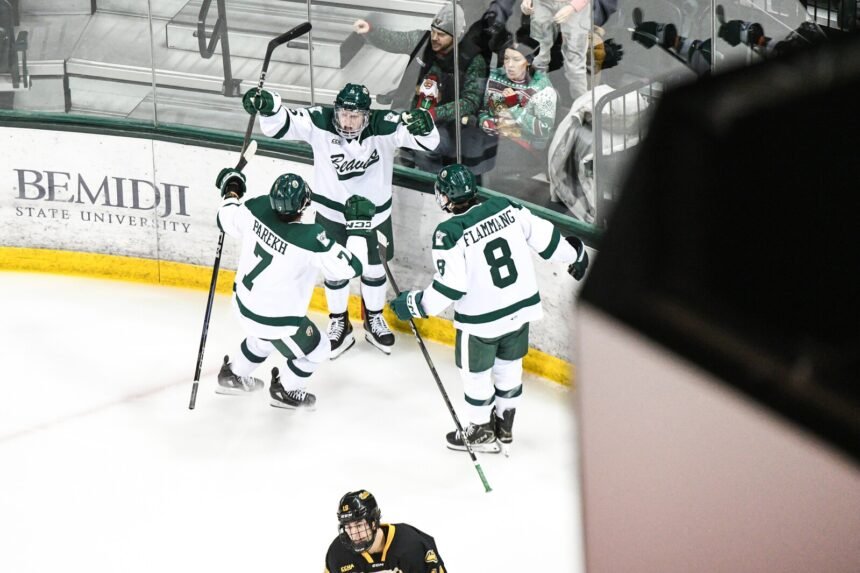
Benjamin Vigneault also fills a need for BSU. The 6-foot, 181-pound defenseman is the third right-shot blueliner on Bemidi State’s roster, joining Isa Parekh and Ryan Henderson. Vigneault had nine goals and 29 assists in 53 games for the Québec Remparts last season in the Québec Maritimes Junior Hockey League.
The Beavers also added a traditional transfer in the form of
Vann Yuhas, who comes from Merrimack in Hockey East.
“By a mile, it’s the most diverse (incoming) class we’ve ever had,” Serratore said. “Our staff is pumped, for sure. We’re going to be a better hockey team than we were last year, but so is everybody else. Every single team got better. Every team in college hockey got better, too. So much is unknown, but I’m excited about the unknown.”
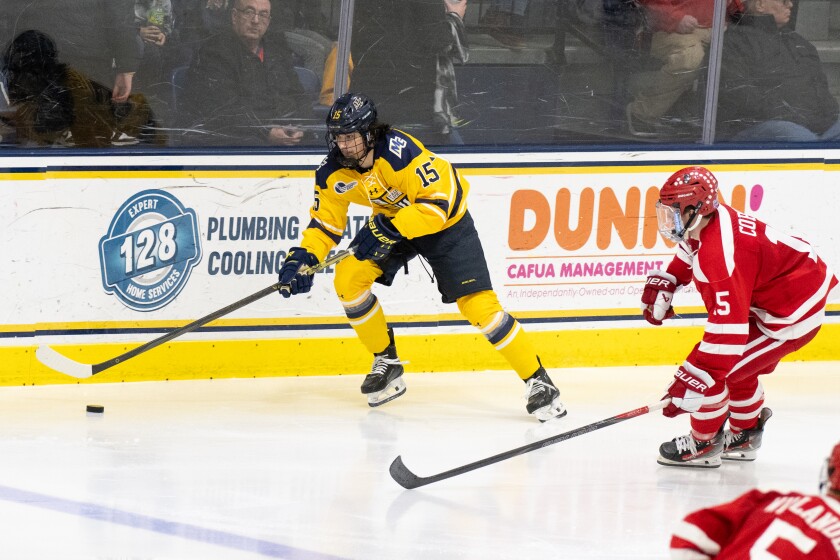
Courtesy / Merrimack College Athletics