California State University, East Bay (CSUEB) faculty and students are raising concerns after the university identified its Spanish bachelor’s degree program for elimination. It is currently CSUEB’s only degree program slated for full discontinuation, with changes set to take effect by the Spring 2027 semester if approved.
The plan comes after the university’s Low Degree Conferring Task Force (LDC) reported low enrollment in the Spanish B.A. program. Members of CSUEB’s Academic Senate claim the LDC’s report, originally filed in 2023, now contains outdated information. According to data from Pioneer Insights, Spanish B.A. enrollment rose from 16 to 24 single majors from Fall 2024 to Fall 2025. Double majors were not counted.
University administrators originally scheduled the Spanish B.A. program for discontinuation by the Spring 2026 semester. However, after pushback from faculty, they delayed the cut by a year.
Additionally, the Department of Modern Languages and Literatures merged with the English Department, forming the Department of Writing, Languages, and Literatures in the 2024–25 academic year. At the time, the department also implemented an online Spanish degree pathway and discontinued the French B.A. program.
Gabriela Díaz-Dávalos, an assistant professor who teaches courses in the Spanish B.A. program, said the enrollment increase and department merger should have exempted the degree program from being cut. However, the program remains at risk of elimination.
“We’ve been working to upgrade the majors, numbers, and course quality to improve the actual degree program, but this change needs time. The [LDC’s] decision was made before we had the data from Fall 2024,” Díaz-Dávalos said.
Díaz-Dávalos said discontinuing the Spanish B.A. program would be a disservice to CSUEB’s Hispanic/Latinx students, who make up nearly 40% of the university’s student population.
If the program were cut, CSUEB would become the only CSU campus without a standalone Spanish degree program, potentially pushing students to enroll elsewhere.
“Having a B.A. in Spanish opens doors. People get paid more not for speaking Spanish, but for holding the credentials that certify they know Spanish,” Díaz-Dávalos stated.
She added the cut goes against CSUEB’s core mission and values, especially due to the university’s designation as a Hispanic-Serving Institution (HSI) since 2015. The university was also one of 46 institutions nationwide to receive the Seal of Excelencia in 2024, which recognized CSUEB for its service to Latinx students.
Faculty also believe that the current political climate makes discussions about eliminating the program especially troubling.
“In the current political climate we’re living in right now, our families are facing heightened risks. We have community fragmentation. It [the program cut] really undermines our institutional commitment as an HSI,” Díaz-Dávalos said.
Díaz-Dávalos and other faculty members of the Academic Senate approved a measure to retain the Spanish B.A. program during the Senate’s Feb. 24 meeting. The Academic Senate stated cutting the Spanish B.A program would bring no fiscal benefit and that the university has not provided evidence to the contrary.
Students are also speaking out against the potential cut. Several students, including some Spanish majors, have written direct letters to University President Cathy Sandeen and Provost Anthony Muscat urging the university to keep the program.
Sandeen’s office also received statements from several CSUEB departments, the California Latino Legislative Caucus, and state Assemblymember Liz Ortega.
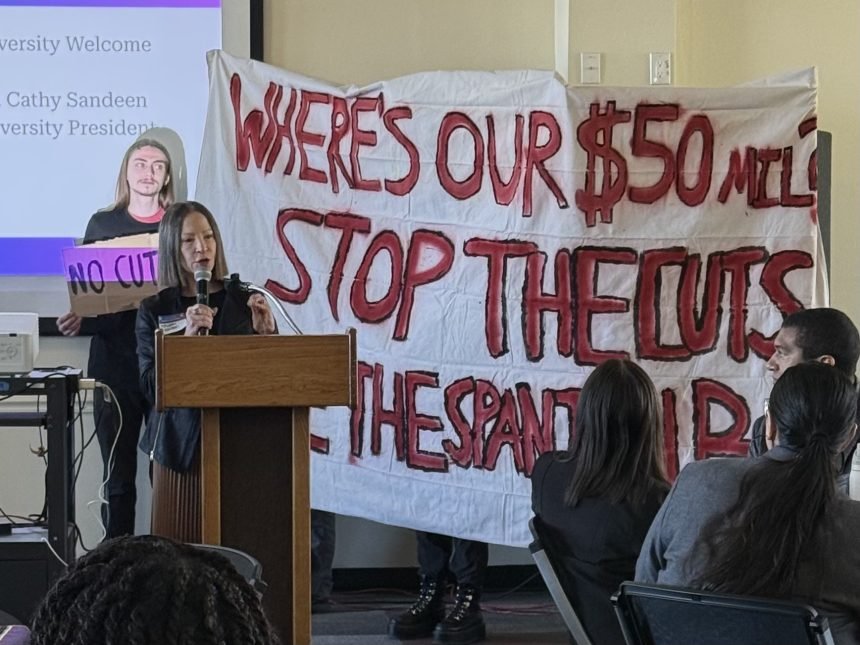
Activists from Students for Quality Education (SQE) organized a silent demonstration as Sandeen spoke during the HSI Summit on March 5, calling for part of the $50 million donation from philanthropist MacKenzie Scott to be used to keep the degree program.
“This is a slap in the face for Hispanic students. I feel disrespected by this,” said SQE intern Kenia Juárez during a student panel at the summit. “I do think it’s a simple fix. Stopping the cut will make us feel more represented.”
Sandeen said the decision on whether to cut the Spanish B.A. program has not been finalized, but will be made before the end of the current semester. She added that Spanish courses will not be eliminated entirely, and that students currently enrolled in the Spanish B.A. program will be able to finish their degree.
“We have many [Spanish] courses that are filled to capacity, but there are non-majors in those courses,” Sandeen said during an open mic dialogue session on March 5.
She emphasized, “It’s not that all of Spanish is going away. That was never the consideration.”
Sandeen also stated that the Cal State East Bay Educational Foundation recently approved an allocation framework for the $50 million donation, with at least 80% expected to go toward permanent endowment funds.
“It would be invested and grow, and we would use the earnings from that to fund different programs at the university,” Sandeen said. “We don’t just want to spend all the money in two years and have nothing left for the future.”
Díaz-Dávalos, Juárez, and others believe there is clear demand for the Spanish B.A. program. They also believe that saving the program would ensure a significant portion of Cal State East Bay’s community continues to be represented and protected.
“I’m going to continue teaching Spanish courses, but for what? Students are going to be without a program,” Díaz-Dávalos said. “I think both of them [Sandeen and Muscat] need to know that students are concerned about this.”