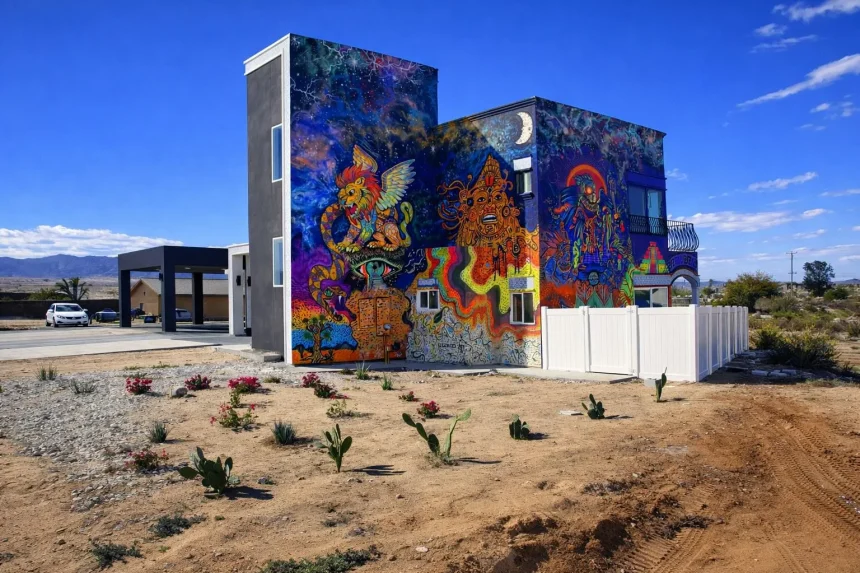
If you have recently driven along Sunburst Street in Joshua Tree, you have likely noticed a brightly painted, two-story house across the street from the old JT Elementary School. The recent build has received a spectrum of responses from the Hi-Desert community and Reporter Adeline J. Wells sat down with the property owner to learn more about the unique house and the story behind its design.
Orange County resident Armando Estevane first experienced the magic of the Mojave Desert during his youth, when he frequented the area on camping trips spent under the stars. Now an adult, Estevane has returned to the Morongo Basin by way of Casa Oaxaca, his passion project of a house built on Sunburst Street in Joshua Tree. Estevane explained that he conceptualized the house to honor his late father, Armando Estevane Sr., a nurse who died during the COVID pandemic.
“My dad always wanted to build a place of his own. He was initially an engineer back in Mexico, came to California, and became a nurse. I wanted to pay tribute to my Hispanic culture, and him and his struggles in coming over here. He served folks who were having drug addiction problems, and would go into the jails, do the dosing. The vision behind this was also something that can continue to give back in his honor.”
Estevane purchased the land on Sunburst Street in 2023 and broke ground the following year. Like many investors in recent years, he sought to build a vacation house in the Hi-Desert that would also serve as a short-term rental when not in use by his family. The house features a stargazing rooftop, and artwork on the interior by artist Ignacio Moya. In honor of his father, Estevane intends to donate a portion of the rental proceeds to support local opioid recovery programs in the Morongo Basin.
“It’s not something for me to just enrich myself. It’s something that I wanted to use part of those proceeds to give back to the community.”
Casa Oaxaca is a notable two-story building, differing from the single-story homes more commonly found in the neighborhood and the desert at large.
It features a mosaic of Mexican tiles and is landscaped with native desert plants, such as aloe vera and beavertail cacti. Casa Oaxaca’s most defining feature is an abstract, vibrant mural that spans the north side of the house, painted by artist Ulysses Gonzalez. The mural is vivid in color, especially against the muted natural landscape. Further, Estevane explained that the mural, including its depictions of an eagle, snake, and lion, incorporate his Mexican heritage.

“It’s an Oaxaca-themed style; along with the artworks, it’s a little bit on the wild side. It was all inspired by my dad. In Oaxaca, you take the day of your birth, along with the year, and you are assigned a specific spiritual animal. For him, it was an eagle, a snake, and a lion. With the Aztec-looking guy, there’s an actual medical symbol within the guy’s face. That’s representing my dad and the work that he did.”
While the City of Twentynine Palms and the Town of Yucca Valley both have Planning Commissions that help dictate the scale and style of developments, Joshua Tree’s status as an unincorporated area leaves parameters and enforcement to San Bernardino County. Some of the Hi-Desert’s iconically colorful properties can be found in Joshua Tree, including the Rainbow House and the Area 55 Futuro House.
Though Estevane designed the house with intention, Casa Oaxaca has been somewhat of a divisive build, garnering varied responses from the community. Some have been supportive of the innovation and unique mural, while others have criticized the two-story build and the intensity of the art and aesthetics.

“When we were initially doing both the building and the painting, we would get mixed vibes. Probably 80% of the folks were giving us thumbs up and honking. I think it’s easy to be critical without understanding the backstory behind it. Not everyone will like the same type of style or theme. I’ve heard, “it’s so out there, it’s so big,” or, “you’re disrupting the natural landscape of what we’ve had here.” I can appreciate that as well.”
Regardless of the nature of the feedback, Estevane is grateful to the community for its interest in Casa Oaxaca.
“I want to say thank you to the whole community for being both positive and also critical. We need some feedback and criticism to help, but overall, it’s been a great experience, and it’s something positive that I’m trying to bring to the community. I wish my dad were here to see it.”