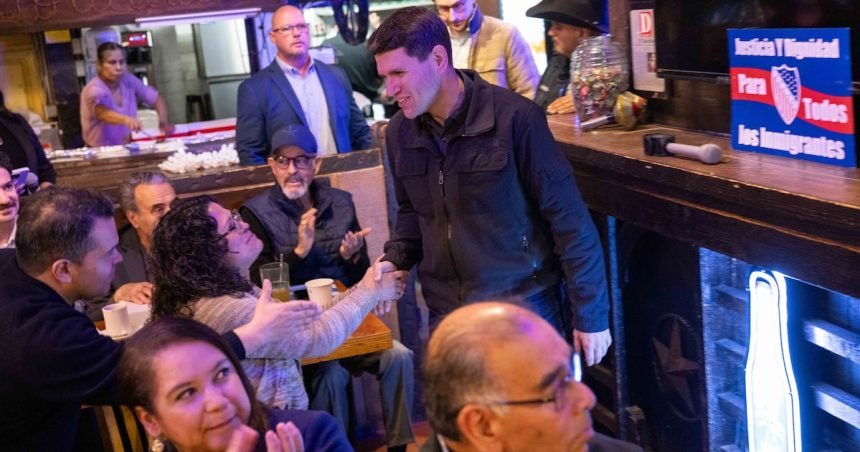
With chorizo sizzling and menudo steaming, hundreds of voters jammed into Oak Cliff’s El Ranchito restaurant for a hearty Tex-Mex breakfast – and to put the candidates on the grill.
Why is the cost of housing so high? How are you going to stop abuses by federal immigration agents? Will you abolish ICE? How will you make higher education more affordable? What’s your plan for creating good-paying jobs?
Related
A mostly Latino crowd of residents and activists fired those questions and more at Democratic Senate hopeful James Talarico and Congressional District 33 contenders Colin Allred, Julie Johnson and Zeeshan Hafeez at the recent breakfast forum.
“They challenged every single candidate, as they should,” said Tristeza Ordex, a former drill instructor in the Marines who now organizes for VoteVets, a grassroots advocacy group. “Everybody’s vying for the Latino vote right now.”
Sponsored by LULAC, a civil rights group, the Chorizo & Menudo Community Breakfast highlighted the growing weight of the Hispanic vote in the March 3 primary. It’s a critical bloc, with influence stretching from the Senate, governor and congressional races at the top of the ballot to local judicial and county contests below.
That showed in the Tarrant County state Senate special election last month in which the Democratic Hispanic vote share rose to nearly 80%, helping Taylor Rehmet flip a reliably Republican seat.
“We’ve seen it in a number of different areas around the country – Latinos have become the most important swing vote,” said Jason Villalba, CEO of the Texas Hispanic Policy Foundation, a nonpartisan research organization.
He said they could tip close primaries and prove crucial in the November general election.
Led by President Donald Trump in 2024, Republicans have made significant gains with Hispanics, and he carried 55% of their vote in that election, according to the Texas Politics Project at the University of Austin.
But a November 2025 Pew Research study found Latino voters growing disenchanted with Trump.
Strong majorities disapproved of both his job performance and his administration’s immigration policies. That poll was conducted before federal immigration agents killed two people in Minneapolis.
Eric Cedillo, a Dallas immigration lawyer and legal adviser for LULAC, said immigration and the aggressive raids by Immigration and Customs Enforcement will be central issues in many Texas races.
“Among Latinos, it’s critical that we look at the underlying issues with respect to immigration,” said Cedillo, who attended the breakfast. “It’s become a much bigger optic for a lot of people.”
Raids and reform
Ordex, who did tours in Afghanistan and Iraq, said she wants ICE abolished, echoing many in the room. Even her status as a veteran and citizen has not shielded her from harassment or scrutiny, she said.
“We’ve seen so many veterans that have gotten caught up in this that are U.S. citizens,” Ordex said. “We know veterans are being deported and our families are being touched. And as a Latina veteran that lives here in Oak Cliff, I’m not exempt from that.”
Those attending the forum pressed the candidates to define where they stood and how far they were willing to go.
Talarico, the state representative from Austin who is running in the Senate primary against U.S. Rep. Jasmine Crockett of Dallas, said Texas should lead the way in developing comprehensive immigration reform.

State Rep. James Talarico, who running for the U.S. Senate, speaks during the League of United Latin American Citizens’ Chorizo & Menudo community breakfast at El Ranchito on Saturday, Feb. 7, 2026, in Dallas.
Juan Figueroa / Staff Photographer
“It is time to tear down this secret police force and replace it with an agency that is actually going to focus on public safety for all of us, whether we are documented or undocumented,” he said. “We should be hunting down human traffickers, not moms and babies.”
Allred, the former congressman now seeking election in the newly drawn, Dallas-based District 33, was asked directly whether he would do away with ICE and whether border security mattered more to him than protecting Latinos from overly aggressive immigration enforcement.
“We need to have a complete overhaul of the agency,” he said. “I’m fine with unraveling everything they’ve done under this administration and going back to basically the studs.”

Former U.S. Rep. Colin Allred, who is running for election in Texas’ 33rd Congressional District, speaks during the League of United Latin American Citizens’ Chorizo & Menudo community breakfast at El Ranchito on Saturday, Feb. 7, 2026, in Dallas.
Juan Figueroa / Staff Photographer
Asked whether that amounted to a “no” on abolishing ICE, Allred said: “We’re not the party that destroys agencies. What we do is we reform things and fix them.”
Johnson, a one-term House member who faces Allred in the Democratic primary, reaffirmed her commitment to reining in ICE.
“I have voted against funding ICE every time,” she told the breakfast group. “I have authored legislation to hold rogue enforcement agents accountable.”

U.S. Rep Julie Johnson, who is running for election in Texas’ 33rd Congressional District, speaks to attendees during the League of United Latin American Citizens’ Chorizo & Menudo community breakfast at El Ranchito on Saturday, Feb. 7, 2026, in Dallas.
Juan Figueroa / Staff Photographer
On an issue Allred has targeted in the race, Johnson was asked about her stock trades, including purchases of Palantir, a contractor whose software assists immigration officials with deportations.
“Yes, I had stock assets. I immediately signed on to a banned stock,” she said, referring to legislation to bar members of Congress from trading individual stocks.
Related
Financial disclosures show she bought Palantir shares in amounts between $1,000 and $15,000 and later sold them in that same range on April 1 and June 30 in 2025. Johnson said at the breakfast she made $90 after selling her Palantir stock.
Hafeez said he also would abolish ICE and defended his previous work at major tech companies. He said he favors a digital bill of rights to protect Americans and their personal data.
“I’ve spent most of my career in big tech, so I know their secrets,” he said.

Attorney Zeeshan Hafeez, who is running for election in Texas’ 33rd Congressional District, speaks during the League of United Latin American Citizens’ Chorizo & Menudo community breakfast at El Ranchito on Saturday, Feb. 7, 2026, in Dallas.
Juan Figueroa / Staff Photographer
Economic focus
Former LULAC president Domingo Garcia, who moderated the forum, said voters are looking for candidates who offer meaningful plans to lower prices for groceries, housing and health care, issues that came up repeatedly in the breakfast.
Susi Rios, a 26-year Dallas ISD teacher, zeroed in on schools, saying she wants students supported and safe.
“Putting education in the forefront is very important to me in our community,” she said.
Another at the event, former LULAC president Hector M. Flores, said the stakes stretch beyond one election.
He said Hispanics are seeking greater recognition from policymakers and business leaders alike. “They don’t respect and recognize what we contribute” in driving growth, Flores said.
Winning their votes in 2026, he said, will depend on candidates who focus on jobs, expand economic opportunity and show they value the role Hispanics play in the state’s future.