
Diamondbacks’ Corbin Carroll reveals who his diverse idols were
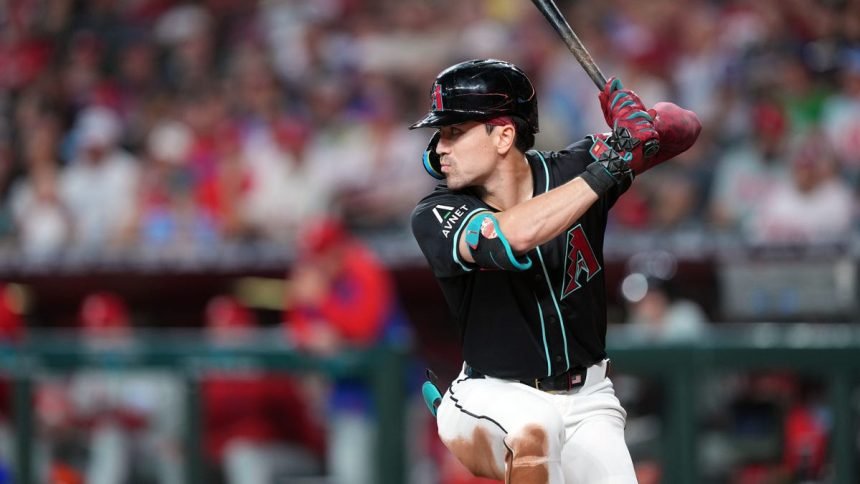
Arizona Diamondbacks star outfielder Corbin Carroll uncovers who his diverse role models were growing up at MLBPA’s 2026 Playmakers Classic.
Dana Scott/The Republic
Arizona Diamondbacks All-Star Corbin Carroll grew up idolizing Ken Griffey Jr.
Carroll smiled when he was asked about his all-time favorite African-American baseball player while he was at the MLB Players Association’s Playmakers Classic charity event in Phoenix on Feb. 18,
“I’m a Seattle kid, so I grew up a Mariners fan,” Carroll told The Arizona Republic. “Griffey was kind of my guy, and Ichiro (Suzuki) and all those Seattle guys, but African-American specifically, yeah, Griffey.”
The Hall of Famer Ichiro is Japanese.
Diversity is important for Carroll, who is of Taiwanese descent on his mother’s side, as he recalled his hometown Mariners’ early-2000s team.
Carroll, 25, wasn’t born until after Griffey’s prime in the 1990s. But he saw Griffey’s final two years played in Seattle from 2009-10.
That period also saw MLB’s steep decline of African-American players: 19% on Opening Day in 1995 to 8.5% in 2011, per the Institute for Diversity and Ethics in Sports at the University of Central Florida.
White players made up 61.3% of the 30 MLB team rosters last year, according to the Orthopedic Journal of Sports Medicine’s 2025 report. Black youths have gravitated more to sports such as basketball and football in the United States. The NBA and NFL have nearly 72% and 53.5% of Black players, respectively, per Statista.
“I guess there’s been a bit of a switch,” said retired six-time All-Star Bobby Bonilla, who was at the charity event. “I think back in the ’70s, it was 30% Black. There’s kind of been a switch where it’s 30% Hispanic and maybe 4 or 5% Black. You want to see more of the Black players more involved, but in my humble opinion, I think they’re playing more basketball and football.”
African-American MLB players are gradually on the rise again in youth baseball and the minor leagues, but are outnumbered by Latino players.
Carroll said overall diversity is a positive in baseball.
“I think it’s everything,” Carroll said. “You want this game to be as talented as it can be and that involves people, as you can see, from all over the country and the world and all different sorts of circumstances.”
Youth programs helps develop Black players
The MLBPA’s Playmakers Classic is a fundraiser for youth baseball programs, such as MLB Develops and Play Ball, to increase Black player participation.
“I think we’re in a better place and I also think there’s a long way to go,” Cincinnati Reds‘ left fielder Will Benson, who is Black, told The Republic. The Reds are among the teams in the Phoenix area currently conducting spring training in the Cactus League.
MLB reported that Opening Day 2025 had 40.8% non-white players, its highest overall diversity since 2019, including the first year-over-year percentage uptick of Black players since 2018.
Latino players were at 28.6%, internationally born players comprised 27.8%, and African-American players were 6.2% in 2025, up from 6% the previous year.
There were 59 Black players on Opening Day active and inactive lists, including 18 Black minor league players on MLB 40-man rosters, last year. Of those, 17 were alumni of MLB Develops’ Black youth outreach programs. That includes the MLB Youth Academy, the Breakthrough Series, the DREAM Series, the Nike RBI program and the Hank Aaron Invitational Camp.
Benson was developed in the L.E.A.D. Center For Youth run by former Chicago Cubs outfielder and fellow Atlanta native CJ Stewart.
“At the time, (Atlanta Public Schools) didn’t have a baseball program for middle schoolers,” Benson said. “(Stewart) brought the program to APS and fortunately that was my sixth-grade year, and that’s when I really started to have fun with baseball in that school setting.”
The program mentored and developed elite MLB talent, including former Diamondbacks outfielder Kyle Lewis, ex-Cubs world champion Jason Heyward, Baltimore Orioles All-Star Pete Alonso, five-time All-Star Andrew McCutchen and Hall of Famer Andruw Jones.
Like Benson, Lewis, Heyward and McCutchen are African-American and Jones is a Black Latino from Curacao.
Benson said “it’s a blessing” to be a part of the current push for more African-Americans in baseball, and kids seeing them play on TV and the Black players’ accessibility at camps is “where the real value happens.”
To boost Black representation during the All-Star Week festivities, MLB added the HBCU Swingman Classic for Black colleges’ baseball teams.
“A lot of kids are not going to be drafted, but you can still be in the sport that you love,” said Griffey Jr., during the 2024 HBCU event, which he led.
Baseball in the Bronx
Bonilla, who is Puerto Rican, discovered baseball as a kid in the South Bronx area of New York City during the 1970s, when baseball showcased numerous high-profile Black players.
“When you’re young, you’re not thinking about diversity or anything like that,” said Bonilla, who played from 1986-2001 and spent time with eight teams, most notably the Pittsburgh Pirates and New York Mets.
“What you’re doing is playing the game you love. I honestly didn’t put any thought into that because everybody was either White, Black or Hispanic. I’m from a pretty diverse neighborhood, so I didn’t really think about those things as a kid.”
Bonilla helped lead the Pirates to two straight National League Championship Series in 1991 and 1992 and won a 1997 title with the Florida Marlins. He was once the league’s highest-paid player.
Bonilla, who retired in 2001, broke ground that led to the MLB deferred payment contracts for superstar players, which ensure long-term security for players and tax advantages on a team’s payroll. July 1 is known as “Bobby Bonilla Day” in the MLB community. He is paid annually $1.19 million on that date for 25 years, from 2011 through 2035, by the New York Mets, as part of his $5.9 million buyout with 8% interest in 1999.