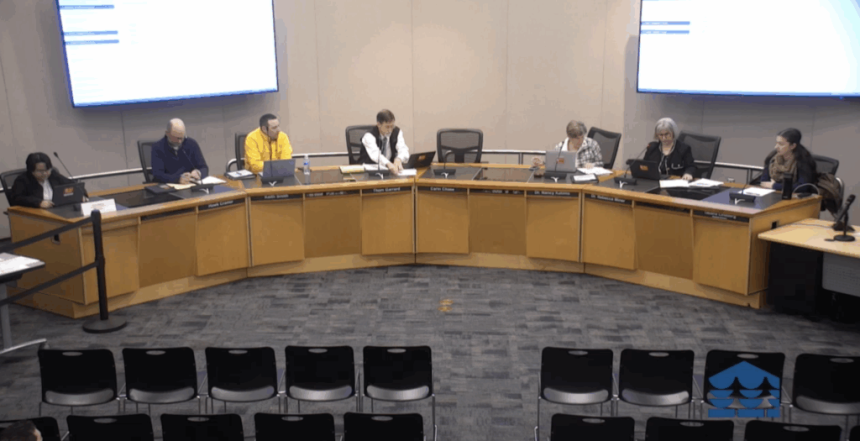
The Edmonds School Board at its Jan. 27 business meeting reviewed trends in District graduation rates, approved policy changes regarding property leases and discussed education-related bills during a legislative update.
Graduation rates
Assistant Superintendent Greg Schwab presented data for the class of 2025, reporting a Districtwide graduation rate of 86%, a 1.5% increase over the previous year. The district also saw a decline in the dropout rate from 8.8% to 8.2%.
While noting overall improvements, Schwab said the District is falling behind on some goals outlined in itsstrategic plan, including a 94% on-time graduation rate for the class of 2026.
“We see fewer students disengaging completely and slightly fewer are lingering without a clear path,” Schwab said.
Schwab highlighted school-specific achievements, noting that traditional schools including Meadowdale and Mountlake Terrace high schools both exceeded 90% graduation rates, and Lynnwood High School remained steady at 87%. The outlier was Edmonds-Woodway High School, the rate falling from 88.5% in 2024 to 87%. The eLearning Academy saw a significant jump, growing from a 48% graduation rate in 2024 to 61%.
However, Edmonds Career Access Program (EdCAP) and Scriber Lake High School remained low, the latter maintaining a roughly 50% four-year completion rate. Only 4.9% of the roughly 500 students attending EdCAP in 2025 graduated in four years, up from less than 2% the year before. EdCAP offers a career-focused path toward a diploma or GED to students ages 16 to 21. The majority of students, 52%, remained enrolled and on track to finish in over four years, while 42% dropped out.
All major programs and most racial/ethnic groups saw increases in four-year graduation rates, except Hispanic/Latino students, whose rate fell from 74% to 73%.
Rates by program:
- Multilingual learners: 65% to 71%
- McKinney-Vento: 65% to 79%
- Free/reduced meals:76% to 79%
- Students with disabilities: 64% to 70%
Rates by race/ethnicity:
- Asian students: 93% to 95%
- Black/African American students: 83% to 86%
- White students: 87% to 90%
- Two or more races: 84% to 89%
Rates for Native American and Native Hawaiian/Pacific Islander students weren’t disclosed in 2025, as state policy prohibits disclosing certain data for groups of 10 students or fewer.
Board President Nancy Katims addressed the disparity among Hispanic and Latino groups, suggesting the District “drill down” into the data to understand students and their needs.
“That’s a really important group,” she said. “They need to be graduating at the same levels as everyone else.”
Schwab said the District is changing its approach for 2025-26 to bolster graduation rates through early intervention, quick credit recovery and evidence-based graduation practices.
Because high school schedules allow for 24 credits – the exact number required for graduation – failing a single class as early as freshman year could put a student off track immediately. Schwab said data shows that students are more likely to graduate if they have a successful freshman year. If students do fail, the District is exploring more quick-grade-recovery options through support during the school day, after school and in the summer.
Find more data on the District’s report card from the Washington Office of Superintendent of Public Institution.
November 2025 budget report
As of November, the District’s finances remained consistent and on track with budget expectations, Executive Director of Business & Finance Lydia Sellie said.
Sellie also briefed the board on HB 2593, a proposal from Superintendent of Public Instruction Chris Reykdal that would require districts with over 2,000 students to maintain a minimum fund balance of between 6 to 12%, up from the current 4%. Based on current projections, the District is on track for 8.6% for the end of the 2025-26. If the bill did pass, it would likely go into effect in the 2030-31 school year, but Sellie said she didn’t expect it to have a lot of traction during the current legislative session.
Policy changes
Under unfinished business, the board unanimously approved a revision to policy regarding the rental, sale or lease of District real property. The updated policy allows the District to extend lease terms from five years to 10 years under specific conditions.
Director Hawk Cramer expressed support for the change, noting it would help the District secure external funding.
“If we can get a grant that we couldn’t get by extending the lease to 10 years instead of five, that makes a lot of sense,” Cramer said.
The board also held a first reading of a policy on claim certification. The proposed changes include minor changes to reflect state policies and modernize language to include payment methods beyond paper checks. The revision also formally establishes an auditing committee, consisting of the board president and vice president, to review bills and vouchers during the agenda review process.
Legislative update
Director Thom Garrard provided an update on the 2026 state legislative session.
After District Student Advisor Scarlett Luo testified before state lawmakers in support of HB 5574, on Jan. 20, the Senate Committee for Early Learning and K-12 Education approved the bill, sending it to the Rules Committee for a second reading. If passed, the bill would require Asian American and Native Hawaiian/Pacific Islander, Latino American and Black American history in public school curriculum.
Garrard also cited nearly 20 “unfunded mandates” currently filed in Olympia. These bills, if approved, would require District action without additional state funding. He specifically mentioned HB 5883, proposing districts reduce health insurance waiting periods for substitutes and non-contracted staff from two years to one.
While the board expressed support for the concept, Superintendent Rebecca Miner provided data to state legislators showing the mandate would cost the District nearly $1.4 million annually without new revenue, potentially leading to cuts.
“Give us the money,” Katims said. “Don’t make it unfunded. Give us a mandate and fund it.”
The District will have a better idea of what bills will pass – and any funding they might bring in – during the first week of February, Gerrard said.
The agenda and meeting recording are available on the District’s website.
— Contact Ashley at ashley@myedmondsnews.com.