Newswise — Korea’s research community has reached an important milestone on the path toward next-generation mobile communications with the development of a technology platform that brings the 6G era closer. Researchers expect that AI-Native mobile networks, in which artificial intelligence autonomously controls and optimizes the communication system, could achieve transmission efficiencies up to 10 times higher than those of 5G.
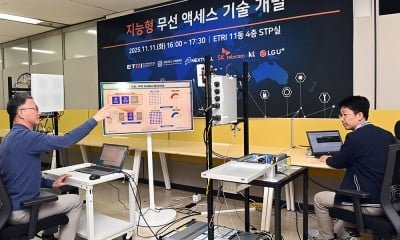
ETRI announced that it has completed the development of AI-based wireless access technology (AI-RAN), a core foundational technology for the 6G era, and has achieved significant results in paving the way for the AI-based next-generation mobile communication era.
The biggest feature of this technology is that it has applied AI to wireless transmission, network control, and edge computing throughout the network to reliably handle large volumes of data even in ultra-dense network environments. Through this, it aims to achieve up to 10 times higher transmission efficiency compared to 5G and the technology is being evaluated as a core foundational technology for the realization of AI-native 6G networks.
ETRI researchers have successfully implemented an AI-RAN structure by which AI learns the state of wireless networks and independently adjusts to the optimal connection environment.
AI-RAN technology performs ▲channel state analysis for beamforming and power control, ▲cooperation and interference management between base stations, ▲edge traffic prediction and distribution, ▲delay minimization, and more, ensuring stable communication quality even in ultra-high-density environments. Through this, it has become possible to provide ultra-high-speed services seamlessly in diverse user environments.
In particular, one of the representative achievements of this research, the Neural Receiver technology, is a next-generation reception technology by which AI directly restores wireless signals and immediately detects errors. While the existing wireless reception method faced limitations in achieving stable performance in high-frequency environments due to its reliance on a statistical model-based step-by-step processing method, neural receivers can reliably maintain performance by allowing AI to learn complex channel environments on its own.
Experimental results showed that AI-based receivers in millimeter-wave environments demonstrated superior performance compared to existing methods, including ▲approximately 18% improvement in data recovery accuracy, ▲approximately 15% improvement in channel prediction accuracy, and ▲a 30% reduction in data loss rate. This demonstrates that AI technology can dramatically improve communication efficiency even in wireless transmission environments.
ETRI is strengthening its global 6G technology competitiveness by leading the standardization of technologies such as “AI/ML-based wireless interface” and “AI-based mobility management” in 3GPP, an international standardization organization.
To date, ETRI has achieved outstanding results in the fields of research, technology, and standardization, including ▲applying for 119 domestic and international patents ▲contributing 68 technology articles to 3GPP, 12 of which were adopted ▲publishing 17 SCI papers. ETRI is also pursuing the acquisition of standard patents in core AI-RAN technologies.
ETRI plans to develop this achievement into a “Self-Evolving RAN” technology, by which AI independently learns and evolves to maintain optimal communication performance. It will also continue to strengthen its capabilities to ensure Korea leads the way in AI network technology in the 6G era through AI-RAN Alliance activities, international joint research, and participation in global exhibitions such as MWC.
Yongsoon Baek, Senior Vice President of ETRI’s Terrestrial & Non-Terrestrial Integrated Telecommunications Research Laboratory, stated, “AI-based wireless access technology is the first step in directly implementing the core functions of communication networks through AI, and it will serve as an important milestone in realizing 6G ‘AI-Native Networks.’”
Jungsook Bae, Director of ETRI’s Intelligent Wireless Access Research Section, also stated, “We have confirmed that AI can intervene in the actual wireless transmission process to overcome the limitations of existing mobile communication. We will develop and move forward with autonomous wireless technology that predicts and controls the entire network in the future.”
1) AI-Native: A form in which AI is not an auxiliary function but becomes the center of the system, with the entire structure and operation designed accordingly.
2) AI-RAN: Artificial Intelligence-based Radio Access Network. As a wireless access method that utilizes AI technology to optimize wireless network resource utilization and transmission performance in real time, it refers to a core 6G technology that integrates and optimizes transmission, control, and edge resources of wireless networks using AI.
3) Edge Computing: A computing method that reduces latency and increases real-time performance by processing data locally at the edge of the network, such as terminals or base stations, instead of sending the data to a central cloud.
4) Neural Receiver: AI-based receiver that performs channel estimation, correction, and restoration of wireless data signals.
5) 3GPP: International Mobile Telecommunications Standardization Organization. (3rd Generation Partnership Project)
6) Self-Evolving RAN: A completely autonomous wireless network by which the network learns and evolves on its own.
7) AI-RAN Alliance: A global industry-academia-research council formed in 2024 to fully integrate AI technology into radio access networks (RAN) to innovatively improve RAN operational performance and simultaneously provide AI-based services on the same infrastructure to create new revenue opportunities.
###
This research was conducted as part of the “6G Core Technology Development Project” supported by the Ministry of Science and ICT and the Institute of Information & Communications Technology Planning & Evaluation (IITP), and was carried out in collaboration with Seoul National University, Nextwill Co., Ltd., SKT, KT, LG Uplus, Korea University, Pohang University of Science and Technology (POSTECH), Sungkyunkwan University, Inha University, and Chungnam National University.
About Electronics and Telecommunications Research Institute (ETRI)
ETRI is a non-profit government-funded research institute. Since its foundation in 1976, ETRI, a global ICT research institute, has been making its immense effort to provide Korea a remarkable growth in the field of ICT industry. ETRI delivers Korea as one of the top ICT nations in the World, by unceasingly developing world’s first and best technologies.