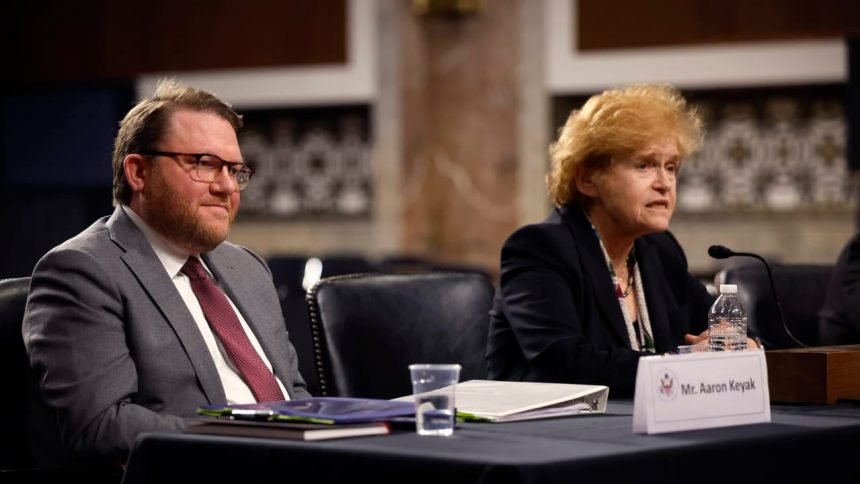
The revelation that Pennsylvania Governor Josh Shapiro was asked if he was a “double agent for Israel” during the vetting process for the 2024 Democratic vice-presidential nomination has sparked a firestorm of criticism. One of those leading the charge is Aaron Keyak, the former Deputy Special Envoy to Monitor and Combat Antisemitism during the Biden-Harris administration, who called the line of questioning “horrifying” and a clear application of a double standard.
In his new memoir, “Where We Keep the Light”, Governor Shapiro details the intense scrutiny he faced while being considered as a running mate for former vice president Kamala Harris. According to Shapiro, members of the vetting team asked him whether his loyalties were split, specifically using the term “double agent.”
For Keyak, who now serves on the Advisory Board of the Combat Antisemitism Movement (CAM), the question is not just a political misstep; it is a manifestation of an ancient and dangerous trope.
Asking a governor if he is a Israeli double agent ‘blatantly antisemitic,’ Keyak says
“Antisemitic bias appears in a lot of forms, some of it obvious, some of it subtle,” Keyak told The Jerusalem Post. “But to come out and ask a sitting governor if he is an Israeli double agent lacks any subtlety. It’s hard to understand what that person was thinking. It is a blatantly antisemitic question.”
Keyak argued that the question relies on the “dual loyalty” trope, which has historically been used to marginalize Jewish citizens by suggesting they are more loyal to Israel than to their own country.
“You certainly wouldn’t have asked Governor Tim Walz (who was picked by Harris to be her VP running mate) if he was an Israeli double agent,” Keyak remarked. “You wouldn’t ask an Irish-American about their secret loyalties to Ireland, or a Catholic American if they had dual loyalties to the Vatican. The rhetoric in the question was blatantly antisemitic.”
While Keyak expressed doubt that Harris would have asked such a question herself, he noted that the incident reveals a troubling “conscious or unconscious bias” within the political apparatus.
“What is so shocking is that it’s such an obvious example of the use of antisemitic rhetoric,” Keyak said. “It treats Governor Shapiro in a way that you wouldn’t treat a non-Jewish candidate. Beyond the horrifying aspect of the antisemitism, there is a practical uselessness to the question. If a person were truly an intelligence asset of a foreign government, they’re just going to say ‘no.’ So, what was the motivation? Were they trying to intimidate him? Were they trying to send a message?”
Keyak’s frustration stems from more than just this single incident. During the interview, he revealed that he faced similar experiences during his own career in Washington.
“The worst examples were asked of me in a classified setting when I was getting my top-secret security clearance,” Keyak shared. “It was clear in the moment that they were asking me questions in a way that they don’t ask other non-Jewish appointees. In my conversations with fellow appointees, it was clear that those of us with a Jewish background were too often given different treatment by bureaucrats who deal with security matters.”
Keyak suggested that the vetting of Shapiro reflects a broader pattern where Jewish public servants are subjected to a “litmus test” regarding Israel that is not applied to other ethnic or religious groups regarding the policies of other nations.
The controversy comes at a time of unprecedented rising antisemitism globally following the October 7 Hamas attacks on Israel. Keyak emphasized that the stakes for such rhetoric are higher than ever.
“We are in an environment with a surge in global antisemitism,” Keyak said. “When it comes to the rhetoric used with Shapiro, there’s no question that it revealed an antisemitic bias in practice, if not intent.”
Keyak called for a systemic re-evaluation of how Jewish candidates and officials are treated, urging institutions to move away from double standards.
“Whether we are a candidate for a presidential ticket, a senior diplomat, or a student on a college campus, Jews just want to be given the same rights, dignity, and respect that everyone else gets, regardless of religion, race, or ethnicity,” Keyak concluded.
“We have to be systematically on guard. When you are vetting someone or considering how to treat protesters, you must do so in a way that doesn’t apply double standards—and in a way that doesn’t collectively hold Jews accountable for the actions of the Israeli government.”