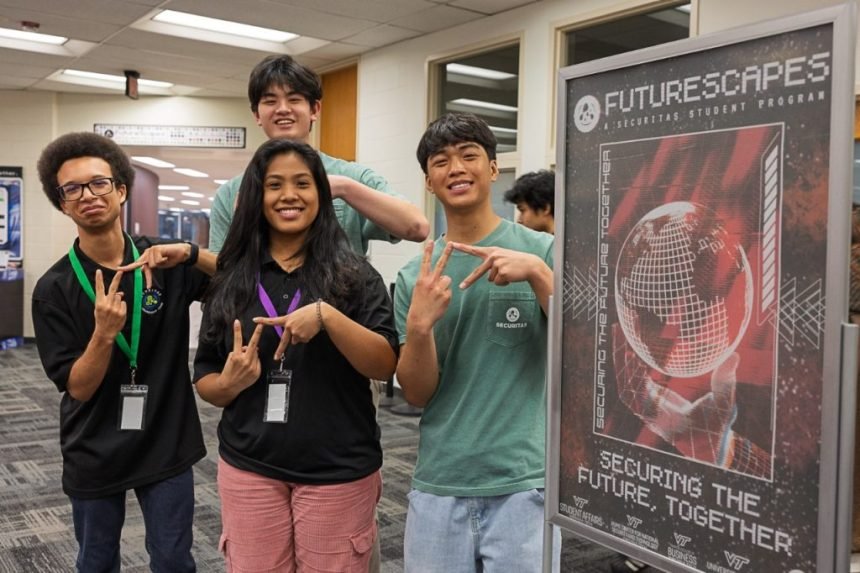
On March 2, 2026, the Securitas Living-Learning Program at Virginia Tech launched their returning students’ exhibit called FutureScapes: Curating Quests Through Digital Dimensions.
FutureScapes is a program for second-year Securitas students at Virginia Tech to explore ideas and ways of thinking about technology using history, literature, and artifacts. Throughout the semester, students discussed technology in science fiction and fantasy books with invited experts from departments across Virginia Tech. They also conducted site visits to the University Archives and the XYZ Gallery in Blacksburg, Va. The culmination of their research was the FutureScapes exhibit.
“For my portion of the exhibit, I chose to focus on awareness and how people can protect their information. We live in an age where it’s becoming harder and harder to not give out your personal information to go about daily life,” said Gavin Neysmith, a junior studying creative technologies. “It might feel worrying or stressful to know exactly how much the apps or tools you use know about you, so I wanted to give agency back to the user by showing them how they can control the amount of data they have to hand over.
Arianna Schuler Scott, senior associate director of the Integrated Security Education and Research Center as well as Securitas’ academic lead, was inspired to create FutureScapes by an exhibition called Electric Dreams: Art and Technology Before the Internet.
“My goal with FutureScapes was to challenge students to move beyond a technology-based mindset and into a space where they could question, interpret, and create,” said Schuler Scott. “The exhibit is the result of that shift—thoughtful, collaborative, and human.”
FutureScapes was carried out in collaboration with the University Libraries, unlocking a range of subject matter experts and extensive resources for students.
The exhibit team consisted of:
- Gavin Neysmith, a junior studying creative technologies
- Jamie Osmeña, a junior studying computer science
- Luke Pineda, a junior studying computer science
- Andrew Kee, a junior studying computer science
“I do a lot of design work in my Creative Technologies major, so it was really nice to be able to feel comfortable and have fun doing the same type of work for this project,” said Neysmith. “Since doing studies on our core aesthetic for the project, Retro Futurism, I’ve learned how to apply these design styles in a creative and informational way.”
Hollis Wittman, metadata consultant for the University Libraries, hosted a book discussion for the program focused on “Neuromancer” by William Gibson. She and her intern, Yumna Rizvi, worked with the student curators on user experience, particularly in the intersection of libraries and cyberspace. In the Futurescapes exhibit, the students needed to represent the digital in a physical exhibit space.
“We had some really good discussions about how technology can solve problems and yet create new ones, and how to balance feedback with surveillance, just to begin,” said Wittman. “These students are the future of cybersecurity, and I feel confident in their ability to tackle their next projects with integrity and humanity at the center of their strategy. ”
The FutureScapes exhibit will be showing on floor 4 of Newman Library until June 2026.
Written by Arianna Schuler Scott and Hollis Wittman