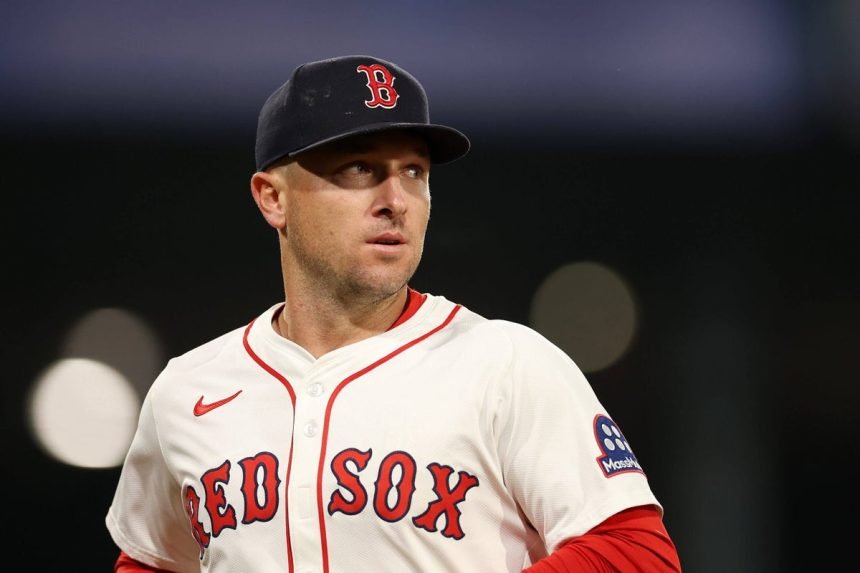
The Boston Red Sox may have felt they made an aggressive offer to Alex Bregman, but in the end, it wasn’t enough.
In allowing the third baseman to walk away and agree to a five-year, $175 million deal with the Chicago Cubs, it further highlighted the club’s aversion to long-term deals for players over the age of 30.
Though the Red Sox reportedly were willing to go five years on a deal for Bregman, which would have been the longest free-agent deal signed under chief baseball officer Craig Breslow, their offer fell short in Bregman’s eyes.
Now the Red Sox must pivot and find a way to pacify a livid fan base less than one month before spring training begins.
Bregman, the unquestioned leader of last year’s Red Sox team and a key cog in its return to the postseason, expressed interest in re-signing with the club on a long-term deal after opting out of his three-year, $120 million deal in November. The Red Sox, however, let negotiations drag deep into the offseason, allowing other teams that are seemingly more worried about winning than payroll to enter the picture and eventually sign the 31-year-old.
Last offseason, as the Red Sox courted Bregman in their initial pursuit, a team source confirmed that the club was focused on a three- or four-year deal, but nothing longer than that, to not block infield prospects Marcelo Mayer and Kristian Campbell. Yet, having seen Campbell struggle and Mayer battle injuries, while also watching Bregman’s impact, there’s little excuse for not securing the three-time All-Star.
The Philadelphia Phillies had no reservations giving their own mid-30s free-agent clubhouse leader, Kyle Schwarber, a five-year, $155 million deal during the Winter Meetings.
Bregman, who turns 32 in March, made it clear he was seeking a deal that would take him through the final years of his career.
The three-year deal Bregman signed with the Red Sox last spring was then – and remains now – the longest free-agent deal under Breslow. Since Breslow’s hiring in 2023, he’s signed eight free agents to one- or two-year deals.
Where Breslow has excelled, however, is in inking long-term deals with Boston’s budding young stars.
Over the last two seasons, he’s signed six players, including Roman Anthony and Garrett Crochet, to multiyear contract extensions. None of those players, however, was older than 25 at the time of their signing.
The Red Sox have said they’re serious about winning behind a slew of young, controllable players contributing now and in the future.
This offseason, they’ve added roughly $40 million to payroll, trading for Sonny Gray ($21 million), Willson Contreras ($18 million) and Johan Oviedo ($2 million). That’s taken them up to the first luxury tax threshold of $244 million. The Red Sox were willing to spend beyond the first threshold, but it seemed unlikely that they’d spend beyond the second threshold of $264 million, a financial terrain they would have surpassed with Bregman’s deal.
A year ago, Bregman grilled the Red Sox front office with a 16-page document filled with questions on the direction of the organization, the development plan for the club’s top prospects and how Boston planned to invest and spend to bring the organization back to the postseason. At the time, Breslow’s answers were enough to convince Bregman to take a shorter deal compared to the six-year, $171.5 million offer he’d received from the Detroit Tigers.
That wasn’t going to be the case this time around.
Bregman took a strong interest in mentoring the club’s top prospects like Anthony and Mayer, but he also offered insight to veteran hitters going through slumps and even to pitchers, suggesting how he’d attack them as an opponent to help them better game plan.
He leveled up nearly every aspect of the club, and his leadership void must be filled. His absence will put even more attention on Trevor Story, who has been a guiding force for the club, but offers a quieter approach than Bregman. Elsewhere, the Red Sox also lost another veteran leader in Rob Refsnyder, who recently signed a one-year, $6.25 million deal with the Seattle Mariners.
Bregman will be in his late 30s by the end of the deal, and there’s always risk involved in signing older players, particularly ones who play as aggressively as him. Though he played just 114 games last year with a right quad strain, he’d played 145 games or more in each of the previous three seasons.
A pivot to bolster the middle of the order alongside Contreras is a must.
Bo Bichette, who turns 28 in March, is likely to be their primary target. Four years younger than Bregman, Bichette is expected to receive an even larger deal. The Athletic’s Tim Britton projects him to sign for eight years, $212 million. If Boston’s greatest reservation was about Bregman’s age and the length of the deal rather than the actual money spent, then signing Bichette makes the most sense. He’s already said he’s willing to move from shortstop to second base, an area of need for the Red Sox.
The Red Sox have also shown interest in free agent Eugenio Suárez while keeping tabs on the trade market for Houston’s Isaac Paredes. The Arizona Diamondbacks recently took another trade target, Ketel Marte, off the market.
Whatever direction the Red Sox chose, finding a replacement for Bregman — on and off the field — won’t be easy.