Written by: Alison Foster | March 19, 2026
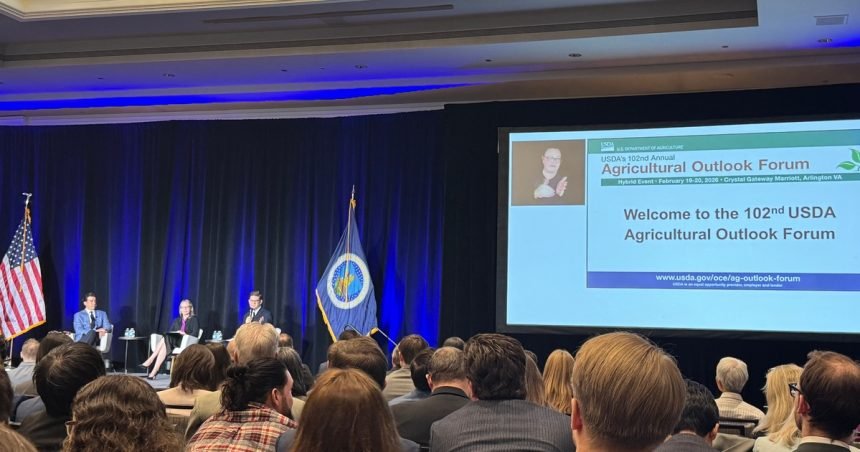
I recently attended the U.S. Department of Agriculture’s annual Agricultural Outlook Forum for the first time. The event’s 30 breakout sessions covering current and emerging issues facing the food and agriculture sector proved to be a valuable and informative, if not a bit overwhelming (in a good way), experience. Adding to the excitement, exhibitor booths showcasing all 29 USDA agencies were stationed throughout the event space.
One of my favorite parts was a virtual reality experience codeveloped by Boehringer Ingelheim and USDA’s Agricultural Research Service. I put on the VR headset and was instantly transported to a farm where I met with veterinarians on the front lines of combatting emerging diseases threatening the livestock and poultry operations across the country, such as New World Screwworm and highly pathogenic avian influenza. It was such a unique hands-on learning experience. I’m also thankful that I didn’t bump into a wall while I moved around in the real world!
The first plenary session featured Julie Callahan, chief agricultural negotiator at the Office of U.S. Trade Representative (USTR), who discussed President Donald Trump’s trade policies and how a new paradigm has seen greater collaboration between USTR and USDA, resulting in some early successes such as reducing the forecasted trade deficit by $10 billion over projected estimates and instigating dozens of simultaneous trade negotiations with an unprecedented number of countries. The conversation between Ambassador Callahan and USDA Under Secretary Luke Lindberg really homed in on the administration’s emphasis on reciprocity and the use of tariffs to strengthen fair trade relationships.
I stuck around to hear the panelists take a few questions from the audience. The question that caught my attention was about what industry can expect from the upcoming review process of the United States-Mexico-Canada (USMCA) trade agreement. Ambassador Callahan acknowledged the significance of the agreement for the U.S. economy, but noted there is room for improvement. She also addressed speculation about splitting the agreement into two separate bilateral deals, explaining that each country’s relationship requires tailored negotiations. She added that she expects conversations will take place between the U.S. and Canada, the U.S. and Mexico and potentially Mexico and Canada, in addition to broader discussions among all three parties.
These insights were of particular interest, given the AFIA’s involvement in the USMCA policy space. Most recently, the AFIA joined the Agricultural Coalition for USMCA in advocating for the full 16-year renewal of the trilateral trade deal. As AFIA increases its engagement with industry partners and government officials, it was helpful to gain insight into how the administration is approaching the July review.
In contrast, Secretary Brooke Rollins’ keynote address made little mention of tariffs or international trade. Rather, her remarks centered on domestic affairs and the president’s commitment to placing farmers at the core of his policy agenda. She closed out her remarks by sharing her vision for charting a more successful path forward, a message that aligned well with the theme of this year’s Forum: securing wins for American farmers, ranchers and rural communities.
My first Agricultural Outlook Forum was such a great experience, I’m already looking forward to next year!