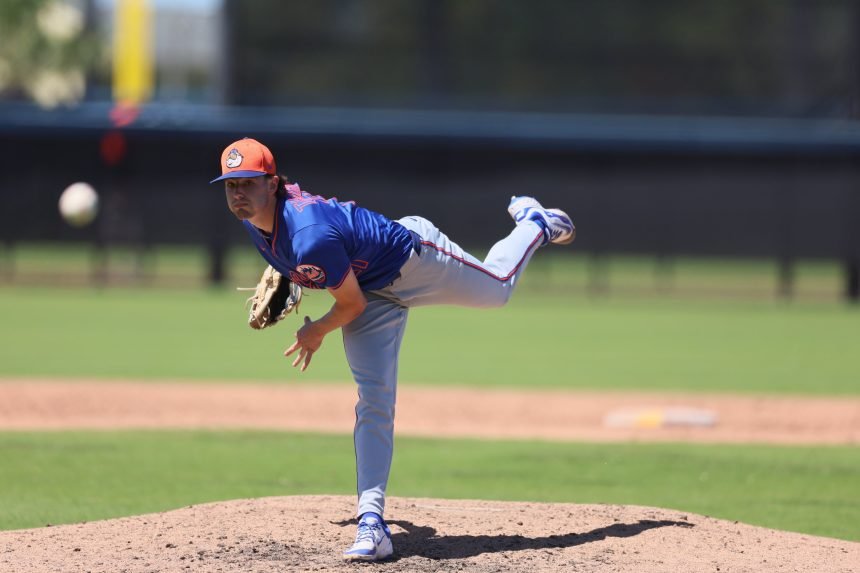
That’s a natural question to ask as players graduate from—or fall off—our Top 100 Prospects ranking. Players with upper-levels minor league experience and proximity to MLB tend to crowd the top of the list, so it’s only natural that successors tend to play at lower levels.
That is the case for every one of my position player picks on this year’s prospect breakout team. None of them played a game above High-A, and one has not yet made his pro debut.
My picks for breakout pitching prospects are a different story. Three of the four have Double-A experience and a chance to make their MLB debuts this year. The one exception also has yet to make his pro debut—and also is a product of the same MLB team’s 2025 draft class.
The rules for this year are simple: Players who rank among Baseball America’s Top 100 Prospects and/or 2025 first-round picks are ineligible for inclusion. Check out the full team below. Two other BA staffers, Geoff Pontes and Ian Cundall, also took part in the exercise. You can find Geoff’s team here and Ian’s team here.
Marco Dinges, C, Brewers
Dinges was one of just seven minor league catchers to top a .900 OPS while batting at least 300 times last season. The 22-year-old had no trouble transferring his power production from college to the pro game, hitting 13 home runs in 77 games at the Class A levels before a hamstring injury curtailed his season. The key to success for Dinges is high-end bat speed and a good feel for the barrel. After not catching at Florida State, Dinges faces questions that need to be answered about how well he can refine his game-calling and pitch-framing skills. Even if he does settle in at another position, Dinges’ bat would make him an interesting prospect.
Randy Guzman, 1B, Mets
Guzman is the younger brother of former MLB first baseman Ronald Guzman. Unlike his older brother, Randy did not dominate low-level competition. In fact, he hit just .186 in two Dominican Summer League seasons. So it’s a credit to Guzman’s work ethic that he turned himself into a prospect with a powerful finish to his 2025 season. Last season, he was one of 17 minor leaguers age 20 or younger to have an isolated slugging of .200 or greater while batting at least 250 times. Guzman has elite bat speed and very strong exit velocity data paired with a good zone-contact rate for a young power hitter. All his value will be concentrated in his bat, so it will be interesting to see how he fares this season.
Demetrio Crisantes, 2B, D-backs
Crisantes is a classic example of the scouting maxim that hitters hit. His issue has simply been staying on the field. The 2022 seventh-rounder has missed significant time with Tommy John revision surgery early in his pro career and shoulder surgery last year. When healthy, Crisantes is a career .323 hitter who swings at strikes and has nearly as many walks as strikeouts. While his surface numbers at High-A Hillsboro in an abbreviated showing last year are tame, he was heating up in May with a .902 OPS before injuring his shoulder on a swing. A healthy season could result in a healthy batting line for Crisantes, especially considering the hitter-friendly hitting environments at Double-A Amarillo and/or Triple-A Reno.
Juan Sanchez, 3B, Blue Jays
Six-foot-3 and physical as a 17-year-old, Sanchez has an unsubtle, pull-oriented hitting approach that produced results in the Dominican Summer League. His 1.004 OPS ranked third among his age peers as he cracked eight homers in 56 games. Sanchez has good plate coverage and quality bat-to-ball skills for a young power hitter. He played a lot of shortstop in his pro debut but lacks the internal clock to stick there and is a third baseman all the way.
Josh Hammond, SS, Royals
Hammond had pro potential as both a pitcher and position player before committing to the latter as a high school senior and capturing scouts’ attention with intriguing power, a hard-nosed playing style and ability to stay on the dirt. The Royals drafted him 28th overall last year, using the PPI pick they added for Bobby Witt Jr.’s runner-up MVP finish in 2024. Hammond hasn’t made his official pro debut yet, so we don’t know for sure where he will line up defensively, but his bat will play if he has to slide over to third base.
Roldy Brito, OF, Rockies
No minor leaguer topped Brito’s .371 batting average last season, at least among those who batted at least 350 times. While the BABIP gods smile on hitters in the Arizona Complex and California leagues, which Brito played in last year, the 19-year-old switch-hitter has a number of attributes that bode well for his future hitting ability. Namely, he is at least a double-plus runner who makes a lot of hard contact to all fields. As Brito matures physically, his hitting approach also should mature and yield more consistent power production. Even if that tool remains below-average, Brito has many avenues to value, from hitting and on-base ability to speed and basestealing to the athleticism and versatility required to play center field and second base.
Kane Kepley, OF, Cubs
The Cubs are bought in on Kepley’s upside potential, and it’s easy to see why. The 2025 second-rounder out of North Carolina had no trouble adapting to pro ball. Kepley batted .299/.481/.433 with 25 walks and 16 stolen bases in 28 games for Low-A Myrtle Beach in his pro debut, which was one of the best for any draft pick last summer. “We really believe in this guy, because he was probably the best contact-and-swing-decision combination in the country last year. He’s at least a plus center fielder, and he’s going to steal a million bases,” one Cubs official said. That neatly summarizes Kepley’s table-setting upside.
Sam Petersen, OF, Nationals
The Nationals’ High-A affiliate in Wilmington plays in one of the toughest parks for righthanded hitters. That’s what makes Petersen’s showing in the South Atlantic League so impressive, albeit brief as he dealt with a hamstring injury. Petersen has a physical build with twitchy athleticism and above-average speed. He plays a lot of center field now but has the type of power-speed profile that will play on an outfield corner. He hits the ball with authority and can drive it in the air, skills he can emphasize by taking more shots to pull the ball in advantage counts. Washington drafted Petersen in the eighth round in 2024 out of Iowa, where he played mostly left field, and has coaxed more exit velocity and defensive versatility out of him in pro ball.
Jake Bennett, LHP, Red Sox
Bennett was something of an anomaly in the Nationals’ farm system last year. He threw six pitch types in a system in which most of the top arms threw just three or four. The 6-foot-6 lefthander didn’t throw any single wipeout pitch, but he mixed his repertoire—about 60% fastball varieties, 20% breaking pitches and 20% offspeed—and got down the mound with elite extension. Making his return from Tommy John surgery, Bennett threw 75 regular-season innings and 20 more in the Arizona Fall League. The Red Sox took note and traded power-armed righthander Luis Perales to Washington to acquire him in December. Bennett came to camp this spring throwing a few ticks harder than last year and got up near 98 mph, which is velocity that will enhance his above-average changeup and slider.
Michael Lombardi, RHP, Royals
In three seasons at Tulane, Lombardi played all four infield positions as well as center field. He made 61 pitching appearances, including 11 starts. The Royals drafted Lombardi in the second round in 2025, drawn to his stuff, athletic operation and competitiveness, and they plan to develop him as a starter. In other words, he checks a lot of the same boxes as some recent two-way players who emerged as successful pro starters, including Cade Horton, Nolan McLean and Spencer Schwellenbach. For his part, Lombardi has good attributes on his four-seam fastball and curveball and will benefit from pro instruction and routine. Focusing on pitching exclusively also will be beneficial.
Braden Nett, RHP, Athletics
When the Athletics dealt all-star closer Mason Miller to the Padres last year, the transaction was regarded as the Leo De Vries trade. Nett will likely have something to say about that. He has a chance to become a rotation fixture for the A’s based on his raw stuff, wide repertoire and developing feel. Nett gets overlooked because of his atypical background—he went undrafted in 2022 and signed for just $10,000—and because he has ramped up slowly in pro ball. But he has a live arm, an athletic operation and multiple ways to get batters out. He throws seven pitch types and tops out near 99 mph. If Nett refines his overall command and makes progress with pitches to attack lefthanded batters, he could be poised for big things this year.
Zach Thornton, LHP, Mets
The 6-foot-3 Thornton oozed projectability when the Mets drafted him in the fifth round in 2023. He began to realize physical and stuff gains in 2025, when he climbed to Double-A and dominated for 10 starts before a season-ending oblique injury. Thornton throws an array of four-seamers, sinkers, sliders and curveballs, almost none of them in the heart of the zone. He sits in the low 90s and bumps 95 mph, while managing to find the edges of the strike zone while avoiding barrels. That approach can be a tightrope walk unless a pitcher has plus command. Thornton showed that attribute in a breakout 2025—along with deception and tough angles—and could take another step forward this season if he continues to add velocity and keeps developing a changeup to give batters something else to think about.