Article content
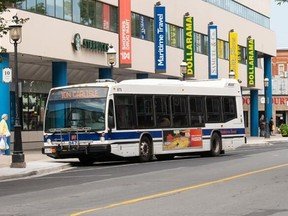
Fredericton Transit is testing out a modification to hybridize an eight-year-old city bus that could reduce its emissions by up to 90 per cent, and fuel consumption up to 32 per cent.
Article content
The pilot project to trial the HY-RANGER, developed by Ontario-based company HYGN Energy and already in use in Sudbury, Kawartha Lakes, and Sault Ste. Marie, was passed by city council.
Greenfoot Dynamic Solutions, an offshoot of Greenfoot Energy Solutions, recently procured the rights to move production of the hydrogen energy stems at their facility in Scoudouc, N.B. Greenfoot offered to install the HY-RANGER free of charge on a diesel-powered city bus for four weeks to allow the city to gather its own data on the device and see if it’s something it would like to pursue.
Greenfoot Dynamic partner and technical advisor Nathan Kavanaugh says that for the system to work, “you’d put three litres of water into this thing, and you’d be able to last a month.”
“This hydrogen gas just gets sucked up with the normal intake air, and it allows for cleaner, more efficient combustion.”
Article content
Kavanaugh said the aim is to bring the technology, already tried in a handful of municipalities in Ontario, to the east coast.
He said data shows the return on investment for the HY-RANGER is usually a little over four months, with the reduction in fuel consumption. Previous testing done in Ontario shows that reduction could range from 10 to 30 per cent. The same testing showed the range for emissions reduction are 60 to 90 per cent.
“We want to compare our data to their data … that they’ve already trialed this equipment on the same buses that we have in different municipalities,” said Scott Brown, the city’s assistant director of engineering and operations.
The city is in the process of converting its bus fleet to hybrid diesel-electric vehicles at a cost of $1.4 million each as part of its corporate energy and emissions plan, with four already in service and six more on the way. But Brown says about 20 of the city’s older diesel buses still work just fine, so, “if this equipment does work as the literature that we’ve been provided says,” then the city could reduce emissions while still running the older assets that might not be replaced for another 10 to 15 years.
Kavanaugh, who recently joined Greenfoot as a partner, said he “didn’t believe” the technology worked when Greenfoot asked him to take a look at it when they were looking at buying it, even after seeing it installed on one of the company trucks.
“I found it too far-fetched. I figured, somebody would have thought about this,” he said.
“I did everything I could to prove that it didn’t work … long story short, I own a piece of the company.”
Share this article in your social network