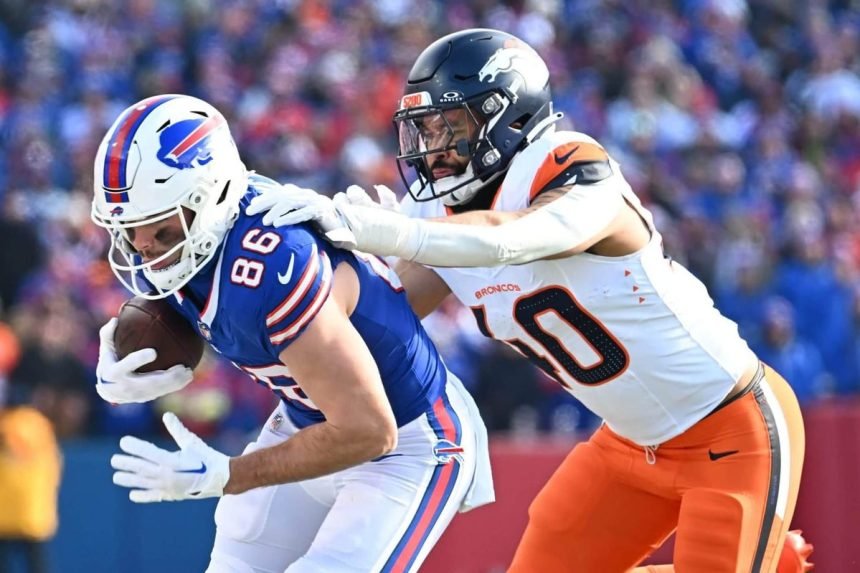
The AFC features a divisional round rematch from last year’s playoffs. The Buffalo Bills overwhelmed the Denver Broncos last season, but this is an improved Broncos team led by a more mature Bo Nix. The Broncos are the No. 1 seed, but some factors favor the Bills. Can the Broncos overcome them?
The Houston Texans defense had the most complete game of any unit last season. How can the New England Patriots move the ball against them?
We’ll look at the most important matchups on both sides of the ball in the AFC’s two divisional games this weekend.
Buffalo Bills at Denver Broncos (4:30 p.m. ET Saturday)
Key matchup: TE Dalton Kincaid vs. Broncos linebackers
From weeks 11 to 17 (the opposing Kansas City Chiefs rested starters in Week 18), the Broncos had a defensive drop-off, going from elite to very good. They still were a very disruptive defense in that span, leading the league in negative play rate (37.2 percent), but dropped to 10th in success rate (57.1 percent), 23rd in EPA per dropback (-0.13) and 21st in points per drive (2.25). Notably, they struggled against mobile quarterbacks. Marcus Mariota, Trevor Lawrence and Jordan Love, even though he doesn’t run as much, had success extending plays and scrambling against the Broncos.
Aside from Josh Allen’s ability to create off-script plays, there are a few ways the Bills offense matches up favorably against the Broncos defense. The Broncos defense specializes in taking away outside receivers with cornerbacks Patrick Surtain and Riley Moss, and of course, that will be an issue for the Bills, but they don’t rely on their outside receivers winning at a high rate to move the ball. The Bills rank fifth in receiving yards to tight ends and running backs.
In the playoff matchup with the Broncos last season, the Bills were able to run for 210 yards on a defense that ranked first in success rate that year. More importantly, they took advantage of the Broncos’ linebackers by targeting running backs and tight ends (seven catches for 101 yards). Dalton Kincaid has missed several games this season with injuries, but he’s improved as a player and should be a major part of the Bills’ game plan.
The Broncos have given up the ninth-most yards to tight ends this season and the eighth-highest average yards per reception to tight ends (10.7). They major in man coverage, but their linebackers don’t play man coverage at a high level. Dre Greenlaw should help, but he’s a better zone defender. Strong safety Talanoa Hufanga is elite in so many areas but weak in man coverage as well.
The Bills should have a similar game plan to last year’s playoff game and target Kincaid. We could even see running back Ty Johnson run some routes against the linebackers.
Key matchup: Bills defensive coordinator Bobby Babich vs. QB Bo Nix
Bills coach Sean McDermott and defensive coordinator Bobby Babich are doing their finest work this season with the defense. It has had injury issues upfront and is being pieced together by retread players such as 34-year-old safety Jordan Poyer and cornerback Tre’Davious White, who has a long injury history. But what they lack in athleticism, they make up for with knowledge of the system and savvy. The Bills are disguising at a high level and constantly breaking tendencies. It’s hard to get a bead on what they are doing with their pre-snap movement.
Trevor Lawrence and the Jacksonville Jaguars’ passing game were on a tear coming into the postseason. The Bills held them to 7 points in the first half, but Poyer was hurt late in the second quarter. Poyer’s injury limited what they could do from an exotic coverage standpoint, but with more practice time with his replacement, Jordan Hancock, the Bills should be able to crank the dial up with their disguises more.
6:48 remaining in the third quarter, first-and-10
Here, the Bills initially showed two-high coverage with both safeties sitting deep.

After the snap, Hancock rotated down, making it appear the defense had rotated into a one-high coverage. Lawrence thought he would have tight end Brenton Strange open down the seam, but the Bills actually rotated a different two-high coverage than the initial look. They played inverted Cover 2 toward Strange’s side, meaning White was playing a deep half rather than staying outside.

White was able to run underneath Strange and nearly pick off the pass.
Bo Nix has struggled against disguised coverages this season. According to Pro Football Focus, when Nix faced two-high switching to one-high coverage rotations, his EPA per dropback was -0.26. Against one-high switching to two-high coverage rotations, his EPA per dropback was -0.02. To put that in perspective, Tennessee Titans quarterback Cam Ward ranked 33rd in EPA per dropback among qualifying quarterbacks, and it was -0.15. Nix’s performance dips significantly against disguised coverages, and the Bills disguise on 40 percent of snaps (league average is 33 percent).
Although the point has been made ad nauseam, it’s imperative the Broncos run the ball efficiently and keep Nix out of third-and-long situations where the Bills can get exotic. The Bills have statistically one of the worst run defenses in the league all season, but they’ve had some spike games when some of their run blitzes and line games hit home. The Jaguars did a good job using motion to displace them, and their running backs ran for 121 yards on 15 carries (8 yards per carry). They should have run the ball more.
The Broncos rank 12th in rushing success rate and explosive run rate. They are better than average at running the ball, but I’m not sure I’d trust them to dominate and completely take the ball out of Nix’s hands. If the game becomes a high-scoring one and they get into a passing script, how Nix can decipher the Bills’ disguised coverages will be key.
Houston Texans at New England Patriots (3 p.m. ET Sunday)
Key matchup: RB Rhamondre Stevenson vs. LB Henry To’oTo’o
Last week, for the Steelers-Texans game, I highlighted Pittsburgh running back Kenneth Gainwell’s matchup with Houston linebacker Henry To’oTo’o, who is a hyperaggressive player against the run but can struggle against the pass. Gainwell ended up converting six targets for four catches and 26 yards. He led the Steelers in catches and was tied for second in receiving yards. He was a big part of the Steelers’ game plan. He was open on several plays and dropped a pass, but ultimately, he had to chip the Texans’ ends on too many plays and couldn’t free release.
There aren’t many weaknesses in the Texans defense, and they have matchup advantages across the board against the New England Patriots’ pass catchers. Running back Rhamondre Stevenson had his most productive game as a receiver last week against the Los Angeles Chargers, catching three passes for 75 yards. Patriots offensive coordinator Josh McDaniels is one of the best at drawing up plays for pass-catching running backs.
The Patriots offensive line struggled to block the Chargers’ pass rush. The Texans’ pass rush is on an entirely different tier. Quarterback Drake Maye is going to have to get rid of the ball quickly. Quick passes to Stevenson or TreVeyon Henderson running routes against To’oTo’o should be an effective tool on early downs.
Key matchup: DT Milton Williams vs. Texans interior O-line
Milton Williams, one of the Patriots’ best defenders, missed all of December with a high ankle sprain. He came back for the final game of the season, and although he still hasn’t quite looked like himself, he flashed against the Chargers, sacking Justin Herbert twice.
The Chargers have arguably the worst offensive line in football, and there were quite a few plays in which Williams wasn’t disruptive. But maybe being another week removed from his injury and two games under his belt to get into game shape, we’ll see the Williams who was dominant at the beginning of the season.
The Texans don’t have an explosive run game, but they’ve become an efficient running team after making Woody Marks the lead back and getting more entrenched in first-year offensive coordinator Nick Caley’s scheme. Against the Steelers in the wild-card round, the Texans rushed for 164 yards, averaging 5.3 yards per carry. The Texans are a below-average pass-blocking team, and their offense was able to turn the corner when they started reducing the rate at which they faced third-and-long situations.
Before Williams was hurt in Week 11, the Patriots ranked eighth in defensive rushing success rate. In the six games he missed, they ranked 31st. The Patriots need Williams to be a stalwart for their run defense against a Texans offense that wants to run the ball on early downs and reduce risk.