In the world’s premier best-on-best tournament, the two leading ice hockey organizations have made every effort to follow a standardized set of rules when it comes to on-ice officiating. Despite those attempts, there have been some notable differences in how those rules are applied in the NHL vs. international play, particularly in regard to goaltender interference.
Both Czechia and the U.S. have come out on the losing side of such calls during the group stage of the tournament.
The stakes were especially high in the game between Czechia and Switzerland on Sunday. It was each team’s last outing of the preliminary round, and whoever won would clinch 2nd place behind Canada in Group A, so there were major implications for playoff seeding.
With just over three minutes left in regulation and Switzerland up 3-2, the puck slipped past goalie Leonardo Genoni — but not before Czechia’s David Pastrnak bumped into him just outside of the blue paint. The goal was immediately waved off by officials. Czechia was able to get the tying goal not long after, but Switzerland triumphed 4-3 in overtime.
By NHL standards, if an attacking player makes incidental contact with a goalie outside of the goal crease, the goal will stand as long as a player “made a reasonable effort to avoid such contact.” The IIHF rules have a similar stipulation, but in practice, the tolerance is seemingly lower.
Whether Pastrnak’s brush with Genoni was “incidental” or not is at the center of the debate. Pastrnak never entered the blue paint, remaining up to a foot in front of the crease the whole time. Genoni was pushing off towards the approaching Pastrnak when the contact was made, so it was the combined momentum of both players that caused the contact between Pastrnak’s elbow and Genoni’s head. (The Swiss goalie was not injured on the play.)
Czechia’s game-tying goal in the third period against Switzerland was called off after David Pastrnak made contact with goalie Leonardo Genoni in front of the net. Switzerland went on to win 4-3 in overtime.
Jared C. Tilton/Getty Images
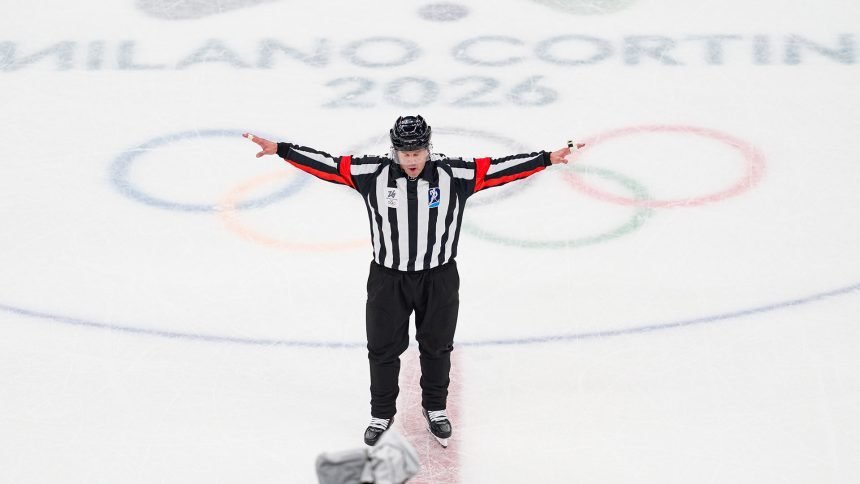
It was actually NHL referee Chris Rooney who made the call. The Olympic tournament features a blended team of NHL and IIHF officials, and both sides worked closely over the past six months to make sure everyone was in agreement about how the international rules would be applied.
More than that, the NHL and IIHF have gotten the two sets of rules to be closer to standardized than ever before since the last time NHLers participated in the Olympics 12 years ago. Much of the language is extremely similar, if not identical, in portions of the rulebooks. That includes the sections on goalie interference.
Still, interpretation of the rules can come down to individual judgment. A comparable situation happened earlier in the NHL season — with the opposite result. In a game on Nov. 22, Columbus Blue Jackets forward Miles Wood was skating laterally at the front edge of the blue paint when he clipped Detroit Red Wings goalie Cam Talbot’s arm. It was enough to impede the movement of his glove hand, and he had little time to recover before Wood deflected a shot into the net.
The Red Wings challenged the play, but the call on the ice was confirmed and the goal stayed on the board. The NHL’s official explanation after the game classified the contact between Wood and Talbot as incidental.
Using that lens to revisit Czechia’s no-goal, both Wood and Pastrnak were in a very similar area of the ice when contact was made with the respective goaltenders. It’s worth noting that the primary point of contact was Talbot’s arm as opposed to Genoni’s head, which may have factored into the two different outcomes. But by the letter of the law, Wood’s contact was deemed incidental and Pastrnak’s was not, despite the similarities in the nature of the hit.