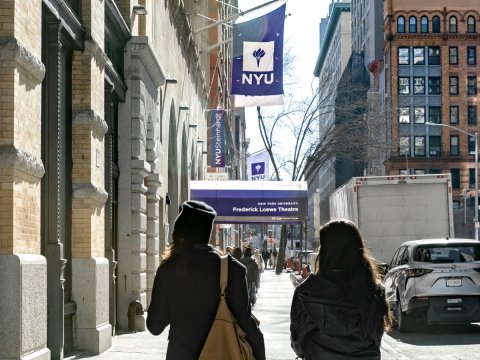
New York University has received the 2026 Carnegie Community Engagement (CE) Classification, a prestigious designation awarded by the American Council on Education (ACE) and the Carnegie Foundation for the Advancement of Teaching for the University’s commitment to community engagement. NYU is one of 230 institutions of higher learning—and one of 80 private colleges and universities—to receive this honor. NYU’s community engagement initiatives were also cited by the Carnegie Foundation in both 2006 and 2015; this year’s award is considered a renewal—or a “reclassification”—of those previous awards.
“It is an honor to receive this distinction from the Carnegie Foundation—for the third time—in recognition of the University’s long-standing commitment to community engagement,” says NYU President Linda G. Mills. “At NYU, that commitment takes many forms, from expanding education access with the NYU Promise, to helping young students throughout the city acquire key math and reading skills, supporting our local entrepreneurs, or fostering a culture of civic participation. We thank the Carnegie Foundation for this recognition.”
The Carnegie Foundation’s Community Engagement Classification is awarded to institutions that have a strong focus on community engagement. The purpose of the award is to promote and encourage partnerships between universities and their communities in order to enrich scholarship and research, strengthen democratic values and civic responsibility, and contribute to the public good.
As examples of NYU’s rich history of community engagement, consider just last year alone:
- More than 16,000 NYU students performed over 1.7 million hours of service;
- More than 10,000 students participated in 1,057 community-based learning and service-related courses;
- NYU celebrated its 28th year as the largest America Reads/America Counts program in the country—with 800 students providing 10 to 12 hours of weekly tutoring in 73 NYC public schools.
“The Carnegie Foundation’s 2026 recognition means that, through teaching, learning, research, and service, we are succeeding in creating local campuses globally,” says NYU Provost Georgina Dopico. “Much has happened in the world since we were last honored 11 years ago, but we continue to reaffirm the importance of collaborations between community partners, students, faculty, administrators, and staff; they connect us to one another and as citizens of the world.”
The CE Classification has been the leading framework for institutional assessment and recognition of community engagement in US higher education for the past 19 years with classification cycles going back to 2006. Under the leadership of the 2026 Carnegie Reclassification Steering Committee, four dedicated working groups from across the University’s various schools, departments, and central administrative units conducted in-depth research and data collection to align with the Carnegie framework, ensuring a comprehensive and institution-wide approach.
Some of the wide-ranging community engagement programs that the University cited in their application for this cycle’s reclassification include:
- The NYU Promise, which guarantees every undergraduate admitted to the New York City campus will not have to pay tuition if they have family income under $100,000; while at the graduate level, the NYU Grossman School of Medicine made history as the first medical school in the nation to go tuition-free in 2018; the NYU Grossman Long Island School of Medicine followed suit when it was established in 2019.
- The America Reads/America Counts program at NYU, the largest in the nation, aims to improve educational outcomes for children in kindergarten through eighth grade. Currently, more than 800 America Reads/America Counts tutors provide 120,000 hours of academic assistance to local students each year.
- The non-partisan NYU Votes initiative was created to improve student registration and voting rates at NYU by making the process more visible and accessible. (Between 2014 and 2018, the NYU student voting rate for the Midterm Elections quadrupled.) For each election cycle, NYU Votes partners with more than 130 campus ambassadors on a marketing campaign that includes messaging, events, discussions, and more.
- Along the same lines, the Veterans Future Lab offers free training programs, mentorship, and resources for active duty service members, veterans, and their spouses who seek to learn entrepreneurial skills or pursue business ventures.
- The Community Engagement and Population Health Research at NYU Langone, in concert with the Grossman School of Medicine, fosters collaborative health research with community members, ensuring public health strategies reflect the lived experiences and needs of local populations.
- The NYU Entrepreneurial Institute provides the NYU community with coaching, mentoring, and workshops to support the success of their start-up ideas. Over the past five years, invention disclosures have more than doubled, licenses have increased by 36 percent, and demand for coaching has increased by 50 percent, indicating the success of these programs and an increased emphasis on societal impact among NYU’s research community.
- The NYU Production Lab serves as an experiential learning bridge between the classroom and a career in the creative industries. Since opening in 2015, the Lab has pledged over $515,000 in artist development to the NYU community. Beyond specialized programs for dancers, filmmakers, and television writers, the Lab has hosted more than 150 career-oriented events, invited over 200 arts and entertainment industry guests to speak, and produced 21 podcast episodes.