When he chose Jackson Park for the location of his landmark presidential center nearly a decade ago, former President Barack Obama said he wanted the development to become the engine for a South Side economic resurgence, spurring new residents to move to the area, more businesses to open, additional fixes to infrastructure and better jobs for locals.
With construction now nearly finished, Obama Foundation officials are touting the thousands they hired for the work by setting the names in stone at the site, marking them in a release as “essential partners in building a world-class institution rooted in community, opportunity, and shared prosperity.”
The next phase of the center’s impact will be less concrete and more difficult to measure, though: whether it sticks to the foundation’s guiding principles of attracting private investment, strengthening the local economic climate and helping longtime working-class neighbors build wealth without pushing them out.
There’s uncertainty as it approaches its June opening.
Michael Strautmanis, the foundation’s chief corporate affairs officer, said he hoped construction and initial hiring were just the beginning of catalytic public and private development in Woodlawn and South Shore, but said “there’s real hubris in thinking that the Obama Foundation is going to reverse hundreds of years of disinvestment. It’s just not.”
But John Betancur, a professor of urban planning and policy at the University of Illinois Chicago who has studied gentrification locally, is skeptical that residents will be protected from getting displaced by the new investments the presidential center hopes to bring.
Obama “argued he was doing a favor to the South Side by bringing development, as if development is something good, disregarding the shakeup that these places do to that area and of course the displacement of the most vulnerable households,” Betancur said.
The foundation is marking the imminent completion of construction by announcing the center will include a Worker Appreciation Wall. The 30-foot long Corian dedication will include the bronzed, etched names of roughly 4,500 construction workers, foundation staff, and vendors.
For the first time, the foundation also released the names of some 400 businesses that took part in the project, from construction and design firms to curators, artists, acoustic consultants, stone suppliers and landscapers.
They include Chicagoland companies like Manual Cinema, a performance and production collective known for its shadow puppetry that created two films for the museum; Civic Projects Architecture, which helped design the permanent exhibit galleries; and dozens of other local and national construction contractors and vendors.
The foundation set diverse and local hiring goals for construction, which was overseen by a minority-led joint venture of four firms known as Lakeside Alliance. Through the end of 2024, just under half of all workforce hours were done by city residents — a third by workers from the South and West sides, according to the foundation’s annual report.
“Everything about it was different” compared with other projects, said Kelly Powers Baria, the executive vice president of lead minority partner Powers & Sons Construction. It was the first time the four minority partners teamed up and featured one of the city’s most ambitious diverse contracting and apprenticeship goals — 1,400 candidates took part in the foundation and Lakeside consortium’s prep classes and construction pre-apprenticeship programs. Of those, over 500 were placed in trade and non-trade positions across the city, including at the Obama Presidential Center.
One of those apprentices was Lewis DeJan, who became a “dinosaur carpenter” — one of the older tradespeople to work on the project — with Carpenters Local 10. An ex-air traffic controller for the U.S. Navy and former chef and truck driver, DeJan, now 55, signed up to learn a trade after hearing about OPC opportunities through a partner career readiness program at St. Paul Community Development Ministry.
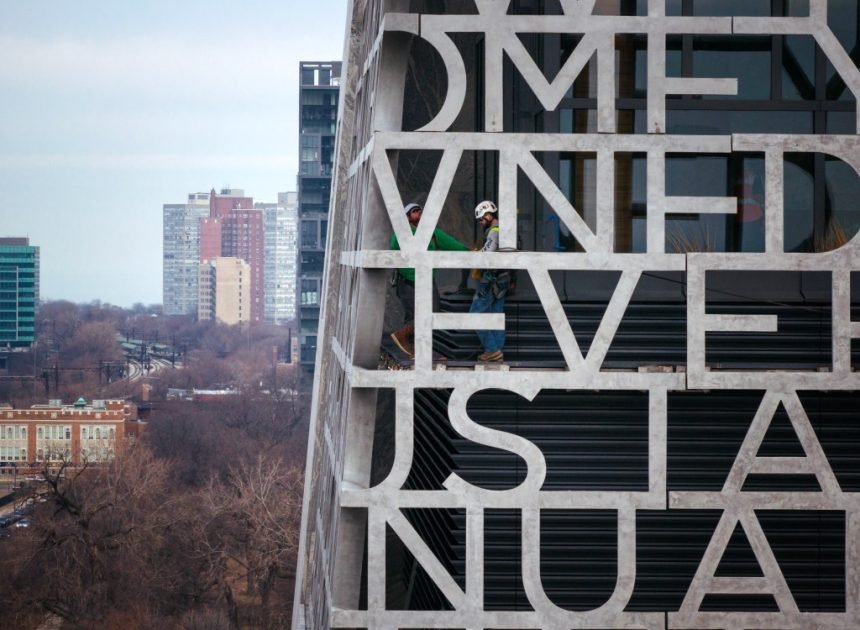
“My DNA is all over the Selma speech,” DeJan told the Tribune in a phone interview, a reference to the text of Obama’s 2015 address at the Edmund Pettus Bridge that wraps around the top of the museum building. DeJan was dispatched to Shaffner-Heaney Associates in South Bend, Indiana, in the spring of 2023 to manage the Scrabble board of letters from the speech, made of high performance concrete letters hardened in fiberglass molds.
The makeup of the center’s construction workforce has been relatively easy to measure by setting priorities and tracking payrolls. It’s a similar story for the roughly 150 people who will be hired to work at the center itself – ranging from security and front desk staff to docents and servers. The foundation hopes to pull from nearby neighborhoods for those jobs.
After June, when the center begins welcoming visitors, the economic ripple effect the president hopes for will largely be out of his hands.
Over breakfast at Daley’s, Chicago’s oldest restaurant located a 15-minute bus ride from the OPC, Strautmanis said beyond prepping businesses to welcome tourists, their role is “force amplification.”
“We kind of resist doing it all and owning it all,” he said. “I think if we set the goal out there and create space and room for others to participate in it while doing our part, I think that’s always been (Obama’s) strategy, and that’s why working with a community organizer is both fun,” he continued, and “a little messy.”

The upside of the neighborhoods’ continued home and business vacancy is room for growth, Obama center boosters say. That growth takes money, a bet that some financiers are unwilling to make, Strautmanis conceded.
“What I have seen is that for people who want to make investments into this neighborhood, it doesn’t, I think the phrase is, ‘pencil out,’” Strautmanis said. “You know, the density isn’t here, the income level isn’t here yet. To me, this is why the decision that President Obama and Mrs. Obama made to come here was so bold and important, right? It was a risk.”
His next task is to convince potential investors “the water’s fine.”
The foundation is also partnering with businesses in Woodlawn, South Shore, Washington Park and Bronzeville to combine their buying power and help save money. The first announced venture of that shared purchasing network involved the foundation and more than 100 businesses jointly procuring trash, recycling and compost services, cutting costs in half for about 60% of participating businesses, according to Ghian Foreman, president and CEO of the Emerald South Economic Development Collaborative. The same could be replicated for restaurant supplies or utilities, he said.
Some residents are taking business into their own hands: Airbnb reported earlier this month that hosts in the 4th, 5th and 20th Wards earned more than $15.1 million from hosting visitors in 2025. With the center’s opening, “the opportunity for locals to economically benefit from a surge in visitors will only grow too,” Airbnb’s Janaye Ingram said in a statement. The foundation hosted a training session for hopeful hosts last week.

The city has played a role in prodding investment with land sales and grants. In 2019, a mix of city, state and private dollars funded “Woodlawn Station,” a mixed-use development with commercial space on the street level and affordable housing from developer POAH above. It’s located just off the Green Line stop at 63rd and Cottage Grove Avenue, where Daley’s relocated. The new Friend Family Health Center is a short walk away.
As part of its slew of grant programs, the Chicago Department of Planning and Development has also given out $5.3 million to 33 small businesses near the center. Ranging from restaurants to child care businesses, 19 projects have been completed over the last seven years and the rest are under construction. Local chambers in Woodlawn and South Shore were awarded another $7 million to fill vacant storefronts along 63rd and 71st streets and Stony Island Avenue.
There are at least three recently city-approved condo and apartment buildings on 65th Place and 66th Place. Another is planned for the 6500 block of South Blackstone Avenue. Other major projects include the Land School — an arts incubator and former home of St. Laurence Catholic Elementary School on 72nd Street — which opened in September.

Thrive Exchange on 79th Street, an apartment building and part of former Mayor Lori Lightfoot’s Invest SouthWest program, is also opening this spring, as is the Urban Market Exchange, a maker space on 67th Street.
But several larger scale projects are still in early stages.
The 59th and 60th Street Metra station is set for a nearly $75 million facelift, which reportedly won’t finish until 2030.
At Daley’s old address, another mixed-use Invest SouthWest project announced in 2023, Woodlawn Social, is still awaiting an application for low-income housing tax credits from the city’s Department of Housing.
The proposed Revive 6300 just south of the Green Line station would transform the crumbling Washington Park National Bank Building into office and retail space and revamp the Coleman Chicago Public Library branch. First pitched in 2019, it still has not broken ground.

It’s a similar story for the Rev. Byron Brazier’s ambitious Woodlawn Central megadevelopment. First unveiled in 2021, it just began its journey through the city’s zoning approval process. A 26-story hotel in the 6400 block of Stony Island cleared the Plan Commission in September, putting a potential opening likely years away.
If and when development picks up, Betancur argues the OPC will have the same effect that The 606 had on Logan Square and Humboldt Park — an accelerant for gentrification already underway in Bronzeville and near the University of Chicago.
“That you have a lot of vacant land doesn’t mean there’s going to be room for everybody,” Betancur said. The key, he said, is what happens to land values because of that development. “Land prices go up so high that they work their way through and people cannot afford the increases in rent, in taxes, and have to move. The point is the foundation thinks like Obama, because we are bringing development that is great for the Black community, well good luck. It’s not great for people that live in an apartment that doubles in price.”
A South Sider who grew up at 73rd and Coles Avenue in South Shore, not far from Michelle Obama’s childhood home, dinosaur carpenter DeJan said he’s looking for his next construction job, but in the meantime it’s been a major point of pride to glimpse the letters that form President Obama’s famous words mounted for all to see.
He’s gotten choked up recalling what his future boss said at an event a few months before he was hired: “‘Most buildings are built in America to last 50 to 100 years,’ he said, ‘This building is going to be up as long as there is an America.’”