SAN ANTONIO – The Perseids are coming!!
One of the best meteor showers of the year and happens every August. This year looks to be a dazzling show to enjoy a warm night outdoors spotting these meteors streaking across the sky.
The Perseid Meteor Shower is a result of Comet 109P/Swift-Tuttle discovered in July of 1862 by Lewis Swift and Horace Parnell Tuttle. The comet itself is about 16 miles wide and takes roughly 133 years to orbit the sun. The last pass close to earth occurred in 1992. Every year, earth passes through the comet’s trail of particles resulting in the Perseid Meteor Shower as they tend to enter the earth’s atmosphere in the northeast sky near the constellation Perseus.
These particles range from the size of sand grains to small M&M candies and enter the atmosphere at an average speed of 36 miles per second. They quickly vaporize with intense heat upon entry and larger meteors can produce fireballs that streak across the sky. Rarely do these meteors actually reach the ground.
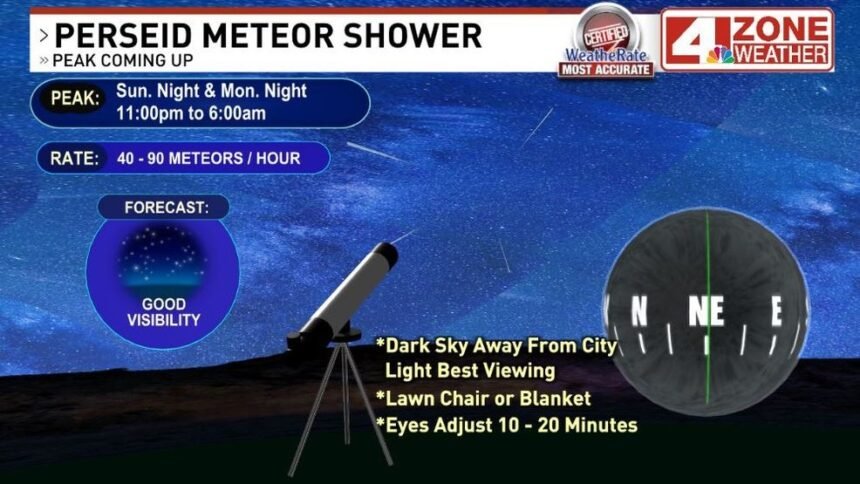
For viewing purposes, the darker the sky the more you’ll see. In and around San Antonio, city light pollution will reduce you to the brighter meteors zipping across the sky. This cuts the rate down to around 40 or so meteors per hour which is still very good. Further out from the city in darker skies of outlying suburbs, the rate should increase to 50 – 70 meteors per hour. If you’re able to enjoy very dark rural Texas night skies, a dazzling 80 to possibly close to 100 meteors per hour is possible.
In addition, light pollution from the moon will be kept to a minimum this year. The first quarter moon will set around or before midnight and drop well below the horizon line through the night.
Peak nights for viewing are this Sunday night and again Monday night. Best times for viewing area between 11pm and near daybreak. It is worth noting, you very well could see meteors several nights before and after the peak nights from this shower, but the peak viewing nights are those two nights with the highest rates.
There is no need for a telescope or binoculars. Just take a lawn chair or blanket out, give your eyes a good 10 to 20 minutes to adjust to the night sky and look toward the northeastern sky where the bulk of them originate.