



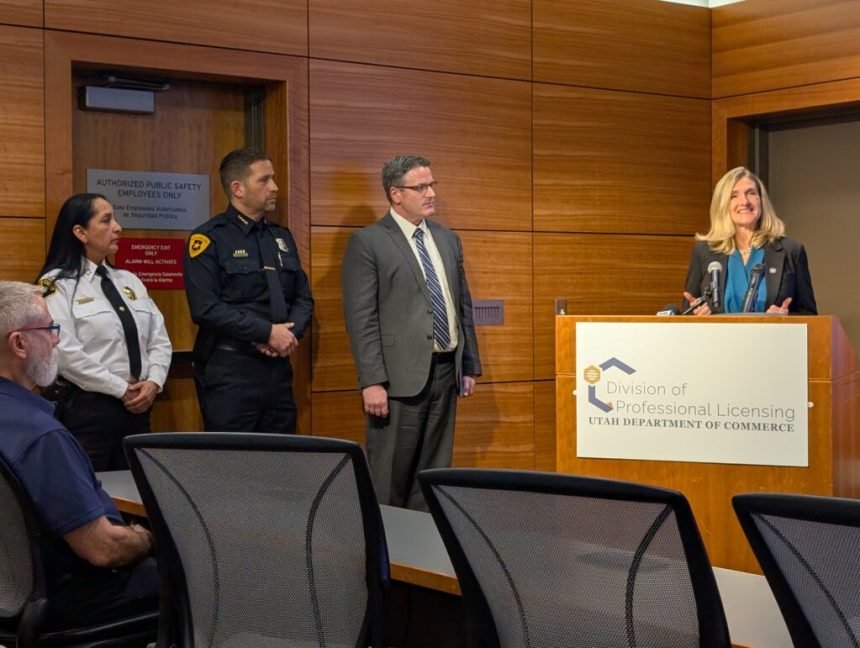
Margaret Busse, executive director of the Utah Department of Commerce, speaks about a new Utah law regulating illicit massage businesses at a news conference at the Salt Lake City Public Safety Building on Jan. 14, 2026. (Utah Department of Commerce)
When one illicit massage business is shut down in Utah, police and state regulators say another opens nearby.
And when they suspect prostitution and human trafficking may be happening behind storefronts with neon signs, they told reporters on Wednesday, they often get nowhere because workers won’t talk to them and owners disappear.
Their shared frustrations are the basis for a new state law they say will help them hold bad actors accountable.
“This is your warning. Get out of town. Get out of our state,” Margaret Busse, executive director of the Utah Department of Commerce, said at a news conference in Salt Lake City. She said the illegal operations detract from the hard work and professionalism of massage businesses offering legal, safe therapy.
The 2025 law removes a “glaring administrative loophole” that allowed state licensors to punish only the workers and not the business owners, Busse said. “We are now able to shift our site from the exploited to the exploiters.”
SUBSCRIBE: GET THE MORNING HEADLINES DELIVERED TO YOUR INBOX
The new law requires massage businesses to register with the agency this year, mandates background checks and finger printing for owners and general managers, and gives the state authority to carry out inspections.
“And in fact, it’s unlawful conduct to resist, to lock the door, to keep the inspectors from entering the premises to ensure compliance with the law,” said Mark Steinagel, director of the Utah
Division of Professional Licensing. He said Utah gives inspectors similar power to see pharmacy records and contractor job sites.
The law took effect in October, and the Commerce Department plans to make its registration form available to companies sometime in spring.
The division has long regulated individual massage therapists by requiring them to be licensed, but not the businesses and owners. If those owners don’t register in compliance with the new law, the state can inform city governments, which can then revoke their business licenses.
Salt Lake City Police Chief Brian Redd said of nearly 200 suspected illicit massage businesses in Utah, 61 are in Salt Lake City.
“It’s very hard to shut these businesses down,” Redd said. “It’s hard to get to the bottom of who the business owners actually are.” He said the new licensing system will help provide police with critical information in future cases.
The measure passed last year after an earlier version faced pushback from the American Massage Therapy Association, which said it would have weakened oversight, rather than strengthen it.
Roger Olbrot, a licensed massage therapist in Sugar House and a past president of the association, said the new law will help him and others separate themselves further from businesses they don’t want to be associated with.
“The people that I have talked to have been very excited about the fact that we can now segregate ourselves, good versus bad,” Olbrot told Utah News Dispatch. “I’ve been in the business now 27 years, and even today, I get solicitations for illicit practice.”
While some other states already have similar laws requiring businesses to register with the state, “they lack teeth because of resources,” said Jeff Shumway with Utah’s Office of Professional Licensure Review.
In Colorado, Aurora passed an ordinance to the same effect, raising requirements to obtain a massage business license and making it easier to revoke.