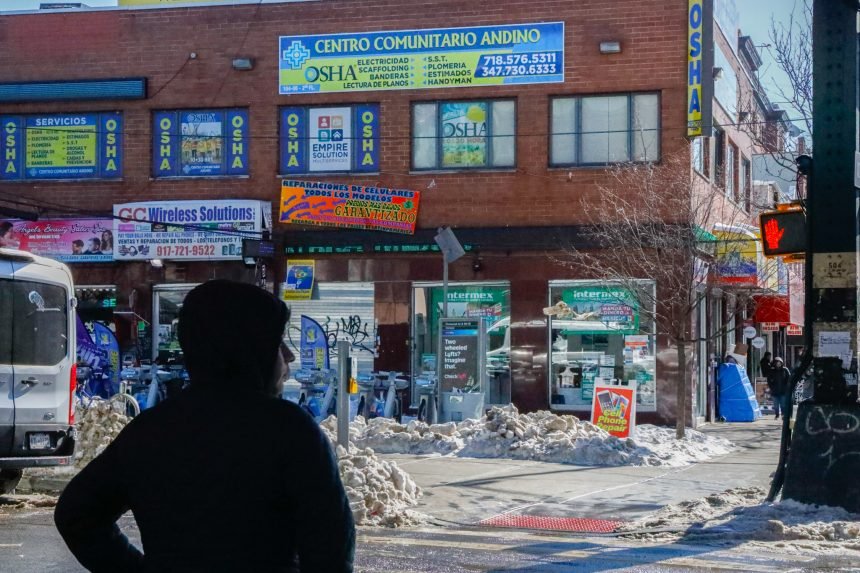
After a three-year rise, fewer immigrants decided to call New York State home in 2025, according to Census Bureau data released last week. The drop in foreign-born people moving to the U.S. occurred nationwide, but immigration advocates pointed to one major issue driving them out of the state: affordability.
“I’ve firsthand heard from so many people that it’s so expensive to live here, and these are new New Yorkers who came here and were dropped off here, living at shelters, trying to make it,” said Tania Mattos, executive director of Unlocal, a nonprofit that provides legal representation to immigrants in New York City.
Unlike years prior, finding a job in New York without a Social Security number or a work authorization card has been more difficult than before, Mattos added.
The Census Bureau’s data shows roughly 96,000 immigrants moved to New York State in 2025, down from 290,637 in 2024. The state’s overall population grew by 0.5%, or 1,008 people, in the same period.
By comparison, in 2023, 211,383 immigrants moved to the state, while 121,570 immigrants settled in New York in 2022. In 2021, 28,772 immigrants were counted as new New Yorkers, an outlier in the broader trend because of the COVID-19 pandemic.
Mattos predicted the numbers are trickling down to “normal” after governors, including Greg Abbott (R-Texas) and Doug Ducey (R-Arizona), bused thousands of immigrants from the Texas-Mexico border to sanctuary cities like New York, Chicago and Los Angeles starting in 2022, likely contributing to the surge. In 2023, crossings at the U.S. southern border hit record numbers, with 3.2 million people recorded that year.
Before the pandemic, between 2015 and 2019, an average of 68,417 immigrants were moving to the state annually.
Economists and immigration experts said they worry about the impact of immigrants leaving the state.
“New York cannot afford to lose immigrants from our communities and our economy,” said Emily Eisner, an economist at the Fiscal Policy Institute, an independent, nonpartisan think tank that researches economic policies.
“International immigration into New York State constitutes a huge driver of the state’s economic growth. Without an annual influx of immigrants, New York’s population tends to fall, threatening the state’s tax base and economic strength.”
Eisner said that without immigrant labor and economic contributions, prices could spike further.
“Immigrants supply essential labor to the economy, such as construction work, food services, healthcare, childcare, and home care,” Eisner added. “Without robust immigration into the state, prices on these essential goods and services will soar, and the economy will contract.”
Although they want to stay, many New York immigrants who decide to leave for more affordable options are often forced to move to non-sanctuary cities and face a greater risk of being harassed or detained by Immigration Enforcement agents. They have to move to places like Idaho, according to Mattos, or places that are “economically better for them.”
For centuries, New York has been known as a home for immigrants, with some of the first European settlers calling the city home in 1624. Around 4.6 million New York State residents are foreign-born, according to 2024 Census data, and roughly 3.1 million of them live in New York City.
With immigration declining, the city risks losing its culture and economic growth, according to David Kallick, director of Immigration Research Institute, a nonprofit, nonpartisan think tank that studies immigrants’ economic, social, and cultural integration in the nation.
“When newcomers arrive from around the country and around the world, they bring in a steady flow of new energy and new ideas,” Kallick said.
“Shutting that dynamo down will have negative impacts on all of us. Especially as the state population ages, we are going to sorely miss this new energy.”