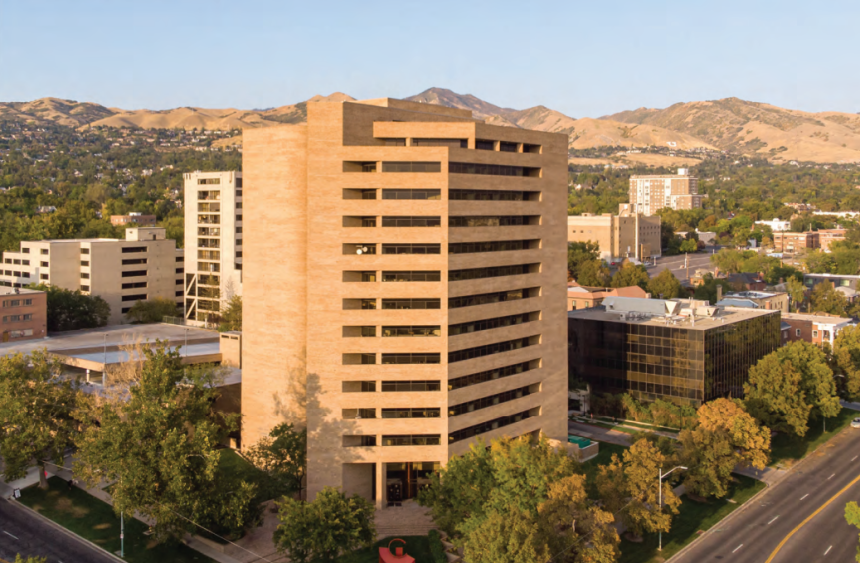
A bold strategy aimed at financially empowering Salt Lake City renters is paying dividends — literally.
Months after cutting the ribbon at its Central City tower, the Perpetual Housing Fund’s profit-sharing housing model will continue to press forward with new builds on the horizon. The fund’s first building quickly leased all of its residential units, and it’s also seeing success in filling its other spaces in the mixed-use tower.
The nonprofit shared some of its latest updates with members of the Salt Lake City Council on Tuesday during a meeting of the Community Reinvestment Agency — which is the agency that first helped it get started.
The PHF model first kicked off with funds it got from the CRA back in 2023, which were used in part to purchase of the former HK Tower at 515 E 100 South. The funds, which totaled over $10 million at the time, came from a federal COVID relief bill, the American Rescue Plan Act (ARPA).
The HK Tower later became Arbor 515, as the building was converted from a 14-floor office tower into a multi-use building. The tower has 96 residences in the middle floors, as well as office and coworking floors, plus a Montessori school on the second level. The tower opened last fall, which drew state and local leaders to the building.
The PHF model works by taking the profits that are typically gained by LIHTC developers and puts that money back into the hands of tenants, including a building’s annual cash flow or profits from the refinancing or sale of a building.
Future PHF projects
Chris Parker, co-director at the PHF and director at Giv Group, a nonprofit development company, previously said during the October ribbon cutting he was planning to acquire additional properties in the hopes of implementing the same profit-sharing programs at other sites.
Chris Parker, right, speaks during a press conference alongside Lt. Gov. Deidre Henderson, left, and Gov. Spencer Cox, center, for the Arbor 515 ribbon cutting in Salt Lake City. Photo by Jacob Scholl | Building Salt Lake
On Tuesday, Parker gave council members the latest updates on PHF projects, including the status of the Arbor 515 building and future projects.
“That site is 100% occupied, and it has been for some time,” Parker said of the residential units. He added that units filled up quickly, in part, due to half the units being family-sized and the school located on the second floor. He added that the Montessori school is currently looking to quadruple its square footage.
In addition to residential tenants, Parker also said the United Way is in the process of retrofitting the 12th floor of Arbor 515 into its future headquarters. The building’s two upper floors house a coworking space for nonprofits.
After the meeting, Parker told Building Salt Lake that it’s hard not to be emotional about Arbor 515’s success. Parker’s office is on the third floor of the building, and he said he regularly takes elevator rides with tenants who are building their wealth. He credited Salt Lake City and large institutions like Zions Bank, Intermountain Health and Goldman Sachs with being willing to support a new, unproven concept like the PHF’s.
“That’s not an easy check to cut,” Parker told BSL. “Politically, people cannot lose their seats or jobs by doing the safe thing, but the safe thing in a world that saw housing change dramatically over COVID just wasn’t really going to work, and they stepped up.”
Members of the council were equally supportive of PHF’s mission, with a number of members saying it’s a bright spot in a city where affordability is a constant battle.
“We needed good news,” said Council Member Alejandro Puy. “From our perspective, that $10 million that we put from ARPA funding probably is going to be the most impactful ARPA funding that we have invested in probably ever in our city.”
During his presentation to the council, Parker outlined a handful of PHF projects in the works in Salt Lake City. Some projects have already been known, but have changed in recent months.
Just north of Arbor 515, he plans to build an additional multifamily housing building where a parking garage currently stands. Parker said there’s two options: build within the guidelines of the existing MU-6 zoning, or go through the design review process to build taller with more units. Either way, Parker said the project could enter the permitting process soon.
“Generally, we’d like to go ahead and get a permit sometime this year, probably earlier in the year,” he said. “We’ll be submitting for a permit with the expectation that by the end of the year we will submit for a 4% LIHTC application for this.”
The median AMI for the new building would equal out to around 60% AMI, and Parker hopes the building would also have 25 affordable, for-sale condos with three bedrooms. Those for-sale units, ideally, would serve households earning between 80% and 120% AMI. He added that, “in aggregate, you would have virtually every person who cannot afford a home in Salt Lake City have a unit that they might live in in this structure.”
Later, Parker told BSL, “it’s no secret that we would like the taller building, but ultimately, that’s not by-right planning, so (I) can’t promise that we can build that.”
Among the PHF’s other projects is a slate of for-sale townhomes in the Guadalupe neighborhood. Previously, the plans for Project Open 3 called for 23 townhomes that would be sold to families earning no more than 80% AMI. The affordability level isn’t changing, but Parker said Tuesday the look and unit count of the development will shift.
“We had a powerline in front of the building, which created some interesting complications with fire code,” Parker said, adding the issues led to redesigning the building.
Now, the plans call for 20 for-sale condo units with three bedrooms. The target price for each unit would be around $300,000. He told BSL that the Project Open 3 development will feature two buildings with 10 units each, and each unit will have a parking stall.
A rendering of the updated plans for Project Open 3. Image via Perpetual Housing Fund
Another PHF project was borne out of the city’s affordable housing incentives that allowed additional density to be built on single-family home lots. Parker said one of the future projects would serve as a demonstration of what’s possible.
Located at 1000 W. 570 South in Poplar Grove, Parker said PFH is planning to build four to six affordable housing units on an existing single family home site. The home, which would continue to stand, is located on a double lot, he said, and abuts a small park to the west. He said the project would be done, “in a way that we feel will really fit with the character of this neighborhood.”
He also discussed the future of Palmer Court, as his Giv Group has been involved with the project that is slated to add 187 additional units to the permanent supportive housing project at 999 S. Main St. He said it’s possible that Palmer Court, which would be demolished and rebuilt after residents move into the new site, could consist of between 400 to 600 units in the future.
PHF has committed to creating 1,000 units in Salt Lake City over the next 20 years, and Parker said he has other projects in the works in Ogden and Moab. Parker’s Giv Group also purchased the Judge Building in Downtown Salt Lake City last year, which could serve as a site for additional housing in the future.
All those future units were made possible by the success of Arbor 515, and Parker told BSL the risks taken by the city’s elected and business leaders paved the way for the PHF model he hopes to implement around not only Salt Lake, but in other areas of Utah.
“That (takes) a huge amount of guts, and I think you’ll see ripples of that for at least decades,” Parker said.
A rendering of the Arbor 515 addition if built to the MU-6 zoning. Image via Perpetual Housing Fund
A rendering of the Arbor 515 addition if built to a taller height. Image via Perpetual Housing Fund