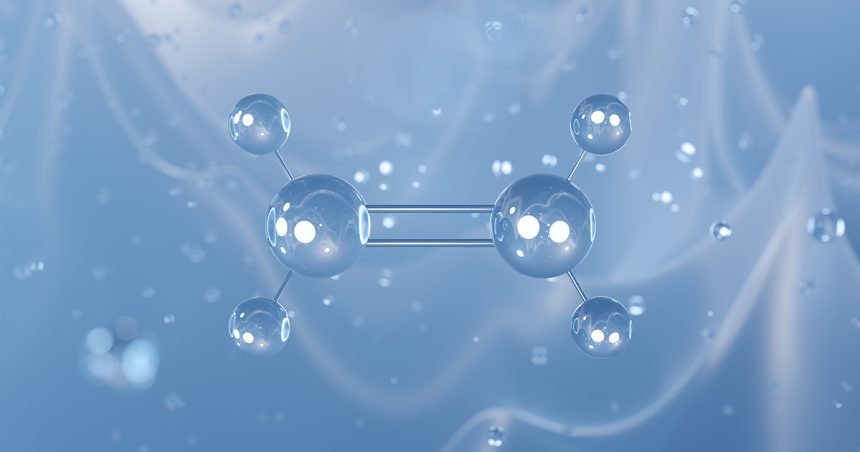
Ethylene is a key chemical used to make plastics, packaging, and many everyday products. More than 150 million tons are produced globally each year, most from natural gas and other fossil fuels, which release about one ton of CO2 for every ton of ethylene made.
The chemical can also serve as a building block for producing longer-chain hydrocarbons, including fuels in the jet-fuel range. New ways of making ethylene from carbon dioxide could therefore help supply the carbon needed for sustainable aviation fuels and other low-carbon chemical products.
A new technology developed in the lab of Professor Ted Sargent can efficiently make ethylene directly from carbon dioxide pulled from the air using electricity. By coupling carbon capture with electrochemical conversion, the approach turns atmospheric carbon dioxide into a useful chemical feedstock.
The team showed that if the system is powered by renewable electricity such as wind, the overall process could remove more CO2 from the atmosphere than it produces, omitting up to three tons of CO2 emissions for every ton of ethylene made. The renewable power source is not essential to the chemical process itself, but using low-carbon electricity significantly reduces emissions during the process.
“This work offers a pathway to turn atmospheric carbon pollution into useful materials while helping address climate change,” said Yuanjun Chen, the first author of the study.
Sargent is the Lynn Hopton Davis and Greg Davis Professor of Chemistry at the Weinberg College of Arts and Sciences, professor of electrical and computer engineering at Northwestern Engineering, and director of the Paula M. Trienens Institute for Sustainability and Energy. The work was presented in the paper “Dilute Alloy Electrocatalysts Enable Asymmetric C–C Coupling for Ethylene Production from a CO2 Post-Capture Liquid,” published March 10 in Nature Synthesis. Additional contributors to the paper include Ke Xie; Professor Jennifer Dunn; Hengzhou Liu, and Peiying Wang, now a post-doctoral fellow at Argonne National Laboratory
Xie is a research associate professor, Dunn is a professor of chemical and biological engineering at the McCormick School of Engineering, and Liu is a postdoctoral fellow in Sargent’s lab.

The new method to convert carbon dioxide acquired through direct air capture into ethylene uses a bismuth-copper (BiCu) alloy catalyst. Earlier attempts to make chemicals directly from captured CO2 didn’t work well because the liquid solutions used contain very little CO2, causing the reaction to produce hydrogen instead of forming the carbon–carbon bonds needed for ethylene.
To address this, the researchers designed the catalyst that promotes a different chemical pathway, enabling carbon–carbon bond formation even when CO2 concentrations are low.
Building on recent work from Sargent’s lab that uses electricity to pull carbon dioxide directly from the air and avoid the high temperatures of traditional systems, the new system converts about 51 percent of the electricity used directly into ethylene, produces a product stream that is 66 percent pure ethylene by weight, and reaches an overall energy efficiency of roughly 20 percent at the tested current. This is about twice as efficient as earlier methods, with an estimated energy cost of roughly 237 million BTUs per ton of ethylene.
“This helps bridge the gap between CO2 capture technologies and electrochemical conversion processes,” Liu said.
Moving forward, the group plans to further focus on improving system efficiency and scaling the technology.
“Our group is continuing work on catalyst optimization, reactor design, and system engineering to increase energy efficiency and productivity for large-scale air-to-ethylene conversion,” Sargent said.