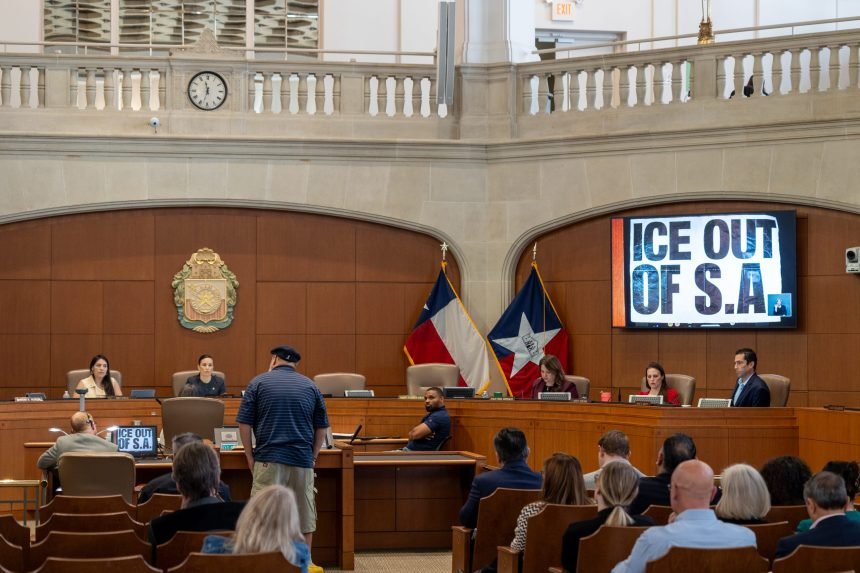
San Antonio City Council on Thursday directed city staff to explore zoning and development code changes governing detention facilities while initiating a moratorium on any new private detention centers.
The action followed a City Manager’s report updating council on a February resolution that asked staff to evaluate what actions San Antonio could legally take in response to immigration enforcement activity and a newly purchased ICE detention facility expected to operate on the East Side.
The new resolution directs staff to examine potential changes to the city’s Unified Development Code, the city’s primary land-use planning ordinance, that could establish detention facilities as a defined land use and require City Council approval before such facilities could be developed in the future.
Council also approved an amendment introduced by District 2 Councilman Jalen McKee-Rodriguez instructing city staff to begin the process of creating a moratorium — a temporary halt on new development approvals — for private detention facilities.
City officials originally recommended zoning code changes over a moratorium, citing implementation time as a benefit to zoning code changes that could be enacted in 45 days under an expedited process versus a months-long process to pass a moratorium.
McKee-Rodriguez argued that the two should move forward simultaneously to prevent new private detention proposals while the city evaluates long-term regulations.
The amendment and the resolution both passed by 8–2 votes. Council members Marc Whyte (D-10) and Misty Spears (D-9) voted against the measures, and Councilman Ric Galvan was absent.
Moratorium applies only to private detention centers
City spokesperson Brian Chasnoff previously stated that under state and federal law, the city would have no zoning authority over federal government property or property leased by the federal government, meaning federal facilities are not required to follow local zoning rules or permitting processes.
Officials confirmed that the actions approved Thursday would not affect any facilities operated or leased by the federal government.
Opponents of the measure leaned heavily on that point, calling the measure largely symbolic.
Whyte said that immigration enforcement falls under federal authority, while directing community members to address their concerns with their representatives in Congress. He called the policy an attempt by the council to create its own immigration policy.
“If we’re really honest about what’s happening here today, this is an attempt to use the UDC as a vehicle to make immigration policy, and that’s wrong,” he said. “That sets a very dangerous precedent for things that could happen in the future. And it’s disappointing that we are spending so much time and taxpayer money on this today.”

Spears expressed concern over municipal authority, zoning and land-use rights and compliance with Texas Senate Bill 4, a 2017 state law that restricts how local governments can limit cooperation with federal immigration enforcement.
“Those are my biggest concerns, any changes to zoning has to be legally defensible, remain in full compliance with Senate Bill 4 and be within our scope of authority,” Spears said.” I’m concerned about unintended consequences here that we wouldn’t foresee. … But beyond that, I’m just not supportive of this resolution. I feel it’s too vague and it’s not going to be very effective.”
Spears questioned staff over possible zoning by right violations or discriminatory zoning that could arise as unintended consequences. City Attorney Andy Segovia said the city would explore options to ensure no action taken could lead to discrimination or violations.
“We will work our process as we go through it, to ensure that at the end of the day it won’t be characterized as that,” Segovia said. “We’re very careful about ensuring that whatever zoning we do is not discriminatory.”
She also questioned city staff over the amount of private detention facilities operating or planning to operate in city limits in the near future. City staff said they were not aware of any such facilities currently planned or operating.

Other council members expressed support for moving forward with the zoning review and moratorium process, arguing the city should explore every option available within the limits of state and federal law.
Several said the measures would allow the city to examine potential tools for regulating detention facilities in the future, even if the policies would not affect facilities operated or leased by the federal government.
Exploring what San Antonio can do
During the broader update on what actions San Antonio can legally take in response to immigration enforcement activity and the impending detention center, officials said several of the measures requested by council were already part of the city’s practices.
Including “Know Your Rights” training by third parties, legal pathways referral for those with legal status and the development of an economic report on the contributions and impact of migrants in San Antonio and Bexar County.
Out of the 21 actions from the February resolution, three were marked as in progress, including providing training for city employees on how to respond if federal immigration agents enter city facilities and a reporting mechanism for community members to report alleged rights violations related to immigration enforcement.
A third is the linking of an ICE data dashboard to a city website, officials noted the dashboard is updated by DHS and may not display the most recent data. The public facing dashboard at ice.gov/statistics only displays data from the beginning of October 2020 to the end of December 2024.
The remaining 12 actions required further evaluation, including four actions that impact the city’s contract and procurement practices.
Those proposals include examining whether the city could adjust contracting policies to consider whether vendors provide services to immigration detention facilities when awarding city contracts.
Preliminary review indicated that “vendor accountability,” would only be applicable to five categories of city contracts without violating state law.
Those categories include professional and consulting services not governed by statute, leases of city-owned real property, concession agreements, other revenue generating contracts and economic development incentive agreements.
Officials recommended procurement-related actions be forwarded to the Economic and Workforce Development Committee for further discussion and evaluation of potential implementation options.
City staff are expected to return to council with updates as the zoning review and moratorium process move forward during next month’s city manager’s report in the City Council A session.