Fany Gerson, owner of Fan Fan Doughnuts and Mijo in New York City, proposed three options to her staff this week: “We can either stay open business as usual … or we could stay open and give a portion or the entire sales to an organization that we all agree upon, or we close.”
Gerson said the vast majority of her employees are immigrants. Everyone chose to shut down, she said.
“I don’t know if we can really afford to, but this is just a bigger and what was most important to us, even though we don’t know exactly like the financial hit,” Gerson said.
As federal lawmakers continue to debate funding for the Department of Homeland Security, including Immigration and Customs Enforcement, activists and grassroots organizations around the country have called for what they’re calling a “national shutdown” Friday, Jan. 30, to take a stand against ICE action in Minnesota and elsewhere.
They’re calling for no school, no work, no shopping. It’s inspired by the general strike last Friday in Minnesota where hundreds of businesses closed their doors and thousands of people took to the streets in protest.
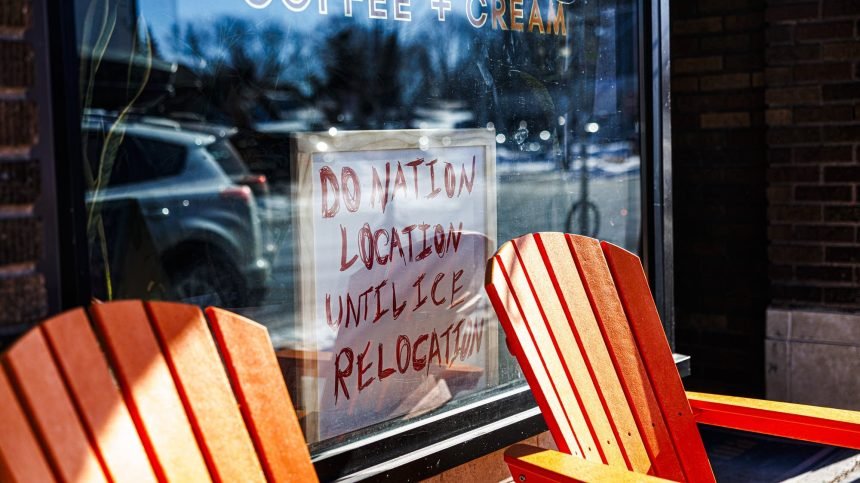
Nationwide, small business owners who support the shutdown in principle weighed the difficult decision of whether to close or stay open.
In Wisconsin, TJ Semanchin, owner of Wonderstate Coffee, said it’s important to him to keep showing solidarity with the movement, even if there’s a financial cost.
“Between lost sales and paying our staff, you know, it’s probably less than $10,000 but it’s in that ballpark,” he said.
But not everyone can do that.
Caroline Glover, co-owner of Annette, a restaurant, and Traveling Mercies, a bar, in Aurora, Colorado, said this is a tough time of year.
“For us, closing down on a Friday night at the end of the slowest month of the year just was not a business decision that we could do, you know we … couldn’t support our staff financially if we did that,” she said.
She said most employees told her, “they want to work because they have rent to make at the end of the month.”
So Glover decided on a middle ground: They’re open and donating 10% of sales all weekend to refugee and immigrant rights organizations.
In the Twin Cities, hundreds of businesses shut their doors last Friday, including The Yarnery, a fiber arts store in St. Paul. But co-owner Scott Rohr said he’s not shutting down Friday.
“In part because we are donating proceeds from various projects, not just today, but throughout the weeks,” he said.
Rohr said he and the business are in this for the long term, so he’s planning for what other actions or closures might look like in the future.