Ben M
January 20, 2026
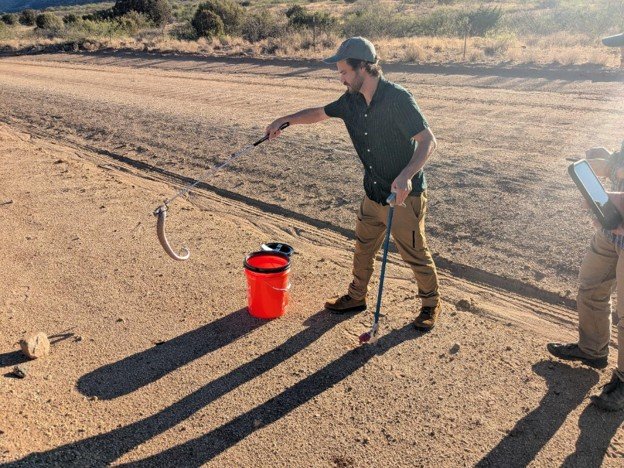
Hey y’all, my name is Benjamin McGlaughlin, and I am a Herpetology Keeper here at Zoo Atlanta. This past summer, I was lucky to have the opportunity to survey snake species across southern Arizona. During this trip, we encountered and sampled five rattlesnake species. This experience has inspired me to educate y’all on some of North America’s most fascinating pit viper species.
Rattlesnakes belong to the genera Crotalus and Sistrurus. The genus name Crotalus is derived from the Greek word krótalon, meaning a rattle or clapper. This is due to their most distinctive feature, their rattle, which they will vibrate in response to a potential threat. This vibration produces a distinct sound that serves as an auditory warning to any potential predators to keep their distance. Their rattle is comprised of keratin, a specialized protein found within hair, skin, and other epidermal tissues. When a rattlesnake sheds, that process adds an additional segment, called a button, to the base of their rattle. While neonatal rattlesnakes do have a small number of buttons, these buttons can break off throughout any point in the snake’s lifespan. Therefore, judging a snake’s age by counting the segments of their rattle is not an accurate way to determine an animal’s age.
As previously mentioned, rattlesnakes are pit vipers, meaning they have heat sensing pits, called loreal pits, located just behind the nostrils of the snake. These loreal pits essentially provide the snakes with “heat vision” that assist their ability to detect, hunt, and strike their prey. Rattlesnake species across the United States have a varied diet that is largely dependent on their life stage, species size, and what prey species are present within their native environments. For instance, the small pygmy rattlesnake may hunt invertebrates, while the desert-adapted sidewinder specializes in lizards. Larger species, such as our Georgia native eastern diamondback, hunt more formidable animals like rabbits and squirrels.
Rattlesnake species exhibit ovoviviparous reproduction. This means that while they technically have eggs, they give live birth due to having eggs that gestate internally. Once gestation is complete, the young emerge as fully formed, live snakes. While this looks like a mammalian trait characteristic, it is fundamentally different because there is no placental connection; the young are nourished entirely by yolk sacs inside the eggs.
During our surveys in Arizona, we were able to find five rattlesnake species across a few different habitat types. In the desert-scrubland environments, we located western diamondbacks, sidewinders, and Mojave rattlesnakes. Moving into the higher-elevation pine-oak forests, we found the black-tailed rattlesnake and the banded rock rattlesnake.
If you want to see some of these incredible animals up close, you don’t have to travel to the Arizona desert. Zoo Atlanta houses several species, including a few Georgia natives such as our eastern diamondback and timber rattlesnakes. Additionally, we house a few other rattlesnake species in Atlanta, including the eastern massasauga from the Midwest and southwestern specialists like the speckled rattlesnake and sidewinder. You can find our rattlesnake habitats near the exit of Scaly Slimy Spectacular, located right across from the diamondback terrapins. I hope you can come visit us this year to learn more about why these species are such a vital part of our ecosystem.
Ben M.
Keeper III, Herpetology