While significant fears and concerns loom in the lives of many people in and around the entertainment industry, a city-sponsored forum and brainstorming session in Burbank on Wednesday, Jan. 14, sought to generate ideas on how to respond and evolve, as well as forge community connections.
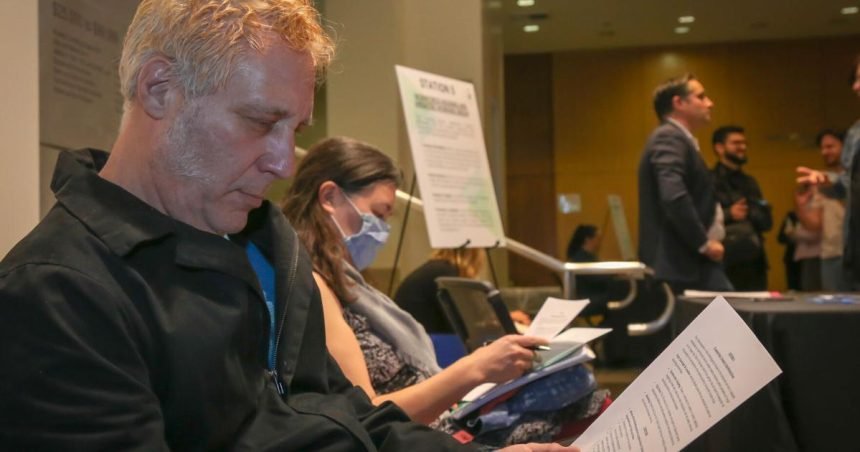
The city’s Creative Industry Task Force held a “Community Workshop” at Woodbury University, with around 75 people in attendance. Participants, who represented a range of professional backgrounds and interests, heard summaries from several industry professionals on the state of affairs, as well as ideas about how the Media Capital of the World might refocus its energies.
“We either save it now or we ignore it,” said screenwriter Shari Wendt, who lives in Burbank. “Most of my friends are in the industry and it’s like crickets out there.”
Like others in attendance who have lived and worked in the city with dramatic changes looming, such as the potential sale of Warner Bros. Discovery to Netflix, workshop attendees wanted to see a plan of action for keeping Burbank as an operational part of the entertainment business.
“I have watched the industry change dramatically and the kind of goodwill-paying jobs that allow us to raise a family and buy a house have all but disappeared,” Wendt said. “This is not what they said it would be like when I went to film school.”
Christina Stark of Burbank, a utility player in the entertainment industry, was not sure what she expected to learn from the workshop. She noted that the vibration on the street has been one of doom and gloom, but at least the workshop brought her some sense of hope — both that she was not alone in facing the challenges and that there were still opportunities to redirect.
“A lot of production has left California, as we know,” she said. “It feels very discouraging, but when they were up there talking it just felt like there’s hope to bring it all back.”
In a panel discussion led by John Bwarie, CEO of Stratiscope, the consulting company directing the task force’s evaluation, ideas and opinions came from three members of the task force, Paul Bailey, vice president and general manager of AOA West, Karen Hofmann, president and CEO of the ArtCenter College of Design, and Tom Vice, chief operating officer of Fotokem.
“I want to see the pipeline really continue,” Hofmann said. “I think Burbank has a huge future to attract really the best creative talent.”
Vice said that while new tax incentives that began at the state level have had some benefit — though more so for smaller independent film projects — it hasn’t had the impact that was hoped for in encouraging more local production.
“There’s a lot of incredibly talented people here in town that just aren’t working,” Vice said. “It’s tough to see and it’s hard to have those conversations with folks that I know. We’ve had a really tough few years and I’ve seen a lot of our industry shrink. It’s been a tough time.”
Bailey said that what he describes as physical storytelling, primary centers on some of his work with theme parks, has actually been thriving, though he noted he hesitates to highlight that given the struggles being seen with films.
“To me, it looks rosy,” Bailey said. “I’ve got phenomenal talent to dip into. I’ve got great partners who are creating a pipeline for us, and there’s tremendous institutional money that’s going into physical experiences, so maybe we can help.”
Hofmann said that, like the entertainment industry, higher education is in a time of dramatic flux, causing them to reinvent themselves in different ways. With regard to the talent pipeline, she sees younger people coming in with a bold connection to — and a high skill level with — technology are also forging a more human-level connection with it to storytelling and entertainment. She said that while artificial intelligence has a negative reputation, it also has a practical and, perchance, welcoming place that is in the process of being discovered.
“It doesn’t replace the humans, it’s just part of the creative process,” Hofmann said, “so we’re seeing just elements of that that do point to a rosy future, it just feels like it’s a little far away for the real roses to start blooming right now.”
Vice said the task force has spoken a lot about rebranding the city, bringing attention to its legacy — and potentially its future — as a creative capital that goes beyond film and TV to include music, gaming and more. Citing Las Vegas’ Area 15 entertainment district as something that Burbank could create, he said the rebranding of the city would go a long way in opening up new business opportunities and drawing visitors.
“People come here already for the studios and other things,” Vice said. “Why not capitalize on that.”
Hofmann pointed out that along with actually creating art, there’s an interest and desire among many people to build a creative community.
“We have the chance to be the magnet and I love the idea of this creative hub, because it doesn’t exist,” she said, noting that affordable housing becomes part of the draw. “I think Burbank has a huge opportunity to create something like that.”
Bailey spoke of Burbank’s history involving unique but quiet innovation and singular invention, with old camera technology.
“I think there’s something special about the ‘only-in-Burbank’ history,” he said.
He also described innovation as born of creative lateral thinking, with problem solving the result of different people from diverse backgrounds offering their contributions toward a common goal, including in the ways of technology and physical development.
“We need to lean into not just being a retail space,” Bailey said. “We need to lean into supporting the physical making of goods and teaching alternative paths beyond degreed education. I think there’s something to be said for beyond maker spaces but technology centers like exist in San Francisco. That’s looking into the past and projecting into the future. That’s who Burbank is. We’ve always made things with our hands. Let’s do more of that.”
All three panelists emphasized that, regardless of their discipline area, professionals need to be open to adapting and expanding, including developing multiple focuses. Panelists acknowledged that it’s tough for active professionals to reinvent themselves, but that it can be done.
“Nature tends to favor generalists over specialists,” Bailey said. “Portability is about broad specialization.”
Vice emphasized that inaction would prove detrimental to a person’s pursuit in the industry.
“You can’t wait for this industry to turn for you, because it’s not going to turn,” he added. “There’s going to be opportunities here and there, but it’s not going to turn to what it was, so getting out there, finding what motives you and drives you, and trying to monetize that in the creator economy, I highly recommend that.”
He and others said humbly that they were on the other side of the coin, as they remained busy in their jobs, so they expressed the awkwardness and vague embarrassment in even telling other people who were out of work how to proceed. Still, they encouraged action above all else.
“The hard advice is don’t wait,” Vice said. “Don’t wait to do something, even if it’s a pivot. Do something.”
Hofmann concurred, noting the value of finding creative connections to do creative work, even if it can’t necessarily be monetized at this time.
“Again, don’t wait,” she said.
Burbank resident Mark Scroggs, a theatrical agent, producer and member of the task force, praised the work being done.
“The task force generates conversations about what everyone is dealing with,” he said. “We are showing that our community takes our industry seriously … Other states and countries have become competitive. We need to learn from what they are doing, make changes and pivot how and what we create.”
In a related initiative, this week the city of Burbank officially launched a marketing campaign called “Film Burbank,” which aims to promote filming and production in the city.
“Film and entertainment are woven into the fabric of Burbank,” Mayor Tamala Takahashi said in a press announcement. “This effort celebrates our creative workforce, iconic locations, and the future generations of filmmakers. ‘Film Burbank’ reinforces why generations of storytellers and creatives have chosen to create right here in our city.”
The ongoing promotional campaign will include both print and digital advertising, media outreach and social media. Content will spotlight creative talent, filming locations and city services that support filming, with added outreach to stakeholders, industry influencers and trade publications. The city will have a dedicated website to serve as a central hub for information on permits and resources.